Application
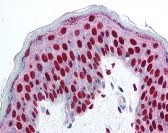
Immunohistochemistry staining of SMAD3 in skin tissue using SMAD3 Antibody.| Product Name | SMAD3 Antibody |
|---|---|
| Antibody Type | Primary Antibodies |
| Product description | Smad3 (also known as Mothers against decapentaplegic homolog 3 Mothers against DPP homolog 3, Mad3, hMAD-3, JV15-2 or hSMAD3) is a transcriptional modulator activated by TGF-β (transforming growth factor) and activin type 1 receptor kinase. These activators exert diverse effects on a wide array of cellular processes. The Smad proteins mediate much of the signaling responses induced by the TGF-b superfamily. Briefly, activated type I receptor phosphorylates receptor-activated Smads (R-Smads) at their c-terminal two extreme serines in the SSXS motif, e.g. Smad2 and Smad3 proteins in the TGF-b pathway, or Smad1, Smad5 or Smad8 in the BMP pathway. Then the phosphorylated R-Smad translocated into nucleus, where they regulate transcription of target genes. Based on microarray and animal model experiments, Smad3 accounts for at least 80% of all TGF-b-mediated response. |
| Immunogen | SMAD3 antibody was raised against amino acids 417 - 425 of SMAD3 (Human). |
| Clonality | Polyclonal |
|---|---|
| Host Species | Rabbit |
| Tested Applications | ELISAIFIHCWB |
| SMAD3 antibody can be used in Western Blot starting at 5 - 1 μg/mL, immunohistochemistry starting at 10 μg/mL, and flow cytometry. | |
| Species Reactivity | BovineChickenHumanMousePigRatXenopusZebra Fish |
| Concentration | 1mg/ml |
| Purification | Affinity purified |
| Gene Symbol | SMAD3 |
|---|---|
| Alternative Names | SMAD3 HSPC193 HMAD-3 HsT17436 LDS1C LDS3 Mad homolog JV15-2 MAD3 MADH3 Mothers against DPP homolog 3 JV15-2 SMA- and MAD-related protein 3 SMAD family member 3 MAD homolog 3 HSMAD3 Mad protein homolog SMAD 3 |
Application
Immunohistochemistry staining of SMAD3 in skin tissue using SMAD3 Antibody.| Application Notes | SMAD3 antibody can be used in Western Blot starting at 5 - 1 μg/mL, immunohistochemistry starting at 10 μg/mL, and flow cytometry. |
|---|
| Form | Liquid |
|---|---|
| Storage Instructions | Store SMAD3 antibody at 4 ˚C or -20 ˚C. As with all antibodies avoid freeze/thaw cycles. |
| Storage Buffer | 0.02 M potassium phosphate, 0.15 M sodium chloride, pH 7.2, 0.01% sodium azide. |


