Application
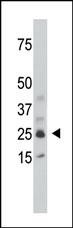
Antibody is used in Western blot to detect SULT1C1 in mouse kidney tissue lysate.| Product Name | SULT1C1 Antibody |
|---|---|
| Antibody Type | Primary Antibodies |
| Antigen Alias | Sulfotransferase 1C2, ST1C2, 282-, Sulfotransferase 1C1, SULT1C#1, humSULTC2, SULT1C2, SULT1C1 |
| Product description | The 296-amino acid human SULTC1 protein, so named on the basis of its significant homology to a rat hepatic cytosolic sulfotranserase ST1C1, catalyzes the sulfate conjugation of many drugs, xenobiotic compounds, hormones, and neurotransmitters, and may be involved in the activation of carcinogenic hydroxylamines. This enzyme also shows activity towards p-nitrophenol and N-hydroxy-2-acetylamino-fluorene (N-OH-2AAF). SULT1C1 is expressed as a 1.4-kb mRNA in adult human stomach, kidney, and thyroid, and in fetal kidney and liver. By functional characterization of recombinant protein, it has been shown that SULT1C1 catalyzes the sulfonation of p-nitrophenol and N-hydroxy-2-acetylaminofluorene, but not dopamine, 17-beta-estradiol, or dehydroepiandrosterone. |
| Immunogen | This SULT1C1 antibody is generated from rabbits immunized with a KLH conjugated synthetic peptide between 95-127 amino acids from the Central region of human SULT1C1. |
| Clonality | Polyclonal |
|---|---|
| Isotype | Ig |
| Host Species | Rabbit |
| Tested Applications | WB |
| For WB starting dilution is: 1:1000: |
|
| Species Reactivity | HumanMouse |
| Concentration | 1mg/ml |
| Gene Symbol | SULT1C2 |
|---|---|
| Alternative Names | Sulfotransferase 1C2 ST1C2 282- Sulfotransferase 1C1 SULT1C#1 humSULTC2 SULT1C2 SULT1C1 |
| Molecular Weight(MW) | 35 kDa |
Application
Antibody is used in Western blot to detect SULT1C1 in mouse kidney tissue lysate.| Application Notes | For WB starting dilution is: 1:1000: |
|---|
| Form | Liquid |
|---|---|
| Storage Instructions | Store at 4˚C for three months and -20˚C, stable for up to one year. As with all antibodies care should be taken to avoid repeated freeze thaw cycles. Antibodies should not be exposed to prolonged high temperatures. |
| Storage Buffer | Supplied in PBS with 0.09% (W/V) sodium azide. |


