Application
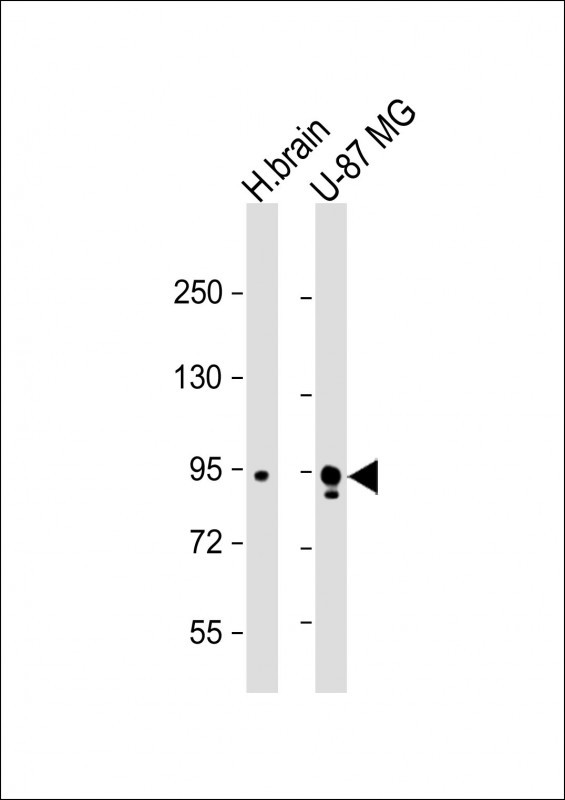
Western Blot at 1:1000 dilution Lane 1: human brain lysate Lane 2: U-87 MG whole cell lysate Lysates/proteins at 20 ug per lane.Application
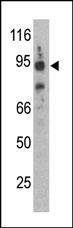
Antibody is used in Western blot to detect Synphilin-1 in mouse brain lysate.| Product Name | Synphilin-1 Antibody |
|---|---|
| Antibody Type | Primary Antibodies |
| Product description | Parkinson is the second most common neurodegenerative disease after Alzheimers. About 1 percent of people over the age of 65 and 3 percent of people over the age of 75 are affected by the disease. The mutation is the most common cause of Parkinson disease identified to date. Synuclein alpha interacting protein (Synphilin-1) contains several protein-protein interaction domains and interacts with alpha synuclein in neurons. Mutations of SNCAIP have been linked to Parkinson disease. The amino acid sequence of synphilin-1 shows extensive homology with its human counterpart, especially in regions containing ankyrin-like motifs and the coiled-coil domain. Expression of mouse synphilin-1 in tissues is similar to its human counterpart. Synphilin-1 has an important role in the formation of aggregates and cytotoxicity in Parkinson disease and that Dorfin may be involved in the pathogenic process by ubiquitylation of synphilin-1. Role of synphilin-1 in synaptic function and protein degradation and in the molecular mechanisms leading to neurodegeneration in Parkinson disease1) Kruger,R. Cell Tissue Res. 318 (1), 195-199 (2004) |
| Immunogen | This Synphilin-1 (SNCAIP) antibody is generated from rabbits immunized with a KLH conjugated synthetic peptide between 593-622 amino acids from the C-terminal region of human Synphilin-1 (SNCAIP). |
| Clonality | Polyclonal |
|---|---|
| Isotype | Ig |
| Host Species | Rabbit |
| Tested Applications | WB |
| For WB starting dilution is: 1:1000 | |
| Species Reactivity | HumanMouse |
| Concentration | 1mg/ml |
| Purification | Unpurified |
| Gene Symbol | SNCAIP |
|---|---|
| Alternative Names | Synphilin-1 Sph1 Alpha-synuclein-interacting protein SNCAIP |
| Molecular Weight(MW) | 100 kDa |
Application
Western Blot at 1:1000 dilution Lane 1: human brain lysate Lane 2: U-87 MG whole cell lysate Lysates/proteins at 20 ug per lane.
Application
Antibody is used in Western blot to detect Synphilin-1 in mouse brain lysate.| Application Notes | For WB starting dilution is: 1:1000 |
|---|
| Form | Liquid |
|---|---|
| Storage Instructions | Store at 4˚C for three months and -20˚C, stable for up to one year. As with all antibodies care should be taken to avoid repeated freeze thaw cycles. Antibodies should not be exposed to prolonged high temperatures. |
| Storage Buffer | Supplied in PBS with 0.09% (W/V) sodium azide. |


