Application
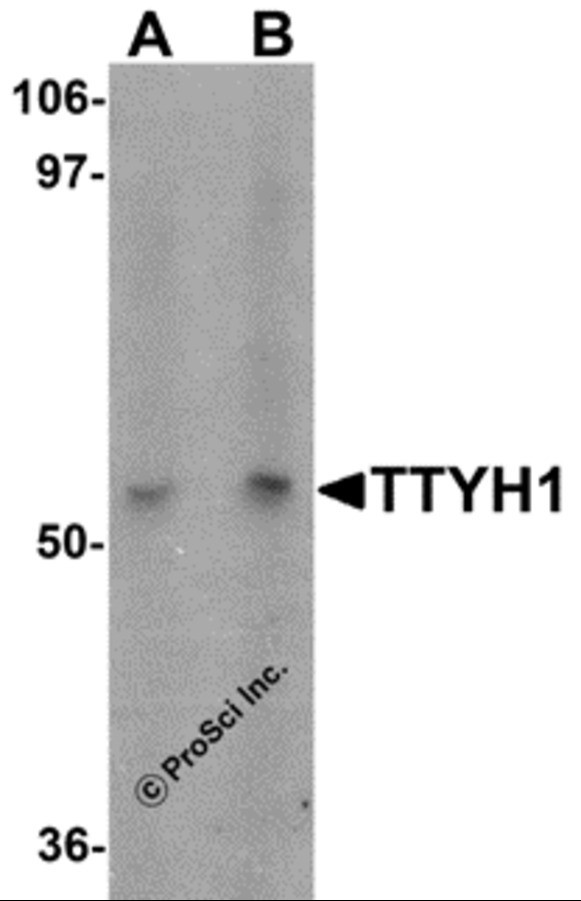
Western blot analysis of TTYH1 in Raji cell lysate with TTYH1 antibody at (A) 1 and (B) 2 μg/mL.Application
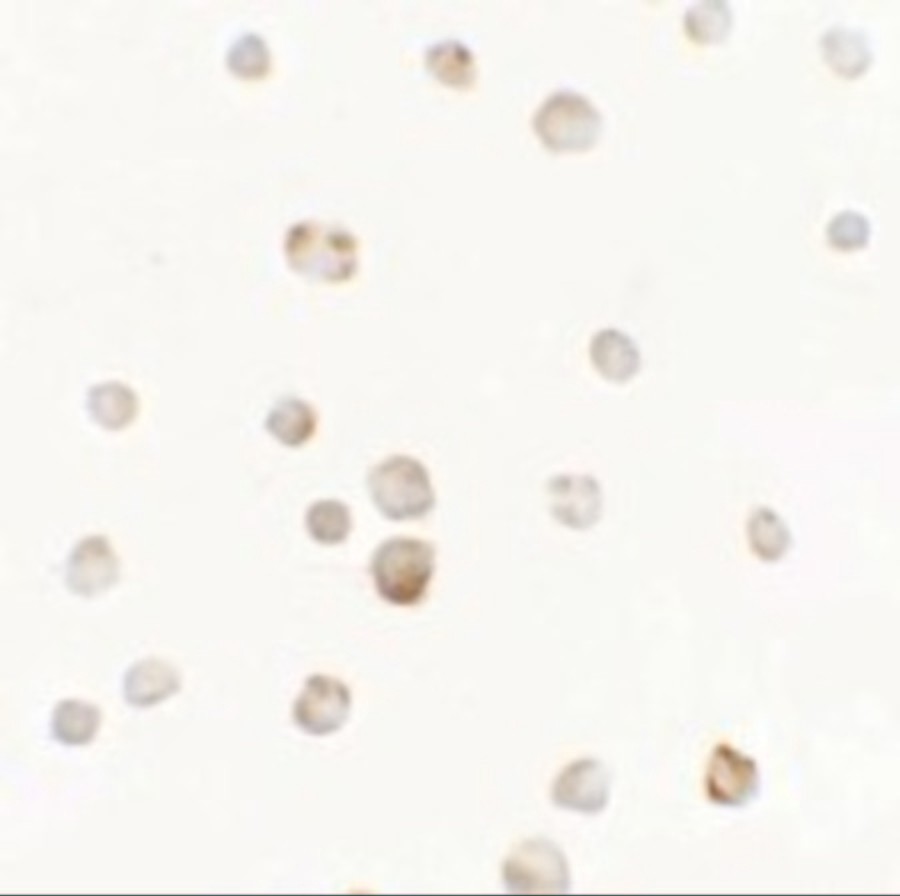
Immunocytochemistry of TTYH1 in Raji cells with TTYH1 antibody at 5 μg/mL.| Product Name | TTYH1 Antibody |
|---|---|
| Antibody Type | Primary Antibodies |
| Antigen Alias | TTYH1 Antibody: Protein tweety homolog 1, hTTY1 |
| Product description | TTYH1 Antibody: TTYH1 is a member of the tweety family of proteins, a family of chloride anion channels containing five transmembrane regions. TTYH1 is a Ca2+-independent, volume-sensitive large conductance chloride (Cl-) channel. TTYH1 is primarily expressed in neural tissue and upregulated in astrocytoma, glioma, and several other cancers. Recent experiments have shown that TTYH1 is an integral endoplasmic reticulum (ER) membrane protein involved in cell proliferation and is thought to play an essential role in embryonic cell growth, possibly through the Ca2+ storage/release process in ER membranes during early development.1) Campbell HD, Kamei M, Caludianos C, et al. Human and mouse homologues of the Drosophila melanogaster tweety (tty) gene: a novel gene family encoding predicted transmembrane proteins. Genomics 2000; 68:89-92. |
| Immunogen | TTYH1 antibody was raised against a 17 amino acid synthetic peptide near the carboxy terminus of human TTYH1. The immunogen is located within the last 50 amino acids of TTYH1. |
| Clonality | Polyclonal |
|---|---|
| Isotype | IgG |
| Host Species | Rabbit |
| Tested Applications | ELISAICCWB |
| TTYH1 antibody can be used for detection of TTYH1 by Western blot at 1 - 2 μg/mL. Antibody can also be used for immunocytochemistry starting at 5 μg/mL.: |
|
| Species Reactivity | Human |
| Concentration | 1mg/ml |
| Purification | Affinity purified |
| Gene Symbol | TTYH1 |
|---|---|
| Alternative Names | TTYH1 Antibody: Protein tweety homolog 1 hTTY1 |
| Sequence Similarities | 2) Cat. No. 17-007 - Raji Cell Slide |
| Tissue Specificity | TTYH1 antibody is human specific. Multiple isoforms of TTYH1 are known to exist. |
| Entrez Gene | 57348 |
|---|---|
| Protein Accession | NP_001005367 |
Application
Western blot analysis of TTYH1 in Raji cell lysate with TTYH1 antibody at (A) 1 and (B) 2 μg/mL.
Application
Immunocytochemistry of TTYH1 in Raji cells with TTYH1 antibody at 5 μg/mL.| Positive Control | 1) Cat. No. 1207 - Raji Cell Lysate |
|---|---|
| Application Notes | TTYH1 antibody can be used for detection of TTYH1 by Western blot at 1 - 2 μg/mL. Antibody can also be used for immunocytochemistry starting at 5 μg/mL.: |
| Form | Liquid |
|---|---|
| Storage Instructions | TTYH1 antibody can be stored at 4˚C for three months and -20˚C, stable for up to one year. As with all antibodies care should be taken to avoid repeated freeze thaw cycles. Antibodies should not be exposed to prolonged high temperatures. |
| Storage Buffer | TTYH1 Antibody is supplied in PBS containing 0.02% sodium azide. |


