Application
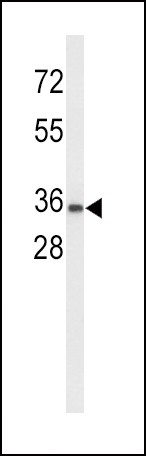
Western blot analysis of UPK1A Antibody in K562 cell line lysates (35ug/lane)| Product Name | UPK1A Antibody |
|---|---|
| Antibody Type | Primary Antibodies |
| Antigen Alias | Uroplakin-1a, UP1a, Tetraspanin-21, Tspan-21, Uroplakin Ia, UPIa, UPKa, UPK1A, TSPAN21 |
| Product description | The protein is a member of the transmembrane 4 superfamily, also known as the tetraspanin family. Most of these members are cell-surface proteins that are characterized by the presence of four hydrophobic domains. The proteins mediate signal transduction events that play a role in the regulation of cell development, activation, growth and motility. This encoded protein is found in the asymmetrical unit membrane (AUM) where it can complex with other transmembrane 4 superfamily proteins. It may play a role in normal bladder epithelial physiology, possibly in regulating membrane permeability of superficial umbrella cells or in stabilizing the apical membrane through AUM/cytoskeletal interactions.1) Wang,H., et.al., J. Mol. Biol. 392 (2), 352-361 (2009) |
| Immunogen | This UPK1A antibody is generated from rabbits immunized with a KLH conjugated synthetic peptide between 191-217 amino acids from the C-terminal region of human UPK1A. |
| Clonality | Polyclonal |
|---|---|
| Isotype | Ig |
| Host Species | Rabbit |
| Tested Applications | WB |
| For WB starting dilution is: 1:1000: |
|
| Species Reactivity | Human |
| Concentration | 1mg/ml |
| Purification | Affinity purified |
| Gene Symbol | UPK1A |
|---|---|
| Alternative Names | Uroplakin-1a UP1a Tetraspanin-21 Tspan-21 Uroplakin Ia UPIa UPKa UPK1A TSPAN21 |
| Molecular Weight(MW) | 29 kDa |
Application
Western blot analysis of UPK1A Antibody in K562 cell line lysates (35ug/lane)| Application Notes | For WB starting dilution is: 1:1000: |
|---|
| Form | Liquid |
|---|---|
| Storage Instructions | Store at 4˚C for three months and -20˚C, stable for up to one year. As with all antibodies care should be taken to avoid repeated freeze thaw cycles. Antibodies should not be exposed to prolonged high temperatures. |
| Storage Buffer | Supplied in PBS with 0.09% (W/V) sodium azide. |


