Application
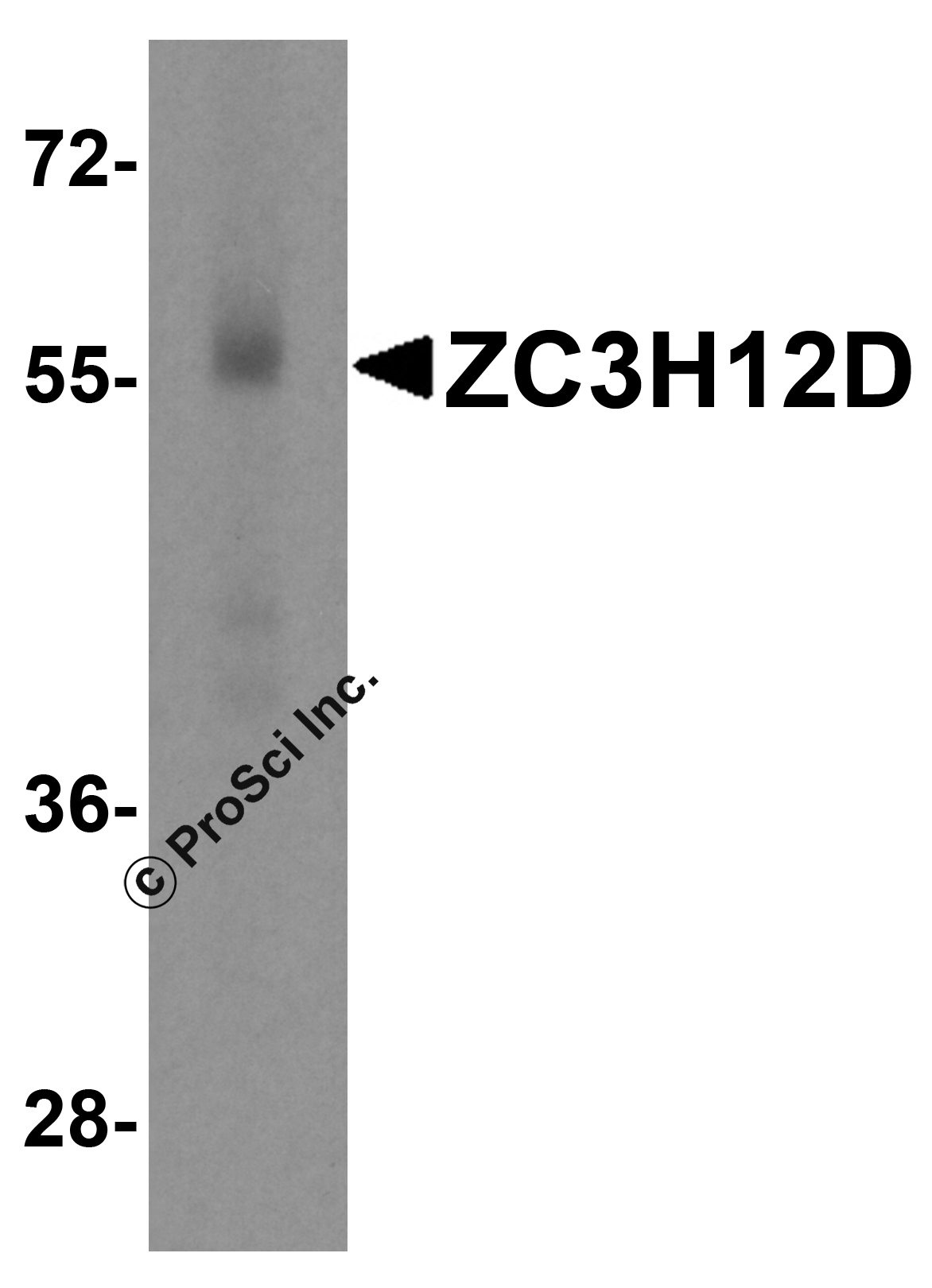
Western blot analysis of ZC3H12D in human spleen tissue lysate with ZC3H12D antibody at 1 μg/mL.| Product Name | ZC3H12D Antibody |
|---|---|
| Antibody Type | Primary Antibodies |
| Antigen Alias | ZC3H12D Antibody: TFL, p34, MCPIP4, C6orf95, dJ281H8.1, TFL, Probable ribonuclease ZC3H12D, MCP-induced protein 4 |
| Product description | ZC3H12D Antibody: ZC3H12D, also known as MCPIP4, is a member of a family of novel CCCH-zinc finger proteins that includes ZC3H12A, a protein that is thought to be involved in macrophage activation, host immunity and inflammatory diseases. ZC3H12D is highly expressed in spleen, intestine, and colon. Similar to ZC3H12A and ZC3H12C, ZC3H12D expression in murine macrophages is also increased after treatment with lipopolysaccharide (LPS), although not to the same level as ZC3H12A. This pattern of expression was not duplicated in human-derived macrophages, suggesting it also may play a different role in host immunity and inflammatory response.1) Zhou L, Azfer A, Niu J, et al. Monocyte chemoattractant protein-1 induces a novel transcription factor that causes cardiac myocyte apoptosis and ventricular dysfunction. Circ. Res.2006; 98:1177-85. |
| Immunogen | ZC3H12D antibody was raised against a 17 amino acid synthetic peptide near the carboxy terminus of human ZC3H12D. The immunogen is located within amino acids 280 - 330 of ZC3H12D. |
| Clonality | Polyclonal |
|---|---|
| Isotype | IgG |
| Host Species | Rabbit |
| Tested Applications | ELISAWB |
| ZC3H12D antibody can be used for detection of ZC3H12D by Western blot at 1 μg/mL.: |
|
| Species Reactivity | Human |
| Concentration | 1mg/ml |
| Purification | Affinity purified |
| Gene Symbol | ZC3H12D |
|---|---|
| Alternative Names | ZC3H12D Antibody: TFL p34 MCPIP4 C6orf95 dJ281H8.1 TFL Probable ribonuclease ZC3H12D MCP-induced protein 4 |
| Molecular Weight(MW) | Predicted: 58 kDa Observed: 57 kDa |
Application
Western blot analysis of ZC3H12D in human spleen tissue lysate with ZC3H12D antibody at 1 μg/mL.| Positive Control | 1) Cat. No. 1306 - Human Spleen Tissue Lysate |
|---|---|
| Application Notes | ZC3H12D antibody can be used for detection of ZC3H12D by Western blot at 1 μg/mL.: |
| Form | Liquid |
|---|---|
| Storage Instructions | ZC3H12D antibody can be stored at 4˚C for three months and -20˚C, stable for up to one year. As with all antibodies care should be taken to avoid repeated freeze thaw cycles. Antibodies should not be exposed to prolonged high temperatures. |
| Storage Buffer | ZC3H12D Antibody is supplied in PBS containing 0.02% sodium azide. |


