Application
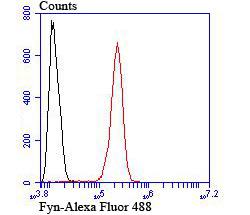
Fig10: Flow cytometric analysis of SH-SY5Y cells with Fyn antibody at 1/100 dilution (red) compared with an unlabelled control (cells without incubation with primary antibody; black). Alexa Fluor 488-conjugated goat anti-rabbit IgG was used as the secondary antibody.Application
Fig10: Flow cytometric analysis of SH-SY5Y cells with Fyn antibody at 1/100 dilution (red) compared with an unlabelled control (cells without incubation with primary antibody; black). Alexa Fluor 488-conjugated goat anti-rabbit IgG was used as the secondary antibody.Application
Fig10: Flow cytometric analysis of SH-SY5Y cells with Fyn antibody at 1/100 dilution (red) compared with an unlabelled control (cells without incubation with primary antibody; black). Alexa Fluor 488-conjugated goat anti-rabbit IgG was used as the secondary antibody.Application
Fig10: Flow cytometric analysis of SH-SY5Y cells with Fyn antibody at 1/100 dilution (red) compared with an unlabelled control (cells without incubation with primary antibody; black). Alexa Fluor 488-conjugated goat anti-rabbit IgG was used as the secondary antibody.Application
Fig10: Flow cytometric analysis of SH-SY5Y cells with Fyn antibody at 1/100 dilution (red) compared with an unlabelled control (cells without incubation with primary antibody; black). Alexa Fluor 488-conjugated goat anti-rabbit IgG was used as the secondary antibody.Application
Fig10: Flow cytometric analysis of SH-SY5Y cells with Fyn antibody at 1/100 dilution (red) compared with an unlabelled control (cells without incubation with primary antibody; black). Alexa Fluor 488-conjugated goat anti-rabbit IgG was used as the secondary antibody.Application
Fig10: Flow cytometric analysis of SH-SY5Y cells with Fyn antibody at 1/100 dilution (red) compared with an unlabelled control (cells without incubation with primary antibody; black). Alexa Fluor 488-conjugated goat anti-rabbit IgG was used as the secondary antibody.Application
Fig10: Flow cytometric analysis of SH-SY5Y cells with Fyn antibody at 1/100 dilution (red) compared with an unlabelled control (cells without incubation with primary antibody; black). Alexa Fluor 488-conjugated goat anti-rabbit IgG was used as the secondary antibody.Application
Fig10: Flow cytometric analysis of SH-SY5Y cells with Fyn antibody at 1/100 dilution (red) compared with an unlabelled control (cells without incubation with primary antibody; black). Alexa Fluor 488-conjugated goat anti-rabbit IgG was used as the secondary antibody.Application
Fig10: Flow cytometric analysis of SH-SY5Y cells with Fyn antibody at 1/100 dilution (red) compared with an unlabelled control (cells without incubation with primary antibody; black). Alexa Fluor 488-conjugated goat anti-rabbit IgG was used as the secondary antibody.| Product Name | Fyn |
|---|---|
| Antibody Type | Primary Antibodies |
| Antigen Alias | C syn protooncogene antibody Fyn antibody FYN oncogene related to SRC FGR YES antibody FYN_HUMAN antibody OKT3 induced calcium influx regulator antibody P59 FYN antibody p59-Fyn antibody Protein tyrosine kinase fyn antibody Proto oncogene tyrosine protein kinase fyn antibody Proto-oncogene c-Fyn antibody Proto-oncogene Syn antibody Protooncogene Syn antibody SLK antibody Src like kinase antibody Src yes related novel gene antibody Src-like kinase antibody Src/yes related novel antibody SYN antibody Tyrosine kinase p59fyn T antibody Tyrosine kinase p59fyn(T) antibody Tyrosine-protein kinase Fyn antibody |
| Product description | Src is the human homolog of the v-src gene of the Rous sarcoma virus, also called avian sarcoma virus or ASV. Src was the first proto-oncogenic non-receptor tyrosine kinase characterized in human. By virtue of common structural motifs, the Src family is composed of nine members in vertebrates, including Src, Yes, Fgr, Frk, Fyn, Lyn, Hck, Lck and Blk. Src-family kinases transduce signals that are involved in the control of a variety of cellular processes, including proliferation, differentiation, motility, and adhesion. Src-family kinases contain an amino terminal cell membrane anchor followed by an SH3 domain and an SH2 domain involved in modular association and activation, respectively. Src-family kinases are normally maintained in an inactive state and can be activated transiently during cellular events such as mitosis. Different subcellular localizations of Src-family kinases may be important for the regulation of specific cellular processes such as mitogenesis, cytoskeletal organization, and membrane trafficking. Fyn and Lck kinases play a key role in T-cell antigen receptor (TCR) signaling. The human Fyn gene maps to chromosome 6q21 and encodes a 537 amino acid protein. |
| Immunogen | Recombinant protein |
| Clonality | Polyclonal |
|---|---|
| Isotype | IgG |
| Host Species | Rabbit |
| Tested Applications | WBICCIHCFC |
| WB:1:500 ICC:1:100-1:500 IHC:1:50-1:200 FC:1:50-1:100 |
|
| Species Reactivity | HumanMouseRat |
| Concentration | 1mg/ml |
| Alternative Names | C syn protooncogene antibody Fyn antibody FYN oncogene related to SRC FGR YES antibody FYN_HUMAN antibody OKT3 induced calcium influx regulator antibody P59 FYN antibody p59-Fyn antibody Protein tyrosine kinase fyn antibody Proto oncogene tyrosine protein kinase fyn antibody Proto-oncogene c-Fyn antibody Proto-oncogene Syn antibody Protooncogene Syn antibody SLK antibody Src like kinase antibody Src yes related novel gene antibody Src-like kinase antibody Src/yes related novel antibody SYN antibody Tyrosine kinase p59fyn T antibody Tyrosine kinase p59fyn(T) antibody Tyrosine-protein kinase Fyn antibody |
|---|---|
| Molecular Weight(MW) | 60 kDa |
| Cellular Localization | Cytoplasm. Membrane. Nucleus. |
Application
Fig10: Flow cytometric analysis of SH-SY5Y cells with Fyn antibody at 1/100 dilution (red) compared with an unlabelled control (cells without incubation with primary antibody; black). Alexa Fluor 488-conjugated goat anti-rabbit IgG was used as the secondary antibody.
Application
Fig10: Flow cytometric analysis of SH-SY5Y cells with Fyn antibody at 1/100 dilution (red) compared with an unlabelled control (cells without incubation with primary antibody; black). Alexa Fluor 488-conjugated goat anti-rabbit IgG was used as the secondary antibody.
Application
Fig10: Flow cytometric analysis of SH-SY5Y cells with Fyn antibody at 1/100 dilution (red) compared with an unlabelled control (cells without incubation with primary antibody; black). Alexa Fluor 488-conjugated goat anti-rabbit IgG was used as the secondary antibody.
Application
Fig10: Flow cytometric analysis of SH-SY5Y cells with Fyn antibody at 1/100 dilution (red) compared with an unlabelled control (cells without incubation with primary antibody; black). Alexa Fluor 488-conjugated goat anti-rabbit IgG was used as the secondary antibody.
Application
Fig10: Flow cytometric analysis of SH-SY5Y cells with Fyn antibody at 1/100 dilution (red) compared with an unlabelled control (cells without incubation with primary antibody; black). Alexa Fluor 488-conjugated goat anti-rabbit IgG was used as the secondary antibody.
Application
Fig10: Flow cytometric analysis of SH-SY5Y cells with Fyn antibody at 1/100 dilution (red) compared with an unlabelled control (cells without incubation with primary antibody; black). Alexa Fluor 488-conjugated goat anti-rabbit IgG was used as the secondary antibody.
Application
Fig10: Flow cytometric analysis of SH-SY5Y cells with Fyn antibody at 1/100 dilution (red) compared with an unlabelled control (cells without incubation with primary antibody; black). Alexa Fluor 488-conjugated goat anti-rabbit IgG was used as the secondary antibody.
Application
Fig10: Flow cytometric analysis of SH-SY5Y cells with Fyn antibody at 1/100 dilution (red) compared with an unlabelled control (cells without incubation with primary antibody; black). Alexa Fluor 488-conjugated goat anti-rabbit IgG was used as the secondary antibody.
Application
Fig10: Flow cytometric analysis of SH-SY5Y cells with Fyn antibody at 1/100 dilution (red) compared with an unlabelled control (cells without incubation with primary antibody; black). Alexa Fluor 488-conjugated goat anti-rabbit IgG was used as the secondary antibody.
Application
Fig10: Flow cytometric analysis of SH-SY5Y cells with Fyn antibody at 1/100 dilution (red) compared with an unlabelled control (cells without incubation with primary antibody; black). Alexa Fluor 488-conjugated goat anti-rabbit IgG was used as the secondary antibody.| Positive Control | HUVEC, N2A, SH-SY5Y, rat brain tissue, human tonsil tissue, human spleen tissue, mouse testis tissue, mouse brain tissue. |
|---|---|
| Application Notes | WB:1:500 ICC:1:100-1:500 IHC:1:50-1:200 FC:1:50-1:100 |
| Form | Liquid |
|---|---|
| Storage Instructions | Store at +4℃ after thawing. Aliquot store at -20℃ or -80℃. Avoid repeated freeze / thaw cycles. |
| Storage Buffer | 1*TBS (pH7.4), 0.5%BSA, 50%Glycerol. Preservative: 0.05% Sodium Azide. |


