Application
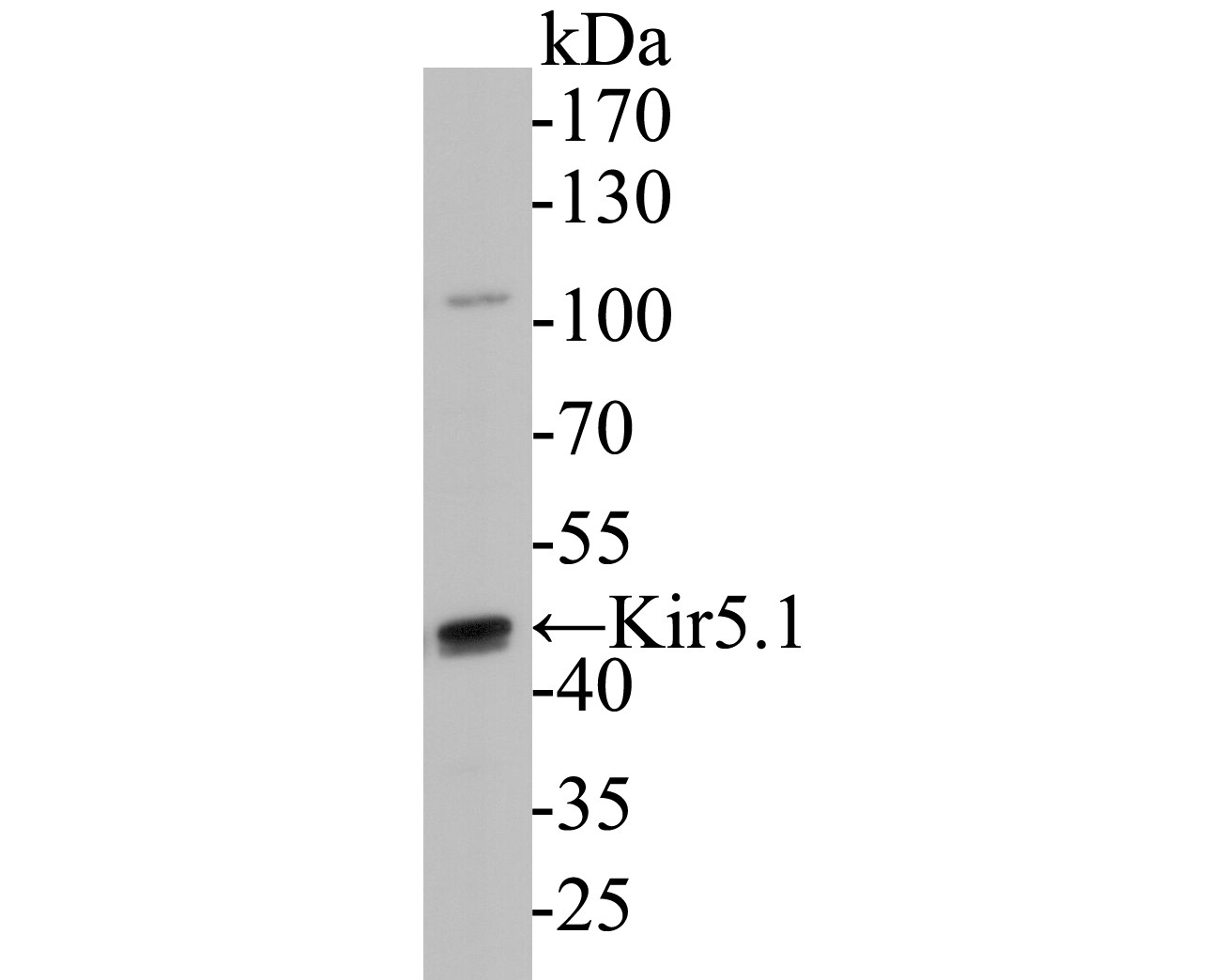
Fig1: Western blot analysis of Kir5.1 on mouse kidney tissue lysate. Proteins were transferred to a PVDF membrane and blocked with 5% BSA in PBS for 1 hour at room temperature. The primary antibody (ER1901-24, 1/2000) was used in 5% BSA at room temperature for 2 hours. Goat Anti-Rabbit IgG - HRP Secondary Antibody (HA1001) at 1:5,000 dilution was used for 1 hour at room temperature.Application
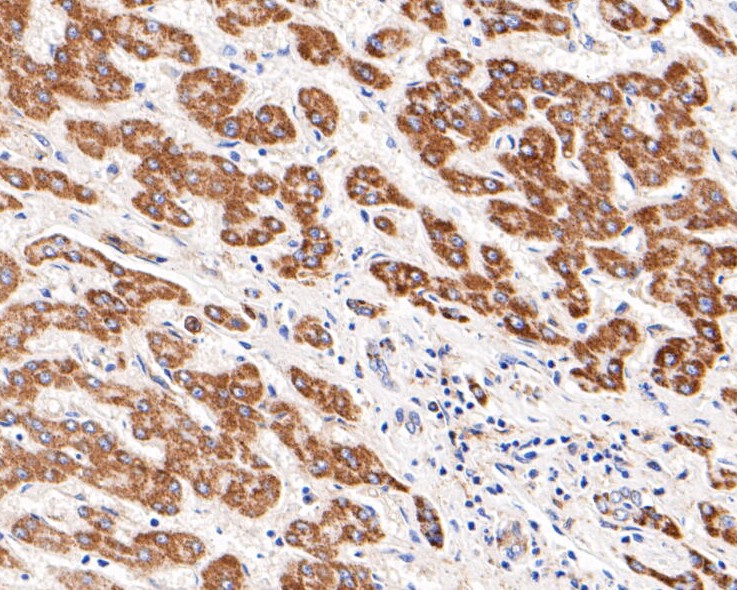
Fig2: Immunohistochemical analysis of paraffin-embedded human liver tissue using anti-Kir5.1 antibody. The section was pre-treated using heat mediated antigen retrieval with Tris-EDTA buffer (pH 8.0-8.4) for 20 minutes.The tissues were blocked in 5% BSA for 30 minutes at room temperature, washed with ddH2O and PBS, and then probed with the primary antibody (ER1901-24, 1/200) for 30 minutes at room temperature. The detection was performed using an HRP conjugated compact polymer system. DAB was used as the chromogen. Tissues were counterstained with hematoxylin and mounted with DPX.Application
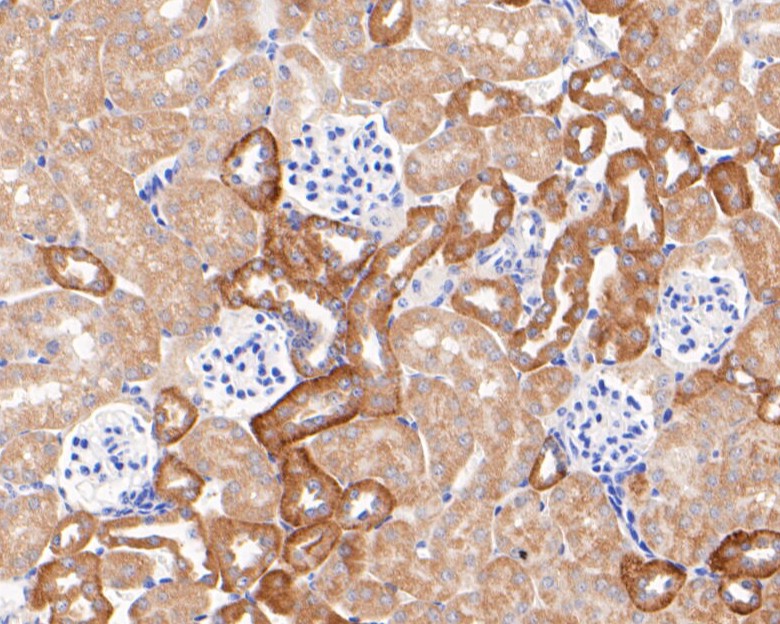
Fig3: Immunohistochemical analysis of paraffin-embedded mouse kidney tissue using anti-Kir5.1 antibody. The section was pre-treated using heat mediated antigen retrieval with Tris-EDTA buffer (pH 8.0-8.4) for 20 minutes.The tissues were blocked in 5% BSA for 30 minutes at room temperature, washed with ddH2O and PBS, and then probed with the primary antibody (ER1901-24, 1/50) for 30 minutes at room temperature. The detection was performed using an HRP conjugated compact polymer system. DAB was used as the chromogen. Tissues were counterstained with hematoxylin and mounted with DPX.Application
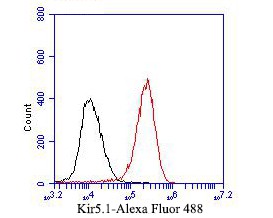
Fig4: Flow cytometric analysis of Kir5.1 was done on 293 cells. The cells were fixed, permeabilized and stained with the primary antibody (ER1901-24, 1/50) (red). After incubation of the primary antibody at room temperature for an hour, the cells were stained with a Alexa Fluor 488-conjugated Goat anti-Rabbit IgG Secondary antibody at 1/1000 dilution for 30 minutes.Unlabelled sample was used as a control (cells without incubation with primary antibody; black).| Product Name | Kir5.1 |
|---|---|
| Antibody Type | Primary Antibodies |
| Antigen Alias | 6430410F18Rik antibody AI132396 antibody BIR9 antibody Inward rectifier K channel Kir5.1 antibody Inward rectifier K(+) channel Kir5.1 antibody Inward rectifier potassium channel 16 antibody IRK16 antibody IRKG antibody KCNJ16 antibody MGC33717 antibody Potassium channel inwardly rectifying subfamily J member 16 antibody Potassium inwardly rectifying channel subfamily J member 16 antibody RP23-218O16.1 antibody |
| Product description | Potassium inwardly-rectifying channel, subfamily J, member 16 (KCNJ16) is a human gene encoding the Kir5.1 protein. Potassium channels are present in most mammalian cells, where they participate in a wide range of physiologic responses. Kir5.1 is an integral membrane protein and inward-rectifier type potassium channel. Inward rectifier potassium channels are characterized by a greater tendency to allow potassium to flow into the cell rather than out of it. Their voltage dependence is regulated by the concentration of extracellular potassium; as external potassium is raised, the voltage range of the channel opening shifts to more positive voltages. The inward rectification is mainly due to the blockage of outward current by internal magnesium. KCNJ16 may be involved in the regulation of fluid and pH balance. In the kidney, together with KCNJ10, mediates basolateral K+ recycling in distal tubules; this process is critical for Na+ reabsorption at the tubules. |
| Immunogen | Synthetic peptide within rat Kir5.1 aa 300-350. |
| Clonality | Polyclonal |
|---|---|
| Isotype | IgG |
| Host Species | Rabbit |
| Tested Applications | WBIHC-PFC |
| WB:1:500-1:2,000 IHC-P:1:50-1:200 FC:1:50-1:100 |
|
| Species Reactivity | HumanMouseRat |
| Concentration | 1mg/mL |
| Alternative Names | 6430410F18Rik antibody
AI132396 antibody
BIR9 antibody Inward rectifier K channel Kir5.1 antibody Inward rectifier K(+) channel Kir5.1 antibody Inward rectifier potassium channel 16 antibody IRK16 antibody IRKG antibody KCNJ16 antibody MGC33717 antibody Potassium channel inwardly rectifying subfamily J member 16 antibody Potassium inwardly rectifying channel subfamily J member 16 antibody RP23-218O16.1 antibody |
|---|---|
| Molecular Weight(MW) | 48 kDa |
| Cellular Localization | Plasma membrane. |
Application
Fig1: Western blot analysis of Kir5.1 on mouse kidney tissue lysate. Proteins were transferred to a PVDF membrane and blocked with 5% BSA in PBS for 1 hour at room temperature. The primary antibody (ER1901-24, 1/2000) was used in 5% BSA at room temperature for 2 hours. Goat Anti-Rabbit IgG - HRP Secondary Antibody (HA1001) at 1:5,000 dilution was used for 1 hour at room temperature.
Application
Fig2: Immunohistochemical analysis of paraffin-embedded human liver tissue using anti-Kir5.1 antibody. The section was pre-treated using heat mediated antigen retrieval with Tris-EDTA buffer (pH 8.0-8.4) for 20 minutes.The tissues were blocked in 5% BSA for 30 minutes at room temperature, washed with ddH2O and PBS, and then probed with the primary antibody (ER1901-24, 1/200) for 30 minutes at room temperature. The detection was performed using an HRP conjugated compact polymer system. DAB was used as the chromogen. Tissues were counterstained with hematoxylin and mounted with DPX.
Application
Fig3: Immunohistochemical analysis of paraffin-embedded mouse kidney tissue using anti-Kir5.1 antibody. The section was pre-treated using heat mediated antigen retrieval with Tris-EDTA buffer (pH 8.0-8.4) for 20 minutes.The tissues were blocked in 5% BSA for 30 minutes at room temperature, washed with ddH2O and PBS, and then probed with the primary antibody (ER1901-24, 1/50) for 30 minutes at room temperature. The detection was performed using an HRP conjugated compact polymer system. DAB was used as the chromogen. Tissues were counterstained with hematoxylin and mounted with DPX.
Application
Fig4: Flow cytometric analysis of Kir5.1 was done on 293 cells. The cells were fixed, permeabilized and stained with the primary antibody (ER1901-24, 1/50) (red). After incubation of the primary antibody at room temperature for an hour, the cells were stained with a Alexa Fluor 488-conjugated Goat anti-Rabbit IgG Secondary antibody at 1/1000 dilution for 30 minutes.Unlabelled sample was used as a control (cells without incubation with primary antibody; black).| Positive Control | Mouse kidney tissue lysate, human liver tissue, 293. |
|---|---|
| Application Notes | WB:1:500-1:2,000 IHC-P:1:50-1:200 FC:1:50-1:100 |
| Form | Liquid |
|---|---|
| Storage Instructions | Store at +4℃ after thawing. Aliquot store at -20℃. Avoid repeated freeze / thaw cycles. |
| Storage Buffer | 1*TBS (pH7.4), 1%BSA, 50%Glycerol. Preservative: 0.05% Sodium Azide. |


