Application
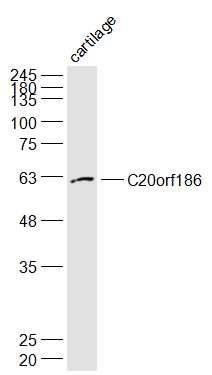
Fig1: Sample: Cartilage (Mouse) Lysate at 40 ug Primary: Anti-C20orf186 (ER1904-72) at 1/1000 dilution Secondary: IRDye800CW Goat Anti-Rabbit IgG at 1/20000 dilution Predicted band size: 63 kD Observed band size: 62 kD| Product Name | C20orf186 |
|---|---|
| Antibody Type | Primary Antibodies |
| Antigen Alias | C20orf186 dJ726C3.5 Ligand-binding protein RY2G5 Long palate, lung and nasal epithelium carcinoma-associated protein 4 LPLC4_HUMAN Lplunc4. |
| Product description | May have the capacity to recognize and bind specific classes of odorants. May act as a carrier molecule, transporting odorants across the mucus layer to access receptor sites. May serve as a primary defense mechanism by recognizing and removing potentially harmful odorants or pathogenic microorganisms from the mucosa or clearing excess odorant from mucus to enable new odorant stimuli to be received (By similarity). |
| Immunogen | KLH conjugated synthetic peptide derived from human C20orf186 501-600/614 |
| Clonality | Polyclonal |
|---|---|
| Isotype | IgG |
| Host Species | Rabbit |
| Tested Applications | WB |
| WB:1:500-2000: |
|
| Species Reactivity | HumanMouseRatDogHorse |
| Concentration | 1mg/ml |
| Alternative Names | C20orf186
dJ726C3.5
Ligand-binding protein RY2G5
Long palate lung and nasal epithelium carcinoma-associated protein 4 LPLC4_HUMAN Lplunc4. |
|---|---|
| Molecular Weight(MW) | 63 KDa |
| Cellular Localization | Secreted (By similarity). Cytoplasm. |
| SwissProt ID | P59827 |
|---|
Application
Fig1: Sample: Cartilage (Mouse) Lysate at 40 ug Primary: Anti-C20orf186 (ER1904-72) at 1/1000 dilution Secondary: IRDye800CW Goat Anti-Rabbit IgG at 1/20000 dilution Predicted band size: 63 kD Observed band size: 62 kD| Positive Control | Expressed in nasal tissue. |
|---|---|
| Application Notes | WB:1:500-2000: |
| Form | Liquid |
|---|---|
| Storage Instructions | Store at -20℃ for one year. Avoid repeated freeze/thaw cycles. The lyophilized antibody is stable at room temperature for at least one month and for greater than a year when kept at -20℃. When reconstituted in sterile pH 7.4 0.01M PBS or diluent of antibody the antibody is stable for at least two weeks at 2-4℃. |
| Storage Buffer | 0.01M TBS(pH7.4) with 1% BSA, 0.03% Proclin300 and 50% Glycerol. |


