Application
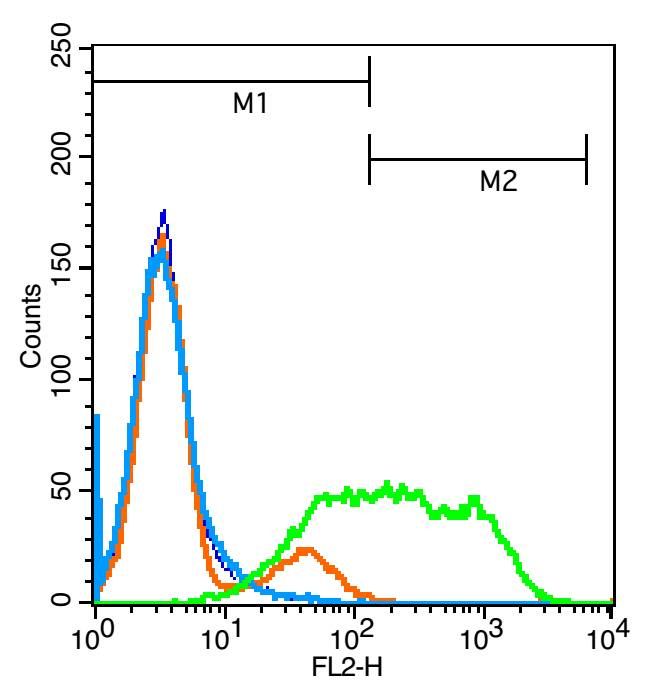
Fig1: Blank control: Jurkat cells(blue). Primary Antibody:Rabbit Anti- CD272 antibody(ER1905-86), Dilution: 1μg in 100 μL 1X PBS containing 0.5% BSA; Isotype Control Antibody: Rabbit IgG(orange) ,used under the same conditions ); Secondary Antibody: Goat anti-rabbit IgG-PE(white blue), Dilution: 1:200 in 1 X PBS containing 0.5% BSA. Protocol The cells were fixed with 2% paraformaldehyde (10 min) . Primary antibody (ER1905-86, 1μg /1x10^6 cells) were incubated for 30 min on the ice, followed by 1 X PBS containing 0.5% BSA + 1 0% goat serum (15 min) to block non-specific protein-protein interactions. Then the Goat Anti-rabbit IgG/PE antibody was added into the blocking buffer mentioned above to react with the primary antibody at 1/200 dilution for 30 min on ice. Acquisition of 20,000 events was performed.Application
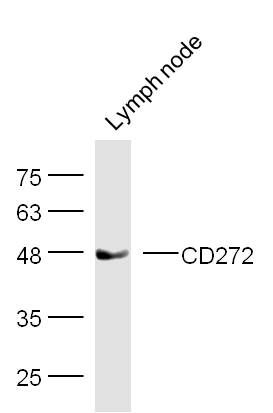
Fig2: Sample: Lymph node (Mouse) Lysate at 40 ug Primary: Anti-CD272 (ER1905-86) at 1/300 dilution Secondary: IRDye800CW Goat Anti-Rabbit IgG at 1/10000 dilution Predicted band size: 28 kD Observed band size: 48 kD| Product Name | CD272 |
|---|---|
| Antibody Type | Primary Antibodies |
| Antigen Alias | B and T lymphocyte associated protein B and T lymphocyte attenuator B and T lymphocyte associated BTLA BTLA1 CD272 antigen FLJ16065 MGC129743 BTLA_HUMAN B- and T-lymphocyte attenuator B- and T-lymphocyte-associated protein CD272. |
| Product description | B- and T-lymphocyte attenuator is a protein that in humans is encoded by the BTLA gene. BTLA has also been designated as CD272. BTLA expression is induced during activation of T cells, and BTLA remains expressed on Th1 cells but not Th2 cells. Like PD1 and CTLA4, BTLA interacts with a B7 homolog, B7H4. However, unlike PD-1 and CTLA-4, BTLA displays T-Cell inhibition via interaction with tumor necrosis family receptors (TNF-R), not just the B7 family of cell surface receptors. BTLA is a ligand for tumour necrosis factor (receptor) superfamily, member 14 (TNFRSF14), also known as herpes virus entry mediator (HVEM). BTLA-HVEM complexes negatively regulate T-cell immune responses. This gene encodes a member of the immunoglobulin superfamily. The encoded protein contains a single immunoglobulin (Ig) domain and is a receptor that relays inhibitory signals to suppress the immune response. Alternative splicing results in multiple transcript variants. Polymorphisms in this gene have been associated with an increased risk of rheumatoid arthritis. |
| Immunogen | KLH conjugated synthetic peptide derived from human B and T-lymphocyte attenuator 221-289/289 |
| Clonality | Polyclonal |
|---|---|
| Isotype | IgG |
| Host Species | Rabbit |
| Tested Applications | WBFC |
| WB:1:500-2000: FC:1μg /test: |
|
| Species Reactivity | HumanMouseRat |
| Concentration | 1mg/ml |
| Alternative Names | B and T lymphocyte associated protein B and T lymphocyte attenuator B and T lymphocyte associated BTLA BTLA1 CD272 antigen FLJ16065 MGC129743 BTLA_HUMAN B- and T-lymphocyte attenuator B- and T-lymphocyte-associated protein CD272. |
|---|---|
| Molecular Weight(MW) | 28 KDa |
| Cellular Localization | Membrane; Single-pass type I membrane protein (Potential). |
| SwissProt ID | Q7Z6A9 |
|---|
Application
Fig1: Blank control: Jurkat cells(blue). Primary Antibody:Rabbit Anti- CD272 antibody(ER1905-86), Dilution: 1μg in 100 μL 1X PBS containing 0.5% BSA; Isotype Control Antibody: Rabbit IgG(orange) ,used under the same conditions ); Secondary Antibody: Goat anti-rabbit IgG-PE(white blue), Dilution: 1:200 in 1 X PBS containing 0.5% BSA. Protocol The cells were fixed with 2% paraformaldehyde (10 min) . Primary antibody (ER1905-86, 1μg /1x10^6 cells) were incubated for 30 min on the ice, followed by 1 X PBS containing 0.5% BSA + 1 0% goat serum (15 min) to block non-specific protein-protein interactions. Then the Goat Anti-rabbit IgG/PE antibody was added into the blocking buffer mentioned above to react with the primary antibody at 1/200 dilution for 30 min on ice. Acquisition of 20,000 events was performed.
Application
Fig2: Sample: Lymph node (Mouse) Lysate at 40 ug Primary: Anti-CD272 (ER1905-86) at 1/300 dilution Secondary: IRDye800CW Goat Anti-Rabbit IgG at 1/10000 dilution Predicted band size: 28 kD Observed band size: 48 kD| Positive Control | Mouse Lymph node Lysate, Jurkat cell. |
|---|---|
| Application Notes | WB:1:500-2000: FC:1μg /test: |
| Form | Liquid |
|---|---|
| Storage Instructions | Store at -20℃ for one year. Avoid repeated freeze/thaw cycles. The lyophilized antibody is stable at room temperature for at least one month and for greater than a year when kept at -20℃. When reconstituted in sterile pH 7.4 0.01M PBS or diluent of antibody the antibody is stable for at least two weeks at 2-4℃. |
| Storage Buffer | 0.01M TBS(pH7.4) with 1% BSA, 0.03% Proclin300 and 50% Glycerol. |


