Application
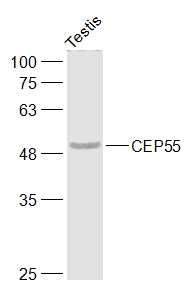
Fig1: Sample: Testis (Mouse) Lysate at 40 ug Primary: Anti-CEP55 (ER1906-16) at 1/1000 dilution Secondary: IRDye800CW Goat Anti-Rabbit IgG at 1/20000 dilution Predicted band size: 54 kD Observed band size: 52 kD| Product Name | CEP55 |
|---|---|
| Antibody Type | Primary Antibodies |
| Antigen Alias | C10orf3 Centrosomal protein 55kDa Centrosomal protein of 55 kDa CEP 55 FLJ10540 Up regulated in colon cancer 6 URCC 6 URCC6 CEP55_HUMAN. |
| Product description | Plays a role in mitotic exit and cytokinesis. Not required for microtubule nucleation. Recruits PDCD6IP and TSG101 to midbody during cytokinesis. |
| Immunogen | KLH conjugated synthetic peptide derived from human CEP55 151-250/464 |
| Clonality | Polyclonal |
|---|---|
| Isotype | IgG |
| Host Species | Rabbit |
| Tested Applications | WB |
| WB:1:500-2000: |
|
| Species Reactivity | HumanMouseRatDogPigHorseSheep |
| Concentration | 1mg/ml |
| Alternative Names | C10orf3 Centrosomal protein 55kDa Centrosomal protein of 55 kDa CEP 55 FLJ10540 Up regulated in colon cancer 6 URCC 6 URCC6 CEP55_HUMAN. |
|---|---|
| Molecular Weight(MW) | 54 KDa |
| Cellular Localization | Cytoplasm, cytoskeleton, centrosome, centriole. Cytoplasm, cytoskeleton, centrosome. Cleavage furrow. Midbody. Note=Present at the centrosomes at interphase. A small portion is associated preferentially with the mother centriole, whereas the majority localizes to the pericentriolar material. During mitosis, loss of affinity for the centrosome at the onset of prophase and diffusion throughout the cell. This dissociation from the centrosome is phosphorylation-dependent. May remain localized at the centrosome during mitosis in certain cell types. Appears at the cleavage furrow in late anaphase and in the midbody in cytokinesis. |
| SwissProt ID | Q53EZ4 |
|---|
Application
Fig1: Sample: Testis (Mouse) Lysate at 40 ug Primary: Anti-CEP55 (ER1906-16) at 1/1000 dilution Secondary: IRDye800CW Goat Anti-Rabbit IgG at 1/20000 dilution Predicted band size: 54 kD Observed band size: 52 kD| Positive Control | Widely expressed, mostly in proliferative tissues. Highly expressed in testis. Intermediate levels in adult and fetal thymus, as well as in various cancer cell lines. Low levels in different parts of the digestive tract, bone marrow, lymph nodes, placenta, fetal heart and fetal spleen. Hardly detected in brain. |
|---|---|
| Application Notes | WB:1:500-2000: |
| Form | Liquid |
|---|---|
| Storage Instructions | Store at -20℃ for one year. Avoid repeated freeze/thaw cycles. The lyophilized antibody is stable at room temperature for at least one month and for greater than a year when kept at -20℃. When reconstituted in sterile pH 7.4 0.01M PBS or diluent of antibody the antibody is stable for at least two weeks at 2-4℃. |
| Storage Buffer | 0.01M TBS(pH7.4) with 1% BSA, 0.03% Proclin300 and 50% Glycerol. |


