Application
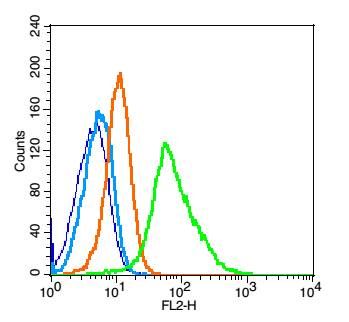
Fig1: Blank control: Raji(blue). Primary Antibody:Rabbit Anti-Claudin 1 antibody(ER1906-37), Dilution: 1μg in 100 μL 1X PBS containing 0.5% BSA; Isotype Control Antibody: Rabbit IgG(orange) ,used under the same conditions ); Secondary Antibody: Goat anti-rabbit IgG-PE(white blue), Dilution: 1:200 in 1 X PBS containing 0.5% BSA. Protocol The cells were fixed with 2% paraformaldehyde (10 min). Antibody (ER1906-37, 1μg /1x10^6 cells) were incubated for 30 min on the ice, followed by 1 X PBS containing 0.5% BSA + 1 0% goat serum (15 min) to block non-specific protein-protein interactions. Then the Goat Anti-rabbit IgG/PE antibody was added into the blocking buffer mentioned above to react with the primary antibody of ER1906-37 at 1/200 dilution for 30 min on ice. Acquisition of 20,000 events was performed.Application
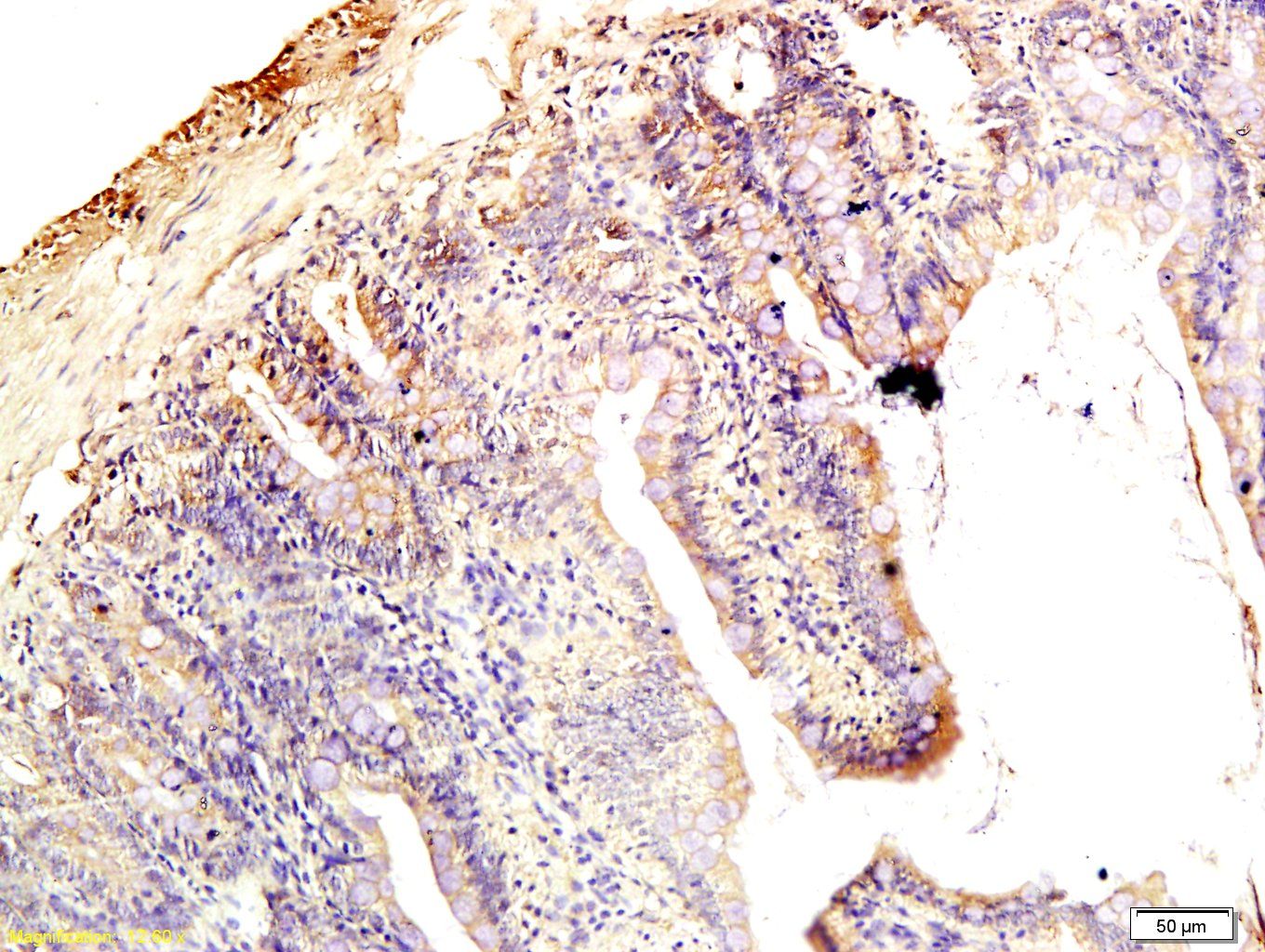
Fig2: Tissue/cell: rat intestine tissue; 4% Paraformaldehyde-fixed and paraffin-embedded; Antigen retrieval: citrate buffer ( 0.01M, pH 6.0 ), Boiling bathing for 15min; Block endogenous peroxidase by 3% Hydrogen peroxide for 30min; Blocking buffer (normal goat serum,C-0005) at 37℃ for 20 min; Incubation: Anti-Claudin-1 Polyclonal Antibody, Unconjugated(ER1906-37) 1:200, overnight at 4℃, followed by conjugation to the secondary antibody(SP-0023) and DAB(C-0010) stainingApplication
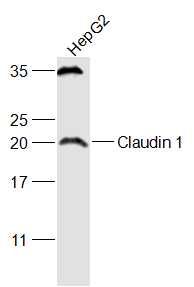
Fig3: Sample: HepG2(Human) Cell Lysate at 30 ug Primary: Anti-Claudin 1 (ER1906-37) at 1/1000 dilution Secondary: IRDye800CW Goat Anti-Rabbit IgG at 1/20000 dilution Predicted band size: 23 kD Observed band size: 23 kDApplication
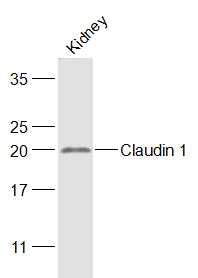
Fig4: Sample: Kidney (Mouse) Lysate at 40 ug Primary: Anti-Claudin 1 (ER1906-37) at 1/1000 dilution Secondary: IRDye800CW Goat Anti-Rabbit IgG at 1/20000 dilution Predicted band size: 23 kD Observed band size: 23 kDApplication
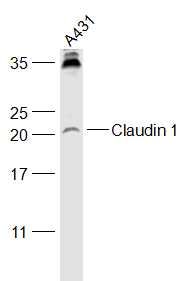
Fig5: Sample: A431(Human) Cell Lysate at 30 ug Primary: Anti-Claudin 1 (ER1906-37) at 1/1000 dilution Secondary: IRDye800CW Goat Anti-Rabbit IgG at 1/20000 dilution Predicted band size: 23 kD Observed band size: 23 kD| Product Name | Claudin 1 |
|---|---|
| Antibody Type | Primary Antibodies |
| Antigen Alias | claudin Claudin1 CLD 1 CLD1 CLDN 1 CLDN1 ILVASC SEMP 1 SEMP1 Senescence associated epithelial membrane protein 1 Senescence associated epithelial membrane protein CLD1_HUMAN. |
| Product description | Claudins function as major constituents of the tight junction complexes that regulate the permeability of epithelia. While some claudin family members play essential roles in the formation of impermeable barriers, others mediate the permeability to ions and small molecules. Often, several claudin family members are coexpressed and interact with each other, and this determines the overall permeability. CLDN1 is required to prevent the paracellular diffusion of small molecules through tight junctions in the epidermis and is required for the normal barrier function of the skin. Required for normal water homeostasis and to prevent excessive water loss through the skin, probably via an indirect effect on the expression levels of other proteins, since CLDN1 itself seems to be dispensable for water barrier formation in keratinocyte tight junctions. |
| Immunogen | KLH conjugated synthetic peptide derived from mouse Claudin 1 121-211/211 |
| Clonality | Polyclonal |
|---|---|
| Isotype | IgG |
| Host Species | Rabbit |
| Tested Applications | WBIHC-PFC |
| WB:1:500-2000: IHC-P:1:400-800: FC:1: |
|
| Species Reactivity | HumanMouseRat |
| Concentration | 1mg/ml |
| Alternative Names | claudin Claudin1 CLD 1 CLD1 CLDN 1 CLDN1 ILVASC SEMP 1 SEMP1 Senescence associated epithelial membrane protein 1 Senescence associated epithelial membrane protein CLD1_HUMAN. |
|---|---|
| Molecular Weight(MW) | 23 KDa |
| Cellular Localization | Cell junction, tight junction. Cell membrane; Multi-pass membrane protein. |
| SwissProt ID | O88551 |
|---|
Application
Fig1: Blank control: Raji(blue). Primary Antibody:Rabbit Anti-Claudin 1 antibody(ER1906-37), Dilution: 1μg in 100 μL 1X PBS containing 0.5% BSA; Isotype Control Antibody: Rabbit IgG(orange) ,used under the same conditions ); Secondary Antibody: Goat anti-rabbit IgG-PE(white blue), Dilution: 1:200 in 1 X PBS containing 0.5% BSA. Protocol The cells were fixed with 2% paraformaldehyde (10 min). Antibody (ER1906-37, 1μg /1x10^6 cells) were incubated for 30 min on the ice, followed by 1 X PBS containing 0.5% BSA + 1 0% goat serum (15 min) to block non-specific protein-protein interactions. Then the Goat Anti-rabbit IgG/PE antibody was added into the blocking buffer mentioned above to react with the primary antibody of ER1906-37 at 1/200 dilution for 30 min on ice. Acquisition of 20,000 events was performed.
Application
Fig2: Tissue/cell: rat intestine tissue; 4% Paraformaldehyde-fixed and paraffin-embedded; Antigen retrieval: citrate buffer ( 0.01M, pH 6.0 ), Boiling bathing for 15min; Block endogenous peroxidase by 3% Hydrogen peroxide for 30min; Blocking buffer (normal goat serum,C-0005) at 37℃ for 20 min; Incubation: Anti-Claudin-1 Polyclonal Antibody, Unconjugated(ER1906-37) 1:200, overnight at 4℃, followed by conjugation to the secondary antibody(SP-0023) and DAB(C-0010) staining
Application
Fig3: Sample: HepG2(Human) Cell Lysate at 30 ug Primary: Anti-Claudin 1 (ER1906-37) at 1/1000 dilution Secondary: IRDye800CW Goat Anti-Rabbit IgG at 1/20000 dilution Predicted band size: 23 kD Observed band size: 23 kD
Application
Fig4: Sample: Kidney (Mouse) Lysate at 40 ug Primary: Anti-Claudin 1 (ER1906-37) at 1/1000 dilution Secondary: IRDye800CW Goat Anti-Rabbit IgG at 1/20000 dilution Predicted band size: 23 kD Observed band size: 23 kD
Application
Fig5: Sample: A431(Human) Cell Lysate at 30 ug Primary: Anti-Claudin 1 (ER1906-37) at 1/1000 dilution Secondary: IRDye800CW Goat Anti-Rabbit IgG at 1/20000 dilution Predicted band size: 23 kD Observed band size: 23 kD| Positive Control | Widely expressed, with highest levels in liver and kidney. |
|---|---|
| Application Notes | WB:1:500-2000: IHC-P:1:400-800: FC:1: |
| Form | Liquid |
|---|---|
| Storage Instructions | Store at -20℃ for one year. Avoid repeated freeze/thaw cycles. The lyophilized antibody is stable at room temperature for at least one month and for greater than a year when kept at -20℃. When reconstituted in sterile pH 7.4 0.01M PBS or diluent of antibody the antibody is stable for at least two weeks at 2-4℃. |
| Storage Buffer | 0.01M TBS(pH7.4) with 1% BSA, 0.03% Proclin300 and 50% Glycerol. |


