Application
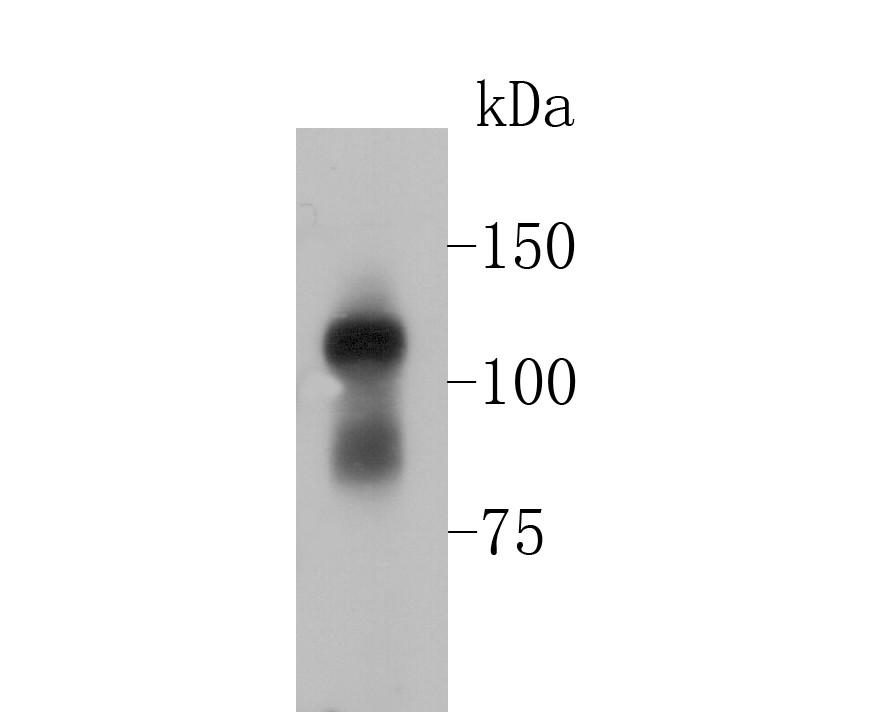
Fig1: Western blot analysis of KAP1 (phospho S824) on 293 cell lysate. Proteins were transferred to a PVDF membrane and blocked with 5% BSA in PBS for 1 hour at room temperature. The primary antibody (ET7110-11, 1/500) was used in 5% BSA at room temperature for 2 hours. Goat Anti-Rabbit IgG - HRP Secondary Antibody (HA1001) at 1:5,000 dilution was used for 1 hour at room temperature.Application
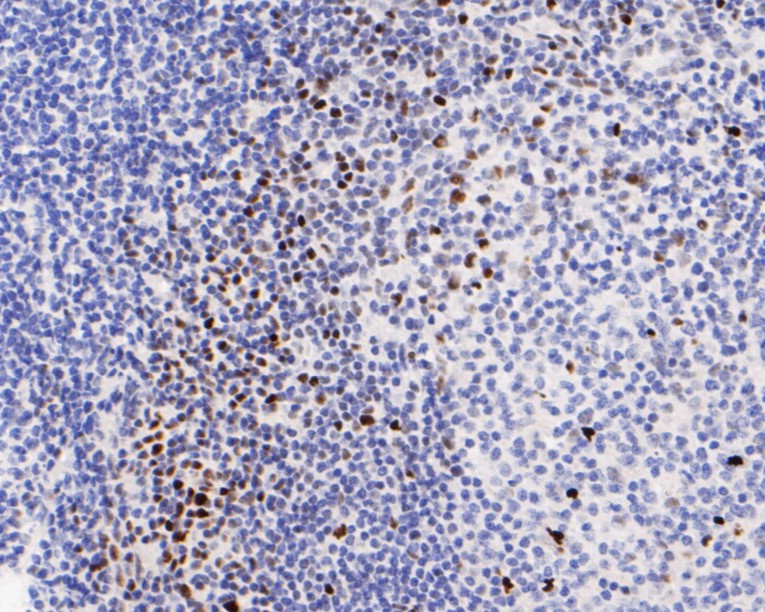
Fig2: Immunohistochemical analysis of paraffin-embedded human tonsil tissue using anti-KAP1 (phospho S824) antibody. The section was pre-treated using heat mediated antigen retrieval with sodium citrate buffer (pH 6.0) for 20 minutes. The tissues were blocked in 5% BSA for 30 minutes at room temperature, washed with ddH2O and PBS, and then probed with the primary antibody (ET7110-11, 1/50) for 30 minutes at room temperature. The detection was performed using an HRP conjugated compact polymer system. DAB was used as the chromogen. Tissues were counterstained with hematoxylin and mounted with DPX.Application
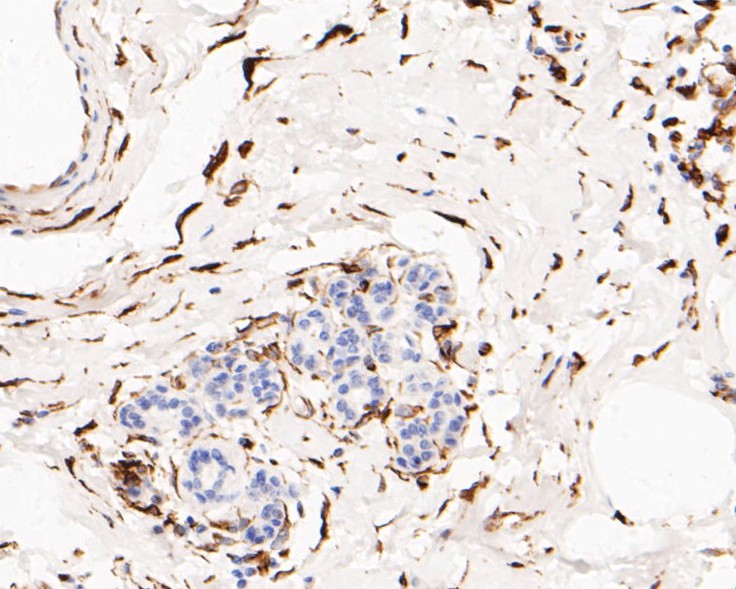
Fig3: Immunohistochemical analysis of paraffin-embedded human breast tissue using anti-KAP1 (phospho S824) antibody. The section was pre-treated using heat mediated antigen retrieval with sodium citrate buffer (pH 6.0) for 20 minutes. The tissues were blocked in 5% BSA for 30 minutes at room temperature, washed with ddH2O and PBS, and then probed with the primary antibody (ET7110-11, 1/50) for 30 minutes at room temperature. The detection was performed using an HRP conjugated compact polymer system. DAB was used as the chromogen. Tissues were counterstained with hematoxylin and mounted with DPX.Application
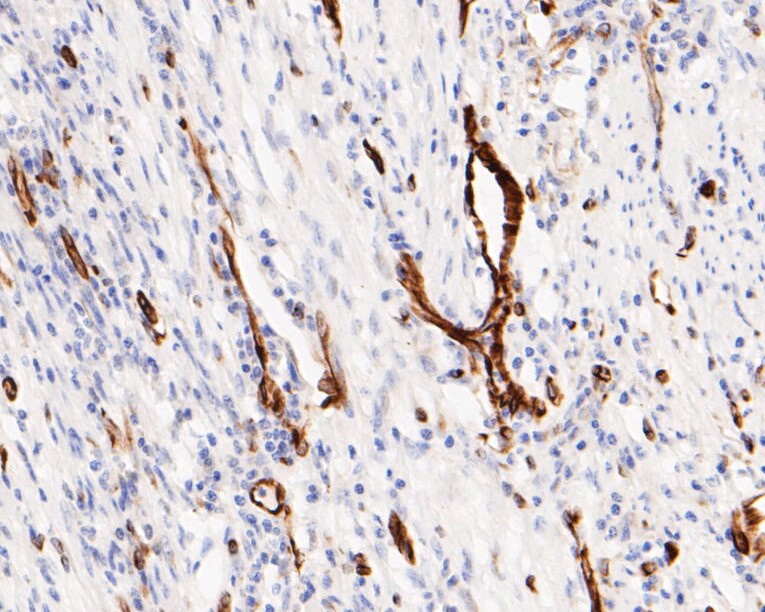
Fig4: Immunohistochemical analysis of paraffin-embedded human gastric carcinoma tissue using anti-KAP1 (phospho S824) antibody. The section was pre-treated using heat mediated antigen retrieval with sodium citrate buffer (pH 6.0) for 20 minutes. The tissues were blocked in 5% BSA for 30 minutes at room temperature, washed with ddH2O and PBS, and then probed with the primary antibody (ET7110-11, 1/50) for 30 minutes at room temperature. The detection was performed using an HRP conjugated compact polymer system. DAB was used as the chromogen. Tissues were counterstained with hematoxylin and mounted with DPX.| Product Name | KAP1 (phospho S824) [JE50-99] |
|---|---|
| Antibody Type | Primary Antibodies |
| Antigen Alias | E3 SUMO protein ligase TRIM28 antibody E3 SUMO-protein ligase TRIM28 antibody FLJ29029 antibody KAP 1 antibody KAP-1 antibody KRAB associated protein 1 antibody KRAB interacting protein 1 antibody KRAB-associated protein 1 antibody KRAB-interacting protein 1 antibody KRIP 1 antibody KRIP-1 antibody KRIP1 antibody Nuclear corepressor KAP 1 antibody Nuclear corepressor KAP-1 antibody RING finger protein 96 antibody RNF96 antibody TF1B antibody TIF1 beta antibody TIF1-beta antibody TIF1B antibody TIF1B_HUMAN antibody Transcription intermediary factor 1 beta antibody Transcription intermediary factor 1-beta antibody Trim28 antibody Tripartite motif containing 28 antibody tripartite motif containing protein 28 antibody Tripartite motif-containing protein 28 antibody |
| Product description | TIF1β is a member of the TIF1 (transcriptional intermediary factor 1) family, a group of transcriptional regulators that play key roles in development and differentiation. Members of this family are characterized by the presence of two conserved motifs – an N-terminal RING-B box-coiled-coil motif and a C-terminal PHD finger and bromodomain unit. TIF1β is a corepressor for KRAB (Kruppel associated box) domain containing zinc finger proteins. The KRAB domain containing zinc finger proteins are a large group of transcription factors that are vertebrate-specific, varied in their expression patterns between species, and thought to regulate gene transcription programs that control speciation. TIF1β has been shown to be essential for early embryonic development and spermatogenesis. It functions to either activate or repress transcription in response to environmental or developmental signals by chromatin remodeling and histone modification. The recruitment and association of TIF1β with heterochromatin protein (HP1) is essential for transcriptional repression, and for progression through differentiation of F9 embryonic carcinoma cells. TIF1β also plays a role in the DNA damage response. Phosphorylation of TIF1β on Ser842 occurs in an ATM-dependent manner in response to genotoxic stress and is thought to be essential for chromatin relaxation, which is in turn required for the DNA damage response. |
| Immunogen | Synthetic phospho peptide corresponding to a region surrounding Serine 824 of Human KAP1 |
| Modification | p-S824 |
| Clonality | Monoclonal |
|---|---|
| Isotype | IgG |
| Host Species | Recombinant rabbit |
| Tested Applications | WBIHC-PIPDot |
| WB:1:500-1:2,000 IHC-P:1:50-1:200 IP:1:10-1:50: |
|
| Species Reactivity | Human |
| Concentration | 1mg/mL |
| Alternative Names | E3 SUMO protein ligase TRIM28 antibody
E3 SUMO-protein ligase TRIM28 antibody
FLJ29029 antibody KAP 1 antibody KAP-1 antibody KRAB associated protein 1 antibody KRAB interacting protein 1 antibody KRAB-associated protein 1 antibody KRAB-interacting protein 1 antibody KRIP 1 antibody KRIP-1 antibody KRIP1 antibody Nuclear corepressor KAP 1 antibody Nuclear corepressor KAP-1 antibody RING finger protein 96 antibody RNF96 antibody TF1B antibody TIF1 beta antibody TIF1-beta antibody TIF1B antibody TIF1B_HUMAN antibody Transcription intermediary factor 1 beta antibody Transcription intermediary factor 1-beta antibody Trim28 antibody Tripartite motif containing 28 antibody tripartite motif containing protein 28 antibody Tripartite motif-containing protein 28 antibody |
|---|---|
| Molecular Weight(MW) | 88/79/117 kDa |
| Cellular Localization | Nucleus. |
| SwissProt ID | Q13263 |
|---|
Application
Fig1: Western blot analysis of KAP1 (phospho S824) on 293 cell lysate. Proteins were transferred to a PVDF membrane and blocked with 5% BSA in PBS for 1 hour at room temperature. The primary antibody (ET7110-11, 1/500) was used in 5% BSA at room temperature for 2 hours. Goat Anti-Rabbit IgG - HRP Secondary Antibody (HA1001) at 1:5,000 dilution was used for 1 hour at room temperature.
Application
Fig2: Immunohistochemical analysis of paraffin-embedded human tonsil tissue using anti-KAP1 (phospho S824) antibody. The section was pre-treated using heat mediated antigen retrieval with sodium citrate buffer (pH 6.0) for 20 minutes. The tissues were blocked in 5% BSA for 30 minutes at room temperature, washed with ddH2O and PBS, and then probed with the primary antibody (ET7110-11, 1/50) for 30 minutes at room temperature. The detection was performed using an HRP conjugated compact polymer system. DAB was used as the chromogen. Tissues were counterstained with hematoxylin and mounted with DPX.
Application
Fig3: Immunohistochemical analysis of paraffin-embedded human breast tissue using anti-KAP1 (phospho S824) antibody. The section was pre-treated using heat mediated antigen retrieval with sodium citrate buffer (pH 6.0) for 20 minutes. The tissues were blocked in 5% BSA for 30 minutes at room temperature, washed with ddH2O and PBS, and then probed with the primary antibody (ET7110-11, 1/50) for 30 minutes at room temperature. The detection was performed using an HRP conjugated compact polymer system. DAB was used as the chromogen. Tissues were counterstained with hematoxylin and mounted with DPX.
Application
Fig4: Immunohistochemical analysis of paraffin-embedded human gastric carcinoma tissue using anti-KAP1 (phospho S824) antibody. The section was pre-treated using heat mediated antigen retrieval with sodium citrate buffer (pH 6.0) for 20 minutes. The tissues were blocked in 5% BSA for 30 minutes at room temperature, washed with ddH2O and PBS, and then probed with the primary antibody (ET7110-11, 1/50) for 30 minutes at room temperature. The detection was performed using an HRP conjugated compact polymer system. DAB was used as the chromogen. Tissues were counterstained with hematoxylin and mounted with DPX.| Positive Control | 293 cell, human tonsil tissue, human breast tissue, human gastric carcinoma tissue. |
|---|---|
| Application Notes | WB:1:500-1:2,000 IHC-P:1:50-1:200 IP:1:10-1:50: |
| Form | Liquid |
|---|---|
| Storage Instructions | Store at +4℃ after thawing. Aliquot store at -20℃. Avoid repeated freeze / thaw cycles. |
| Storage Buffer | 1*TBS (pH7.4), 1%BSA, 50%Glycerol. Preservative: 0.05% Sodium Azide. |


