Application
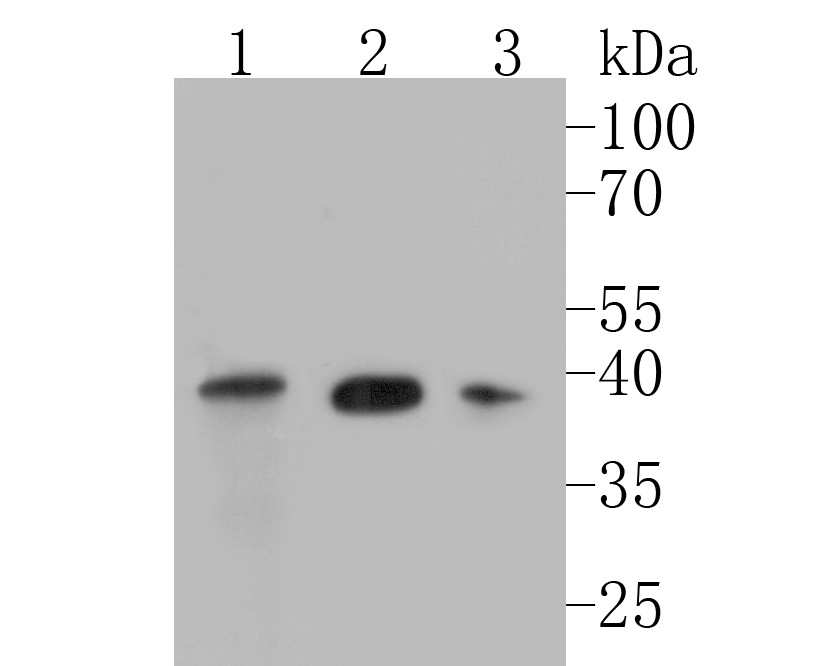
Fig1: Western blot analysis of TIMM50 (Tim50) on different lysates. Proteins were transferred to a PVDF membrane and blocked with 5% BSA in PBS for 1 hour at room temperature. The primary antibody (ET7110-24, 1/500) was used in 5% BSA at room temperature for 2 hours. Goat Anti-Rabbit IgG - HRP Secondary Antibody (HA1001) at 1:5,000 dilution was used for 1 hour at room temperature. Positive control: Lane 1: A549 cell lysate Lane 2: K562 cell lysate Lane 3: MCF-7 cell lysateApplication
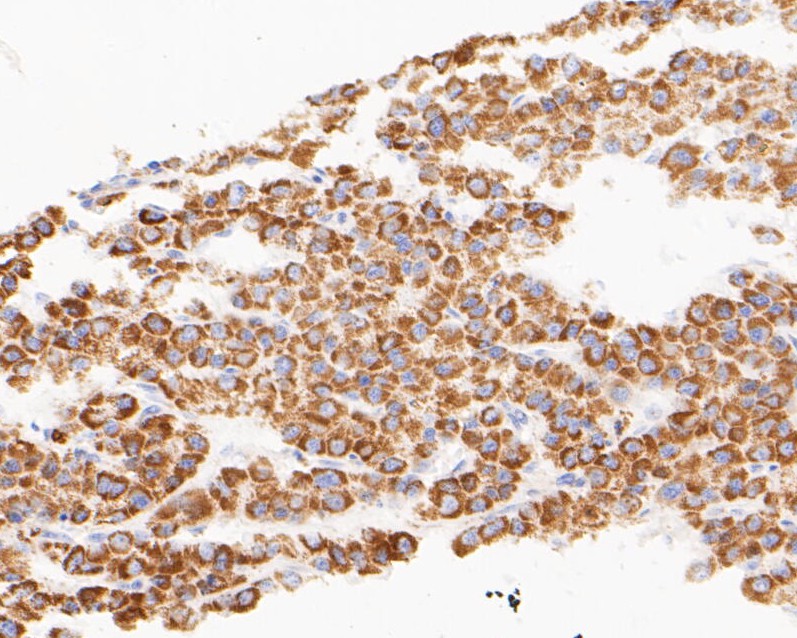
Fig2: Immunohistochemical analysis of paraffin-embedded human liver carcinoma tissue using anti-TIMM50 (Tim50) antibody. The section was pre-treated using heat mediated antigen retrieval with sodium citrate buffer (pH 6.0) for 20 minutes. The tissues were blocked in 5% BSA for 30 minutes at room temperature, washed with ddH2O and PBS, and then probed with the primary antibody (ET7110-24, 1/50) for 30 minutes at room temperature. The detection was performed using an HRP conjugated compact polymer system. DAB was used as the chromogen. Tissues were counterstained with hematoxylin and mounted with DPX.Application
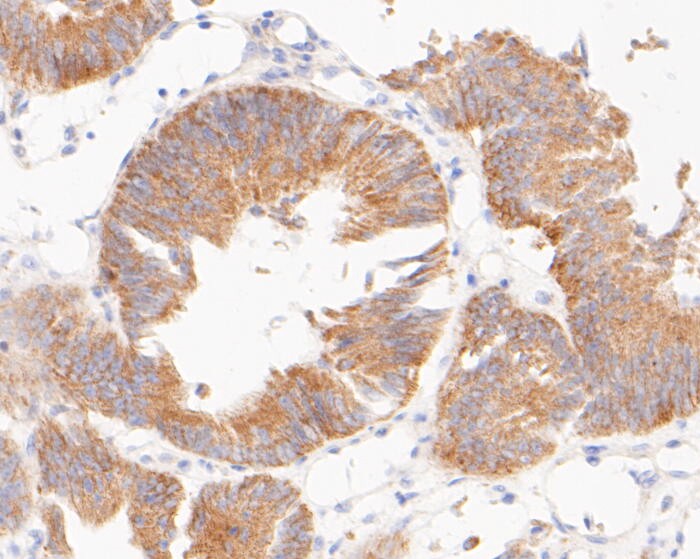
Fig3: Immunohistochemical analysis of paraffin-embedded human colon carcinoma tissue using anti-TIMM50 (Tim50) antibody. The section was pre-treated using heat mediated antigen retrieval with sodium citrate buffer (pH 6.0) for 20 minutes. The tissues were blocked in 5% BSA for 30 minutes at room temperature, washed with ddH2O and PBS, and then probed with the primary antibody (ET7110-24, 1/50) for 30 minutes at room temperature. The detection was performed using an HRP conjugated compact polymer system. DAB was used as the chromogen. Tissues were counterstained with hematoxylin and mounted with DPX.Application
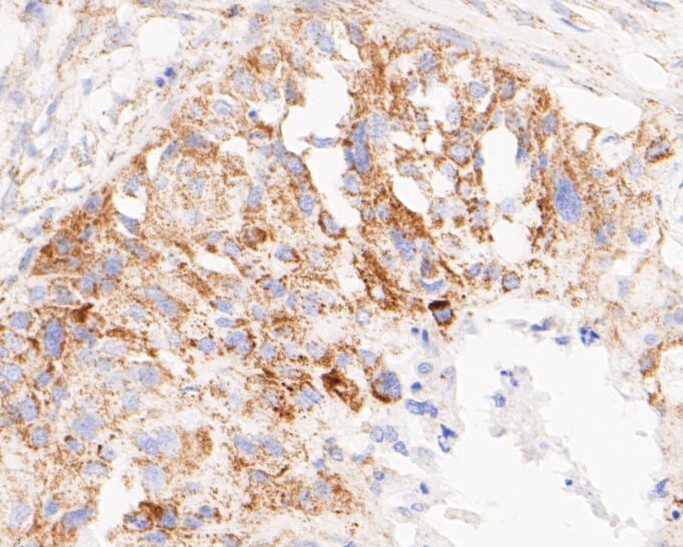
Fig4: Immunohistochemical analysis of paraffin-embedded human breast carcinoma tissue using anti-TIMM50 (Tim50) antibody. The section was pre-treated using heat mediated antigen retrieval with sodium citrate buffer (pH 6.0) for 20 minutes. The tissues were blocked in 5% BSA for 30 minutes at room temperature, washed with ddH2O and PBS, and then probed with the primary antibody (ET7110-24, 1/50) for 30 minutes at room temperature. The detection was performed using an HRP conjugated compact polymer system. DAB was used as the chromogen. Tissues were counterstained with hematoxylin and mounted with DPX.| Product Name | TIMM50 (Tim50) [JE51-61] |
|---|---|
| Antibody Type | Primary Antibodies |
| Antigen Alias | Homolog of yeast Tim50 antibody Import inner membrane translocase subunit TIM 50 antibody Import inner membrane translocase subunit TIM50 antibody Import inner membrane translocase subunit TIM50 mitochondrial antibody MGC102733 antibody Mitochondrial import inner membrane translocase subunit TIM50 antibody TIM 50 antibody TIM 50L antibody TIM50 antibody Tim50 like protein antibody TIM50_HUMAN antibody TIM50L antibody TIMM 50 antibody TIMM50 antibody translocase of inner mitochondrial membrane 50 homolog (S. cerevisiae) antibody Translocase of inner mitochondrial membrane 50 homolog (yeast) antibody Translocase of inner mitochondrial membrane 50 homolog antibody Translocase of inner mitochondrial membrane 50, yeast, homolog of antibody |
| Product description | Mitochondrial import inner membrane translocase subunit TIM50 is an enzyme that in humans is encoded by the TIMM50 gene. Tim50 is a subunit of the Tim23 translocase complex in the inner mitochondrial membrane. Mutations in TIMM50 can lead to epilepsy, severe intellectual disability, and 3-methylglutaconic aciduria. TIMM50 expression is increased in breast cancer cells and decreased in hypertrophic hearts. The TIMM50 gene is located on the q arm of chromosome 19 in position 13.2 and spans 13,373 base pairs. The gene produces a 39.6 kDa protein composed of 353 amino acids. This gene encodes a subunit of the TIM23 inner mitochondrial membrane translocase complex, which mediates the translocation of transit peptide-containing proteins across the mitochondrial inner membrane. The Tim50 protein functions as the receptor subunit that recognizes the mitochondrial targeting signal, or presequence, on protein cargo that is destined for the mitochondrial inner membrane and matrix. This gene in human cells results in the release of cytochrome c and apoptosis. This protein plays a role in maintaining the membrane permeability barrier. The intermembrane space domain of Tim50 induces the translocation pore of the TIM23 channel to close. |
| Immunogen | Synthetic peptide within N-terminal human TIM50. |
| Clonality | Monoclonal |
|---|---|
| Isotype | IgG |
| Host Species | Recombinant rabbit |
| Tested Applications | WBIHC-P |
| WB:1:500-1:2,000 IHC-P:1:50-1:100 |
|
| Species Reactivity | HumanMouse |
| Concentration | 1mg/mL |
| Alternative Names | Homolog of yeast Tim50 antibody
Import inner membrane translocase subunit TIM 50 antibody
Import inner membrane translocase subunit TIM50 antibody Import inner membrane translocase subunit TIM50 mitochondrial antibody MGC102733 antibody Mitochondrial import inner membrane translocase subunit TIM50 antibody TIM 50 antibody TIM 50L antibody TIM50 antibody Tim50 like protein antibody TIM50_HUMAN antibody TIM50L antibody TIMM 50 antibody TIMM50 antibody translocase of inner mitochondrial membrane 50 homolog (S. cerevisiae) antibody Translocase of inner mitochondrial membrane 50 homolog (yeast) antibody Translocase of inner mitochondrial membrane 50 homolog antibody Translocase of inner mitochondrial membrane 50 yeast homolog of antibody |
|---|---|
| Molecular Weight(MW) | 40 kDa |
| Cellular Localization | Mitochondrion inner membrane, nucleus speckle. |
| SwissProt ID | Q3ZCQ8 |
|---|
Application
Fig1: Western blot analysis of TIMM50 (Tim50) on different lysates. Proteins were transferred to a PVDF membrane and blocked with 5% BSA in PBS for 1 hour at room temperature. The primary antibody (ET7110-24, 1/500) was used in 5% BSA at room temperature for 2 hours. Goat Anti-Rabbit IgG - HRP Secondary Antibody (HA1001) at 1:5,000 dilution was used for 1 hour at room temperature. Positive control: Lane 1: A549 cell lysate Lane 2: K562 cell lysate Lane 3: MCF-7 cell lysate
Application
Fig2: Immunohistochemical analysis of paraffin-embedded human liver carcinoma tissue using anti-TIMM50 (Tim50) antibody. The section was pre-treated using heat mediated antigen retrieval with sodium citrate buffer (pH 6.0) for 20 minutes. The tissues were blocked in 5% BSA for 30 minutes at room temperature, washed with ddH2O and PBS, and then probed with the primary antibody (ET7110-24, 1/50) for 30 minutes at room temperature. The detection was performed using an HRP conjugated compact polymer system. DAB was used as the chromogen. Tissues were counterstained with hematoxylin and mounted with DPX.
Application
Fig3: Immunohistochemical analysis of paraffin-embedded human colon carcinoma tissue using anti-TIMM50 (Tim50) antibody. The section was pre-treated using heat mediated antigen retrieval with sodium citrate buffer (pH 6.0) for 20 minutes. The tissues were blocked in 5% BSA for 30 minutes at room temperature, washed with ddH2O and PBS, and then probed with the primary antibody (ET7110-24, 1/50) for 30 minutes at room temperature. The detection was performed using an HRP conjugated compact polymer system. DAB was used as the chromogen. Tissues were counterstained with hematoxylin and mounted with DPX.
Application
Fig4: Immunohistochemical analysis of paraffin-embedded human breast carcinoma tissue using anti-TIMM50 (Tim50) antibody. The section was pre-treated using heat mediated antigen retrieval with sodium citrate buffer (pH 6.0) for 20 minutes. The tissues were blocked in 5% BSA for 30 minutes at room temperature, washed with ddH2O and PBS, and then probed with the primary antibody (ET7110-24, 1/50) for 30 minutes at room temperature. The detection was performed using an HRP conjugated compact polymer system. DAB was used as the chromogen. Tissues were counterstained with hematoxylin and mounted with DPX.| Positive Control | A549, K562, MCF-7, human liver carcinoma tissue, human colon carcinoma tissue, human breast carcinoma tissue. |
|---|---|
| Application Notes | WB:1:500-1:2,000 IHC-P:1:50-1:100 |
| Form | Liquid |
|---|---|
| Storage Instructions | Store at +4℃ after thawing. Aliquot store at -20℃. Avoid repeated freeze / thaw cycles. |
| Storage Buffer | 1*TBS (pH7.4), 1%BSA, 50%Glycerol. Preservative: 0.05% Sodium Azide. |


