Application
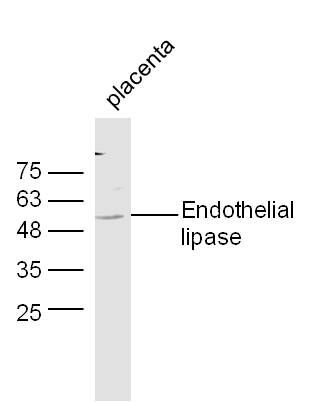
Fig1: Sample: Placenta (Mouse) Lysate at 40 ug Primary: Anti- Endothelial lipase (ER1908-11) at 1/300 dilution Secondary: IRDye800CW Goat Anti-Rabbit IgG at 1/20000 dilution Predicted band size: 55 kD Observed band size: 55 kD| Product Name | Endothelial lipase |
|---|---|
| Antibody Type | Primary Antibodies |
| Antigen Alias | LIPG EC 3.1.1.3 EDL EL Endothelial cell-derived lipase Endothelial lipase Endothelial lipase precursor Lipase endothelial LIPE_HUMAN LIPG Lipoprotein lipase H PL PRO719. |
| Product description | Endothelial lipase (LIPG) is a form of lipase secreted by vascular endothelial cells in tissues with high metabolic rates and vascularization, such as the liver, lung, kidney, and thyroid gland. The LIPG enzyme is a vital component to many biological process. These processes include lipoprotein metabolism, cytokine expression, and lipid composition in cells. Unlike the lipases that hydrolyze Triglycerides, endothelial lipase primarily hydrolyzes phospholipids. Due to the hydrolysis specificity, endothelial lipase contributes to multiple vital systems within the body. On the contrary to the beneficial roles that LIPG plays within the body, endothelial lipase is thought of to play a potential role in cancer and inflammation. Knowledge obtained in vitro and in vivo suggest the relations to these conditions, but human interaction knowledge lacks due to the recent discovery of endothelial lipase. Endothelial lipase was first characterized in 1999. The two independent research groups which are notable for this discovery cloned the endothelial lipase gene and identified the novel lipase secreted from endothelial cells. The anti-Atherosclerosis opportunity through alleviating plaque blockage and prospective ability to raise High-density lipoprotein (HDL) have gained endothelial lipase recognition. |
| Immunogen | KLH conjugated synthetic peptide derived from human Endothelial lipase 301-400/500 |
| Clonality | Polyclonal |
|---|---|
| Isotype | IgG |
| Host Species | Rabbit |
| Tested Applications | WB |
| WB:1:500-2000: |
|
| Species Reactivity | HumanMouseRatChickenDogPigCowHorse |
| Concentration | 1mg/ml |
| Alternative Names | LIPG EC 3.1.1.3 EDL EL Endothelial cell-derived lipase Endothelial lipase Endothelial lipase precursor Lipase endothelial LIPE_HUMAN LIPG Lipoprotein lipase H PL PRO719. |
|---|---|
| Molecular Weight(MW) | 55 KDa |
| Cellular Localization | Secreted. |
| SwissProt ID | Q9Y5X9 |
|---|
Application
Fig1: Sample: Placenta (Mouse) Lysate at 40 ug Primary: Anti- Endothelial lipase (ER1908-11) at 1/300 dilution Secondary: IRDye800CW Goat Anti-Rabbit IgG at 1/20000 dilution Predicted band size: 55 kD Observed band size: 55 kD| Positive Control | High level of expression in the liver, placenta, lung, thyroid, kidney, testis and in the corpus luteum of the ovary. Expressed also in coronary artery endothelial cells, umbilical vein endothelial cells and in hepatocytes and osteosarcoma cell lines. Not detected in heart, brain and muscle. |
|---|---|
| Application Notes | WB:1:500-2000: |
| Form | Liquid |
|---|---|
| Storage Instructions | Store at -20℃ for one year. Avoid repeated freeze/thaw cycles. The lyophilized antibody is stable at room temperature for at least one month and for greater than a year when kept at -20℃. When reconstituted in sterile pH 7.4 0.01M PBS or diluent of antibody the antibody is stable for at least two weeks at 2-4℃. |
| Storage Buffer | 0.01M TBS(pH7.4) with 1% BSA, 0.03% Proclin300 and 50% Glycerol. |


