Application
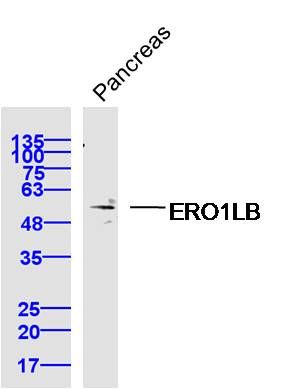
Fig1: Sample: Pancreas (Mouse) Lysate at 40 ug Primary: Anti-ERO1LB (ER1908-33) at 1/300 dilution Secondary: IRDye800CW Goat Anti-Rabbit IgG at 1/20000 dilution Predicted band size: 50 kD Observed band size: 50 kD| Product Name | ERO1LB |
|---|---|
| Antibody Type | Primary Antibodies |
| Antigen Alias | Endoplasmic oxidoreductin-1-like protein B ERO1-L-beta ERO1B_HUMAN ERO1-like protein beta Oxidoreductin-1-L-beta. |
| Product description | Oxidoreductase involved in disulfide bond formation in the endoplasmic reticulum. Efficiently reoxidizes P4HB/PDI, the enzyme catalyzing protein disulfide formation, in order to allow P4HB to sustain additional rounds of disulfide formation. Other protein disulfide isomerase family members can also be reoxidized, but at lower rates compared to P4HB, including PDIA2 (50% of P4HB reoxidation rate), as well as PDIA3, PDIA4, PDIA6 and NXNDC12 (<10%). Following P4HB reoxidation, passes its electrons to molecular oxygen via FAD, leading to the production of reactive oxygen species (ROS) in the cell. May be involved in oxidative proinsulin folding in pancreatic cells, hence may play a role in glucose homeostasis. |
| Immunogen | KLH conjugated synthetic peptide derived from human ERO1LB 1-100/467 |
| Clonality | Polyclonal |
|---|---|
| Isotype | IgG |
| Host Species | Rabbit |
| Tested Applications | WB |
| WB:1:500-2000: |
|
| Species Reactivity | HumanMouseRatRabbitGuinea Pig |
| Concentration | 1mg/ml |
| Alternative Names | Endoplasmic oxidoreductin-1-like protein B ERO1-L-beta ERO1B_HUMAN ERO1-like protein beta Oxidoreductin-1-L-beta. |
|---|---|
| Molecular Weight(MW) | 50 KDa |
| Cellular Localization | Endoplasmic reticulum membrane; Peripheral membrane protein; Lumenal side. Note: The association with ERP44 may be essential for its retention in the endoplasmic reticulum. |
| SwissProt ID | Q86YB8 |
|---|
Application
Fig1: Sample: Pancreas (Mouse) Lysate at 40 ug Primary: Anti-ERO1LB (ER1908-33) at 1/300 dilution Secondary: IRDye800CW Goat Anti-Rabbit IgG at 1/20000 dilution Predicted band size: 50 kD Observed band size: 50 kD| Positive Control | Highly expressed in the digestive tract, including the duodenum and lower digestive tract. In the stomach, highly expressed in enzyme-producing chief cells (at protein level). In the pancreas, expressed in islets of Langerhans and, at lower levels, in enzyme-secreting cells (at protein level). Detected at low level in many other tissues. |
|---|---|
| Application Notes | WB:1:500-2000: |
| Form | Liquid |
|---|---|
| Storage Instructions | Store at -20℃ for one year. Avoid repeated freeze/thaw cycles. The lyophilized antibody is stable at room temperature for at least one month and for greater than a year when kept at -20℃. When reconstituted in sterile pH 7.4 0.01M PBS or diluent of antibody the antibody is stable for at least two weeks at 2-4℃. |
| Storage Buffer | 0.01M TBS(pH7.4) with 1% BSA, 0.03% Proclin300 and 50% Glycerol. |


