Application
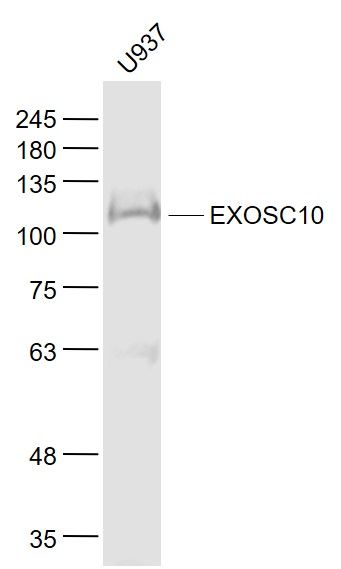
Fig1: Sample: U937(Human) Cell Lysate at 30 ug Primary: Anti- EXOSC10 (ER1908-43) at 1/1000 dilution Secondary: IRDye800CW Goat Anti-Rabbit IgG at 1/20000 dilution Predicted band size: 101 kD Observed band size: 103 kD| Product Name | EXOSC10 |
|---|---|
| Antibody Type | Primary Antibodies |
| Antigen Alias | Autoantigen PM/Scl 2 Exosc10 Exosome component 10 EXOSX_HUMAN P100 polymyositis scleroderma overlap syndrome associated autoantigen P100 polymyositis-scleroderma overlap syndrome-associated autoantigen p2 p3 p4 PM Scl PM/Scl 100 PM/Scl-100 PMSCL PMSCL2 Polymyositis/scleroderma autoantigen 100 kDa Polymyositis/scleroderma autoantigen 2 100 kDa Polymyositis/scleroderma autoantigen 2 RRP6 Rrp6p. |
| Product description | Putative catalytic component of the RNA exosome complex which has 3'->5' exoribonuclease activity and participates in a multitude of cellular RNA processing and degradation events. In the nucleus, the RNA exosome complex is involved in proper maturation of stable RNA species such as rRNA, snRNA and snoRNA, in the elimination of RNA processing by-products and non-coding 'pervasive' transcripts, such as anti-sense RNA species and promoter-upstream transcripts (PROMPTs), and of mRNAs with processing defects, thereby limiting or excluding their export to the cytoplasm. The RNA exosome may be involved in Ig class switch recombination (CSR) and/or Ig variable region somatic hypermutation (SHM) by targeting AICDA deamination activity to transcribed dsDNA substrates. In the cytoplasm, the RNA exosome complex is involved in general mRNA turnover and specifically degrades inherently unstable mRNAs containing AU-rich elements (AREs) within their 3' untranslated regions, and in RNA surveillance pathways, preventing translation of aberrant mRNAs. It seems to be involved in degradation of histone mRNA. EXOSC10 has 3'-5' exonuclease activity (By similarity). EXOSC10 is required for nucleolar localization of C1D and probably mediates the association of SKIV2L2, C1D and MPP6 wth the RNA exosome involved in the maturation of 5.8S rRNA. |
| Immunogen | KLH conjugated synthetic peptide derived from human EXOSC10/PMSCL2 41-140/885 |
| Clonality | Polyclonal |
|---|---|
| Isotype | IgG |
| Host Species | Rabbit |
| Tested Applications | WB |
| WB:1:500-2000: |
|
| Species Reactivity | HumanMouseRatDogPigCowHorseSheep |
| Concentration | 1mg/ml |
| Alternative Names | Autoantigen PM/Scl 2 Exosc10 Exosome component 10 EXOSX_HUMAN P100 polymyositis scleroderma overlap syndrome associated autoantigen P100 polymyositis-scleroderma overlap syndrome-associated autoantigen p2 p3 p4 PM Scl PM/Scl 100 PM/Scl-100 PMSCL PMSCL2 Polymyositis/scleroderma autoantigen 100 kDa Polymyositis/scleroderma autoantigen 2 100 kDa Polymyositis/scleroderma autoantigen 2 RRP6 Rrp6p. |
|---|---|
| Molecular Weight(MW) | 101 KDa |
| Cellular Localization | Cytoplasm. Nucleus > nucleolus. Nucleus. Strongly enriched in the nucleolus and a small amount has been found in cytoplasm supporting the existence of a nucleolar RNA exosome complex form. |
| SwissProt ID | Q01780 |
|---|
Application
Fig1: Sample: U937(Human) Cell Lysate at 30 ug Primary: Anti- EXOSC10 (ER1908-43) at 1/1000 dilution Secondary: IRDye800CW Goat Anti-Rabbit IgG at 1/20000 dilution Predicted band size: 101 kD Observed band size: 103 kD| Application Notes | WB:1:500-2000: |
|---|
| Form | Liquid |
|---|---|
| Storage Instructions | Store at -20℃ for one year. Avoid repeated freeze/thaw cycles. The lyophilized antibody is stable at room temperature for at least one month and for greater than a year when kept at -20℃. When reconstituted in sterile pH 7.4 0.01M PBS or diluent of antibody the antibody is stable for at least two weeks at 2-4℃. |
| Storage Buffer | 0.01M TBS(pH7.4) with 1% BSA, 0.03% Proclin300 and 50% Glycerol. |


