Application
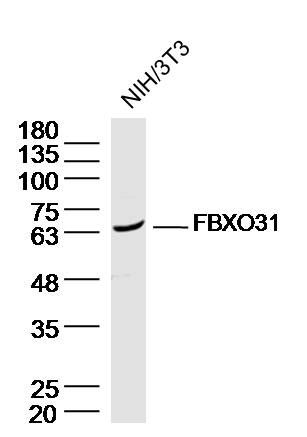
Fig1: Sample: NIH/3T3 cell (mouse) Lysate at 40 ug Primary: Anti-FBXO31 (ER1908-74)at 1/300 dilution Secondary: IRDye800CW Goat Anti-Rabbit IgG at 1/20000 dilution Predicted band size: 61kD Observed band size: 63 kD| Product Name | FBXO31 |
|---|---|
| Antibody Type | Primary Antibodies |
| Antigen Alias | F box only protein 31 FBX14 FBX31 FBXO14 pp2386 Putative breast cancer tumor suppressor SCF ubiquitin ligase specificity factor FBX31_HUMAN. |
| Product description | This gene is a member of the F-box family. Members are classified into three classes according to the substrate interaction domain, FBW for WD40 repeats, FBL for leucing-rich repeats, and FBXO for other domains. This protein, classified into the last category because of the lack of a recognizable substrate binding domain, has been proposed to be a component of the SCF ubiquitination complex. It is thought to bind and recruit substrate for ubiquitination and degradation. This protein may have a role in regulating the cell cycle as well as dendrite growth and neuronal migration. Alternative splicing results in multiple transcript variants. Component of some SCF (SKP1-cullin-F-box) protein ligase complex that plays a central role in G1 arrest following DNA damage. Specifically recognizes phosphorylated cyclin-D1 (CCND1), promoting its ubiquitination and degradation by the proteasome, resulting in G1 arrest. May act as a tumor suppressor. |
| Immunogen | KLH conjugated synthetic peptide derived from human FBXO31 151-250/539 |
| Clonality | Polyclonal |
|---|---|
| Isotype | IgG |
| Host Species | Rabbit |
| Tested Applications | WB |
| WB:1:500-2000: |
|
| Species Reactivity | HumanMouseRatChickenPigCowHorseRabbitSheep |
| Concentration | 1mg/ml |
| Alternative Names | F box only protein 31 FBX14 FBX31 FBXO14 pp2386 Putative breast cancer tumor suppressor SCF ubiquitin ligase specificity factor FBX31_HUMAN. |
|---|---|
| Molecular Weight(MW) | 61 KDa |
| Cellular Localization | Cytoskeleton. |
| SwissProt ID | Q5XUX0 |
|---|
Application
Fig1: Sample: NIH/3T3 cell (mouse) Lysate at 40 ug Primary: Anti-FBXO31 (ER1908-74)at 1/300 dilution Secondary: IRDye800CW Goat Anti-Rabbit IgG at 1/20000 dilution Predicted band size: 61kD Observed band size: 63 kD| Positive Control | Highly expressed in brain. Expressed at moderate levels in most tissues, except bone marrow. |
|---|---|
| Application Notes | WB:1:500-2000: |
| Form | Liquid |
|---|---|
| Storage Instructions | Store at -20℃ for one year. Avoid repeated freeze/thaw cycles. The lyophilized antibody is stable at room temperature for at least one month and for greater than a year when kept at -20℃. When reconstituted in sterile pH 7.4 0.01M PBS or diluent of antibody the antibody is stable for at least two weeks at 2-4℃. |
| Storage Buffer | 0.01M TBS(pH7.4) with 1% BSA, 0.03% Proclin300 and 50% Glycerol. |


