Application
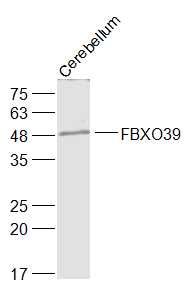
Fig1: Sample: Cerebellum(Rat) Lysate at 40 ug Primary: Anti-FBXO39 (ER1908-76) at 1/1000 dilution Secondary: IRDye800CW Goat Anti-Rabbit IgG at 1/20000 dilution Predicted band size: 31 kD Observed band size: 50 kD| Product Name | FBXO39 |
|---|---|
| Antibody Type | Primary Antibodies |
| Antigen Alias | XIAP-associated factor 1 BIRC 4 binding protein BIRC4-binding protein XAF1 XAF1_MOUSE XIAPAF1 BIRC 4 binding protein BIRC4 binding protein BIRC4BP HSXIAPAF 1 HSXIAPAF1 XAF 1 XIAP associated factor 1 Fbxo39 RP24-450M24.4. |
| Product description | Seems to function as a negative regulator of members of the IAP (inhibitor of apoptosis protein) family. Inhibits anti-caspase activity of BIRC4. Induces cleavage and inactivation of BIRC4 independent of caspase activation. Mediates TNF-alpha-induced apoptosis and is involved in apoptosis in trophoblast cells. May inhibit BIRC4 indirectly by activating the mitochondrial apoptosis pathway. After translocation to mitochondra, promotes translocation of BAX to mitochondria and cytochrome c release from mitochondria. Seems to promote the redistribution of BIRC4 from the cytoplasm to the nucleus, probably independent of BIRC4 inactivation which seems to occur in the cytoplasm. The BIRC4-XAF1 complex mediates down-regulation of BIRC5/survivin; the process requires the E3 ligase activity of BIRC4. Seems to be involved in cellular sensitivity to the proapoptotic actions of TRAIL. May be a tumor suppressor by mediating apoptosis resistance of cancer cells (By similarity). |
| Immunogen | KLH conjugated synthetic peptide derived from mouse XAF1 151-250/273 |
| Clonality | Polyclonal |
|---|---|
| Isotype | IgG |
| Host Species | Rabbit |
| Tested Applications | WBIHC-P |
| WB:1:500-2000: IHC-P:1:400-800: |
|
| Species Reactivity | MouseRat |
| Concentration | 1mg/ml |
| Alternative Names | XIAP-associated factor 1 BIRC 4 binding protein BIRC4-binding protein XAF1 XAF1_MOUSE XIAPAF1 BIRC 4 binding protein BIRC4 binding protein BIRC4BP HSXIAPAF 1 HSXIAPAF1 XAF 1 XIAP associated factor 1 Fbxo39 RP24-450M24.4. |
|---|---|
| Molecular Weight(MW) | 31 KDa |
| Cellular Localization | Cytoplasm (By similarity). Nucleus (By similarity). Mitochondrion (By similarity). |
| SwissProt ID | Q5NBU8 |
|---|
Application
Fig1: Sample: Cerebellum(Rat) Lysate at 40 ug Primary: Anti-FBXO39 (ER1908-76) at 1/1000 dilution Secondary: IRDye800CW Goat Anti-Rabbit IgG at 1/20000 dilution Predicted band size: 31 kD Observed band size: 50 kD| Application Notes | WB:1:500-2000: IHC-P:1:400-800: |
|---|
| Form | Liquid |
|---|---|
| Storage Instructions | Store at -20℃ for one year. Avoid repeated freeze/thaw cycles. The lyophilized antibody is stable at room temperature for at least one month and for greater than a year when kept at -20℃. When reconstituted in sterile pH 7.4 0.01M PBS or diluent of antibody the antibody is stable for at least two weeks at 2-4℃. |
| Storage Buffer | 0.01M TBS(pH7.4) with 1% BSA, 0.03% Proclin300 and 50% Glycerol. |


