Application
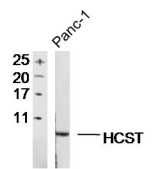
Fig1: Sample: Panc-1 Cell (Human) Lysate at 30 ug Primary: Anti- HCST (ER1910-39)at 1/300 dilution Secondary: IRDye800CW Goat Anti-Rabbit IgG at 1/20000 dilution Predicted band size: 8kD Observed band size: 8kD| Product Name | HCST |
|---|---|
| Antibody Type | Primary Antibodies |
| Antigen Alias | DAP10 DNAX activation protein 10 Hematopoietic cell signal transducer KAP10 Membrane protein DAP10 phosphoinositide 3 kinase adaptor protein PIK3AP Transmembrane adapter protein KAP10 HCST_HUMAN. |
| Product description | Transmembrane adapter protein which associates with NKG2D to form an activation receptor NKG2D-HCST in lymphoid and myeloid cells; this receptor plays a major role in triggering cytotoxicity against target cells expressing cell surface ligands such as MHC class I chain-related MICA and MICB, and UL16-binding proteins (ULBPs); these ligands are up-regulated by stress conditions and pathological state such as viral infection and tumor transformation. Functions as docking site for PI3-kinase PIK3R1 and GRB2. Interaction of ULBPs with NKG2D-DAP10 triggers calcium mobilization and activation of the PIK3R1, MAP2K/ERK, and JAK2/STAT5 signaling pathways. Both PIK3R1 and GRB2 are required for full NKG2D-HCST-mediated activation and ultimate killing of target cells. In NK cells, NKG2D-HCST signaling directly induces cytotoxicity and enhances cytokine production initiated via DAP12/TYROBP-associated receptors. In T-cells, it provides primarily costimulation for TCR-induced signals. NKG2D-HCST receptor plays a role in immune surveillance against tumors and is required for cytolysis of tumors cells; indeed, melanoma cells that do not express NKG2D ligands escape from immune surveillance mediated by NK cells. |
| Immunogen | KLH conjugated synthetic peptide derived from human HCST 19-48/93 |
| Clonality | Polyclonal |
|---|---|
| Isotype | IgG |
| Host Species | Rabbit |
| Tested Applications | WB |
| WB:1:500-2000: |
|
| Species Reactivity | HumanRat |
| Concentration | 1mg/ml |
| Alternative Names | DAP10 DNAX activation protein 10 Hematopoietic cell signal transducer KAP10 Membrane protein DAP10 phosphoinositide 3 kinase adaptor protein PIK3AP Transmembrane adapter protein KAP10 HCST_HUMAN. |
|---|---|
| Molecular Weight(MW) | 8 KDa |
| Cellular Localization | Membrane; Single-pass type I membrane protein. |
| SwissProt ID | Q9UBK5 |
|---|
Application
Fig1: Sample: Panc-1 Cell (Human) Lysate at 30 ug Primary: Anti- HCST (ER1910-39)at 1/300 dilution Secondary: IRDye800CW Goat Anti-Rabbit IgG at 1/20000 dilution Predicted band size: 8kD Observed band size: 8kD| Positive Control | Predominantly expressed in hemopoietic cells such as NK cells, subset of T-cells and monocytes. Detected in leukocytes, spleen, and thymus. |
|---|---|
| Application Notes | WB:1:500-2000: |
| Form | Liquid |
|---|---|
| Storage Instructions | Store at -20℃ for one year. Avoid repeated freeze/thaw cycles. The lyophilized antibody is stable at room temperature for at least one month and for greater than a year when kept at -20℃. When reconstituted in sterile pH 7.4 0.01M PBS or diluent of antibody the antibody is stable for at least two weeks at 2-4℃. |
| Storage Buffer | 0.01M TBS(pH7.4) with 1% BSA, 0.03% Proclin300 and 50% Glycerol. |


