Application
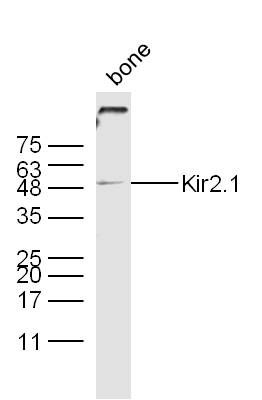
Fig1: Sample: Bone (Mouse) Lysate at 40 ug Primary: Anti-Kir2.1 (Bs- 17067R) at 1/300 dilution Secondary: IRDye800CW Goat Anti-Rabbit IgG at 1/20000 dilution Predicted band size: 48 kD Observed band size: 48 kDApplication
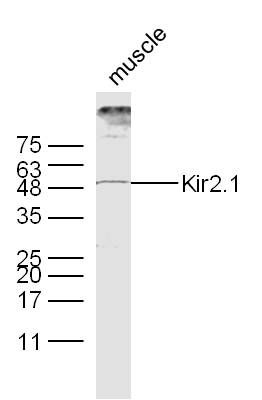
Fig2: Sample: Muscle (Mouse) Lysate at 40 ug Primary: Anti-Kir2.1 (Bs- 17067R) at 1/300 dilution Secondary: IRDye800CW Goat Anti-Rabbit IgG at 1/20000 dilution Predicted band size: 48 kD Observed band size: 48 kDApplication
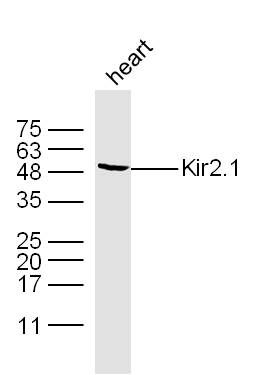
Fig3: Sample: heart (Mouse) Lysate at 40 ug Primary: Anti-Kir2.1(ER1911-91) at 1/300 dilution Secondary: IRDye800CW Goat Anti-Rabbit IgG at 1/20000 dilution Predicted band size: 48 kD Observed band size: 48 kDApplication
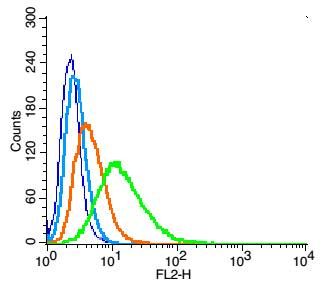
Fig4: Blank control(blue): RSC96(fixed with 2% paraformaldehyde (10 min)). Primary Antibody:Rabbit Anti- Kir2.1 antibody(ER1911-91), Dilution: 0.2μg in 100 μL 1X PBS containing 0.5% BSA; Isotype Control Antibody: Rabbit IgG(orange) ,used under the same conditions ); Secondary Antibody: Goat anti-rabbit IgG-PE(white blue), Dilution: 1:200 in 1 X PBS containing 0.5% BSA.| Product Name | Kir2.1 |
|---|---|
| Antibody Type | Primary Antibodies |
| Antigen Alias | Cardiac inward rectifier potassium channel HHBIRK 1 HHBIRK1 HHIRK1 HIRK 1 hIRK1 Inward rectifier K inwardly rectifying subfamily J member 2 IRK 1 IRK2_HUMAN IRK1 KCNJ2 KIR2.1 LQT7 Potassium channel Potassium channel inwardly rectifying subfamily J member 2 Potassium inwardly rectifying channel J2 Potassium inwardly rectifying channel subfamily J member 2 SQT 3 SQT3. |
| Product description | Probably participates in establishing action potential waveform and excitability of neuronal and muscle tissues. Inward rectifier potassium channels are characterized by a greater tendency to allow potassium to flow into the cell rather than out of it. Their voltage dependence is regulated by the concentration of extracellular potassium; as external potassium is raised, the voltage range of the channel opening shifts to more positive voltages. The inward rectification is mainly due to the blockage of outward current by internal magnesium. Can be blocked by extracellular barium or cesium. |
| Immunogen | KLH conjugated synthetic peptide derived from human Kir2.1 31-130/427 |
| Clonality | Polyclonal |
|---|---|
| Isotype | IgG |
| Host Species | Rabbit |
| Tested Applications | WBFC |
| WB:1:500-2000: FC:1μg/Test: |
|
| Species Reactivity | HumanMouseRatChickenDogPigCowHorseRabbitSheep |
| Concentration | 1mg/ml |
| Alternative Names | Cardiac inward rectifier potassium channel HHBIRK 1 HHBIRK1 HHIRK1 HIRK 1 hIRK1 Inward rectifier K inwardly rectifying subfamily J member 2 IRK 1 IRK2_HUMAN IRK1 KCNJ2 KIR2.1 LQT7 Potassium channel Potassium channel inwardly rectifying subfamily J member 2 Potassium inwardly rectifying channel J2 Potassium inwardly rectifying channel subfamily J member 2 SQT 3 SQT3. |
|---|---|
| Molecular Weight(MW) | 48 KDa |
| Cellular Localization | Membrane. |
| SwissProt ID | P63252 |
|---|
Application
Fig1: Sample: Bone (Mouse) Lysate at 40 ug Primary: Anti-Kir2.1 (Bs- 17067R) at 1/300 dilution Secondary: IRDye800CW Goat Anti-Rabbit IgG at 1/20000 dilution Predicted band size: 48 kD Observed band size: 48 kD
Application
Fig2: Sample: Muscle (Mouse) Lysate at 40 ug Primary: Anti-Kir2.1 (Bs- 17067R) at 1/300 dilution Secondary: IRDye800CW Goat Anti-Rabbit IgG at 1/20000 dilution Predicted band size: 48 kD Observed band size: 48 kD
Application
Fig3: Sample: heart (Mouse) Lysate at 40 ug Primary: Anti-Kir2.1(ER1911-91) at 1/300 dilution Secondary: IRDye800CW Goat Anti-Rabbit IgG at 1/20000 dilution Predicted band size: 48 kD Observed band size: 48 kD
Application
Fig4: Blank control(blue): RSC96(fixed with 2% paraformaldehyde (10 min)). Primary Antibody:Rabbit Anti- Kir2.1 antibody(ER1911-91), Dilution: 0.2μg in 100 μL 1X PBS containing 0.5% BSA; Isotype Control Antibody: Rabbit IgG(orange) ,used under the same conditions ); Secondary Antibody: Goat anti-rabbit IgG-PE(white blue), Dilution: 1:200 in 1 X PBS containing 0.5% BSA.| Positive Control | Heart, brain, placenta, lung, skeletal muscle, and kidney. Diffusely distributed throughout the brain. |
|---|---|
| Application Notes | WB:1:500-2000: FC:1μg/Test: |
| Form | Liquid |
|---|---|
| Storage Instructions | Store at -20℃ for one year. Avoid repeated freeze/thaw cycles. The lyophilized antibody is stable at room temperature for at least one month and for greater than a year when kept at -20℃. When reconstituted in sterile pH 7.4 0.01M PBS or diluent of antibody the antibody is stable for at least two weeks at 2-4℃. |
| Storage Buffer | 0.01M TBS(pH7.4) with 1% BSA, 0.03% Proclin300 and 50% Glycerol. |


