Application
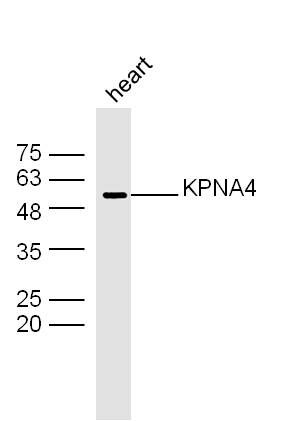
Fig1: Sample: heart (mouse) Lysate at 40 ug Primary: Anti-KPNA4(ER1912-10) at 1/300 dilution Secondary: IRDye800CW Goat Anti-Rabbit IgG at 1/20000 dilution Predicted band size: 57 kD Observed band size: 57 kD| Product Name | KPNA4 |
|---|---|
| Antibody Type | Primary Antibodies |
| Antigen Alias | FLJ31113 IMA4_HUMAN Importin alpha 3 Importin alpha 4 subunit Importin alpha Q1 Importin subunit alpha 3 Importin subunit alpha-4 IPO A3 IPOA 3 IPOA3 Karyopherin alpha 4 (importin alpha 3) Karyopherin alpha 4 Karyopherin alpha 4 importin alpha 3 Karyopherin alpha 4 subunit Karyopherin subunit alpha 4 Karyopherin subunit alpha-4 KPNA 4 Kpna4 MGC12217 MGC26703 OTTHUMP00000213880 QIP 1 Qip1 Qip1 protein SRP 3 SRP3. |
| Product description | Functions in nuclear protein import as an adapter protein for nuclear receptor KPNB1. Binds specifically and directly to substrates containing either a simple or bipartite NLS motif. Docking of the importin/substrate complex to the nuclear pore complex (NPC) is mediated by KPNB1 through binding to nucleoporin FxFG repeats and the complex is subsequently translocated through the pore by an energy requiring, Ran-dependent mechanism. At the nucleoplasmic side of the NPC, Ran binds to importin-beta and the three components separate and importin-alpha and -beta are re-exported from the nucleus to the cytoplasm where GTP hydrolysis releases Ran from importin. The directionality of nuclear import is thought to be conferred by an asymmetric distribution of the GTP- and GDP-bound forms of Ran between the cytoplasm and nucleus. In vitro, mediates the nuclear import of human cytomegalovirus UL84 by recognizing a non-classical NLS. In vitro, mediates the nuclear import of human cytomegalovirus UL84 by recognizing a nonclassical NLS. |
| Immunogen | KLH conjugated synthetic peptide derived from human KPNA4 1-100/521 |
| Clonality | Polyclonal |
|---|---|
| Isotype | IgG |
| Host Species | Rabbit |
| Tested Applications | WB |
| WB:1:500-2000: |
|
| Species Reactivity | HumanMouseRatChickenCowHorse |
| Concentration | 1mg/ml |
| Alternative Names | FLJ31113 IMA4_HUMAN Importin alpha 3 Importin alpha 4 subunit Importin alpha Q1 Importin subunit alpha 3 Importin subunit alpha-4 IPO A3 IPOA 3 IPOA3 Karyopherin alpha 4 (importin alpha 3) Karyopherin alpha 4 Karyopherin alpha 4 importin alpha 3 Karyopherin alpha 4 subunit Karyopherin subunit alpha 4 Karyopherin subunit alpha-4 KPNA 4 Kpna4 MGC12217 MGC26703 OTTHUMP00000213880 QIP 1 Qip1 Qip1 protein SRP 3 SRP3. |
|---|---|
| Molecular Weight(MW) | 57 KDa |
| Cellular Localization | Cytoplasm. Nucleus. |
| SwissProt ID | O00629 |
|---|
Application
Fig1: Sample: heart (mouse) Lysate at 40 ug Primary: Anti-KPNA4(ER1912-10) at 1/300 dilution Secondary: IRDye800CW Goat Anti-Rabbit IgG at 1/20000 dilution Predicted band size: 57 kD Observed band size: 57 kD| Positive Control | Highly expressed in testis, ovary, small intestine, heart, skeletal muscle, lung and pancreas, but barely detectable in kidney, thymus, colon and peripheral blood leukocytes. |
|---|---|
| Application Notes | WB:1:500-2000: |
| Form | Liquid |
|---|---|
| Storage Instructions | Store at -20℃ for one year. Avoid repeated freeze/thaw cycles. The lyophilized antibody is stable at room temperature for at least one month and for greater than a year when kept at -20℃. When reconstituted in sterile pH 7.4 0.01M PBS or diluent of antibody the antibody is stable for at least two weeks at 2-4℃. |
| Storage Buffer | 0.01M TBS(pH7.4) with 1% BSA, 0.03% Proclin300 and 50% Glycerol. |


