Application
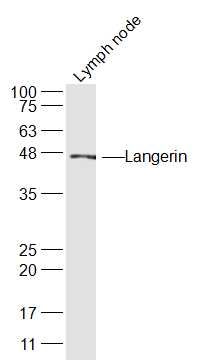
Fig1: Sample: Lymph node (Mouse) Lysate at 40 ug Primary: Anti-Langerin (ER1912-20) at 1/300 dilution Secondary: IRDye800CW Goat Anti-Rabbit IgG at 1/20000 dilution Predicted band size: 37 kD Observed band size: 47 kD| Product Name | Langerin |
|---|---|
| Antibody Type | Primary Antibodies |
| Antigen Alias | C-type lectin domain family 4 member K CD207 antigen, langerin C type lectin domain family 4 member K CD 207 CD207 CD207 antigen CD207 molecule CLEC 4K CLEC4K Langerhans cell specific c type lectin RGD1565913 CLC4K_HUMAN. |
| Product description | Calcium-dependent lectin displaying mannose-binding specificity. Induces the formation of Birbeck granules (BGs); is a potent regulator of membrane superimposition and zippering. Binds to sulfated as well as mannosylated glycans, keratan sulfate (KS) and beta-glucans. Facilitates uptake of antigens and is involved in the routing and/or processing of antigen for presentation to T cells. Major receptor on primary Langerhans cells for Candida species, Saccharomyces species, and Malassezia furfur. Protects against human immunodeficiency virus-1 (HIV-1) infection. Binds to high-mannose structures present on the envelope glycoprotein which is followed by subsequent targeting of the virus to the Birbeck granules leading to its rapid degradation. |
| Immunogen | KLH conjugated synthetic peptide derived from human CD207 161-260/328 |
| Clonality | Polyclonal |
|---|---|
| Isotype | IgG |
| Host Species | Rabbit |
| Tested Applications | WB |
| WB:1:500-2000: |
|
| Species Reactivity | HumanMouseRat |
| Concentration | 1mg/ml |
| Alternative Names | C-type lectin domain family 4 member K
CD207 antigen langerin C type lectin domain family 4 member K CD 207 CD207 CD207 antigen CD207 molecule CLEC 4K CLEC4K Langerhans cell specific c type lectin RGD1565913 CLC4K_HUMAN. |
|---|---|
| Molecular Weight(MW) | 37 KDa |
| Cellular Localization | Membrane; Single-pass type II membrane protein. Note=Found in Birbeck granules (BGs), which are organelles consisting of superimposed and zippered membranes. |
| SwissProt ID | Q9UJ71 |
|---|
Application
Fig1: Sample: Lymph node (Mouse) Lysate at 40 ug Primary: Anti-Langerin (ER1912-20) at 1/300 dilution Secondary: IRDye800CW Goat Anti-Rabbit IgG at 1/20000 dilution Predicted band size: 37 kD Observed band size: 47 kD| Positive Control | Exclusively expressed by Langerhans cells. Expressed in astrocytoma and malignant ependymoma, but not in normal brain tissues. |
|---|---|
| Application Notes | WB:1:500-2000: |
| Form | Liquid |
|---|---|
| Storage Instructions | Store at -20℃ for one year. Avoid repeated freeze/thaw cycles. The lyophilized antibody is stable at room temperature for at least one month and for greater than a year when kept at -20℃. When reconstituted in sterile pH 7.4 0.01M PBS or diluent of antibody the antibody is stable for at least two weeks at 2-4℃. |
| Storage Buffer | 0.01M TBS(pH7.4) with 1% BSA, 0.03% Proclin300 and 50% Glycerol. |


