Application
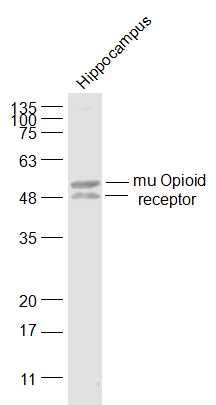
Fig1: Sample: Hippocampus (Mouse) Lysate at 40 ug Primary: Anti-mu Opioid receptor (ER1913-36) at 1/500 dilution Secondary: IRDye800CW Goat Anti-Rabbit IgG at 1/20000 dilution Predicted band size: 45 kD Observed band size: 45/53 kDApplication
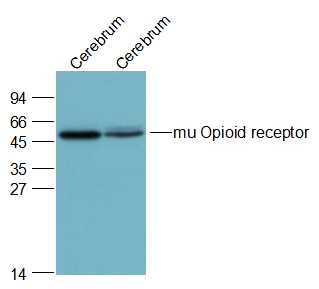
Fig2: Sample: Cerebrum (Mouse) Lysate at 40 ug Cerebrum (Rat) Lysate at 40 ug Primary: Anti-mu Opioid receptor (ER1913-36) at 1/1000 dilution Secondary: IRDye800CW Goat Anti-Rabbit IgG at 1/20000 dilution Predicted band size: 45 kD Observed band size: 47 kDApplication
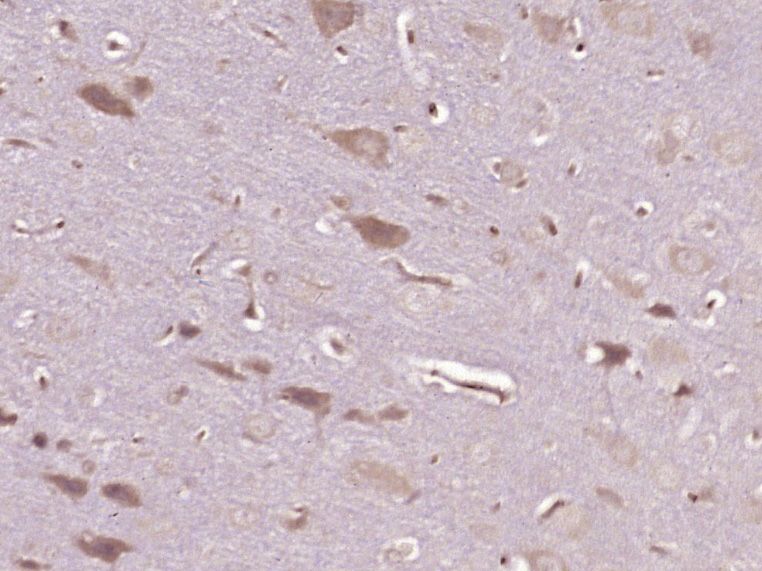
Fig3: Paraformaldehyde-fixed, paraffin embedded (Rat brain); Antigen retrieval by boiling in sodium citrate buffer (pH6.0) for 15min; Block endogenous peroxidase by 3% hydrogen peroxide for 20 minutes; Blocking buffer (normal goat serum) at 37℃ for 30min; Antibody incubation with (mu Opioid receptor) Polyclonal Antibody, Unconjugated (ER1913-36) at 1:400 overnight at 4℃, followed by operating according to SP Kit(Rabbit) (sp-0023) instructions and DAB staining.Application
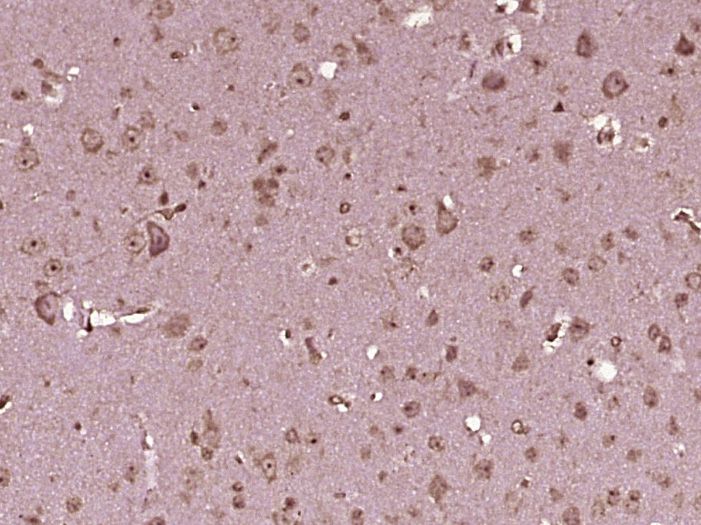
Fig4: Paraformaldehyde-fixed, paraffin embedded (Mouse brain); Antigen retrieval by boiling in sodium citrate buffer (pH6.0) for 15min; Block endogenous peroxidase by 3% hydrogen peroxide for 20 minutes; Blocking buffer (normal goat serum) at 37℃ for 30min; Antibody incubation with (mu Opioid receptor) Polyclonal Antibody, Unconjugated (ER1913-36) at 1:400 overnight at 4℃, followed by operating according to SP Kit(Rabbit) (sp-0023) instructions and DAB staining.Application
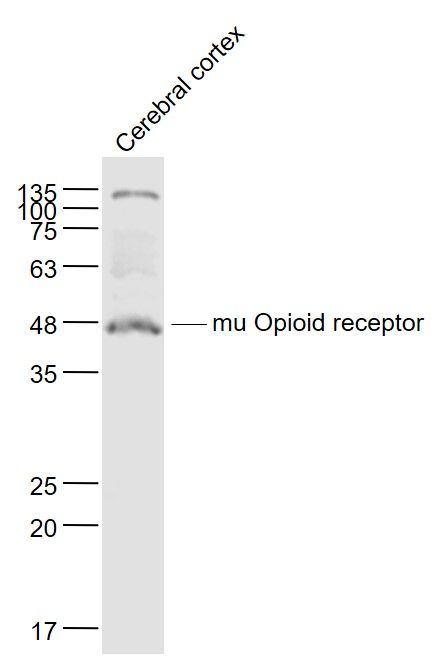
Fig5: Sample: Cerebral cortex (Mouse) Lysate at 40 ug Primary: Anti- mu Opioid receptor (ER1913-36) at 1/500 dilution Secondary: IRDye800CW Goat Anti-Rabbit IgG at 1/20000 dilution Predicted band size: 45 kD Observed band size: 47 kD| Product Name | mu Opioid receptor |
|---|---|
| Antibody Type | Primary Antibodies |
| Antigen Alias | LMOR MOR 1 mor MOR1 Mu opiate receptor mu type opioid receptor Mu type opioid receptor MOR 1 muOR Opioid receptor mu 1 Opioid receptor mu OPRM OPRM1 OPRM_HUMAN. |
| Product description | Receptor for endogenous opioids such as beta-endorphin and endomorphin. Agonist binding to the receptor induces coupling to an inactive GDP-bound heterotrimeric G-protein complex and subsequent exchange of GDP for GTP in the G-protein alpha subunit leading to dissociation of the G-protein complex with the free GTP-bound G-protein alpha and the G-protein beta-gamma dimer activating downstream cellular effectors. The agonist- and cell type-specific activity is predominantly coupled to pertussis toxin-sensitive G(i) and G(o) G alpha proteins, GNAI1, GNAI2, GNAI3 and GNAO1 isoforms Alpha-1 and Alpha-2, and to a lesser extend to pertussis toxin-insensitive G alpha proteins GNAZ and GNA15. They mediate an array of downstream cellular responses, including inhibition of adenylate cyclase activity and both N-type and L-type calcium channels, activation of inward rectifying potassium channels, mitogen-activated protein kinase (MAPK), phospholipase C (PLC), phosphoinositide/protein kinase (PKC), phosphoinositide 3-kinase (PI3K) and regulation of NF-kappa-B. Also couples to adenylate cyclase stimulatory G alpha proteins. The selective temporal coupling to G-proteins and subsequent signaling can be regulated by RGSZ proteins, such as RGS9, RGS17 and RGS4. Phosphorylation by members of the GPRK subfamily of Ser/Thr protein kinases and association with beta-arrestins is involved in short-term receptor desensitization. Beta-arrestins associate with the GPRK-phosphorylated receptor and uncouple it from the G-protein thus terminating signal transduction. The phosphorylated receptor is internalized through endocytosis via clathrin-coated pits which involves beta-arrestins. The activation of the ERK pathway occurs either in a G-protein-dependent or a beta-arrestin-dependent manner and is regulated by agonist-specific receptor phosphorylation. Acts as a class A G-protein coupled receptor (GPCR) which dissociates from beta-arrestin at or near the plasma membrane and undergoes rapid recycling. Receptor down-regulation pathways are varying with the agonist and occur dependent or independent of G-protein coupling. Endogenous ligands induce rapid desensitization, endocytosis and recycling. Heterooligomerization with other GPCRs can modulate agonist binding, signaling and trafficking properties. Involved in neurogenesis. |
| Immunogen | KLH conjugated synthetic peptide derived from human mu Opioid receptor 165-270/400 |
| Clonality | Polyclonal |
|---|---|
| Isotype | IgG |
| Host Species | Rabbit |
| Tested Applications | WBIHC-P |
| WB:1:500-2000: IHC-P:1:400-800: |
|
| Species Reactivity | HumanMouseRatDogPigCowRabbitGuinea Pig |
| Concentration | 1mg/ml |
| Alternative Names | LMOR MOR 1 mor MOR1 Mu opiate receptor mu type opioid receptor Mu type opioid receptor MOR 1 muOR Opioid receptor mu 1 Opioid receptor mu OPRM OPRM1 OPRM_HUMAN. |
|---|---|
| Molecular Weight(MW) | 45 KDa |
| Cellular Localization | Cell membrane; Multi-pass membrane protein. ;Isoform 12: Cytoplasm. |
| SwissProt ID | P35372 |
|---|
Application
Fig1: Sample: Hippocampus (Mouse) Lysate at 40 ug Primary: Anti-mu Opioid receptor (ER1913-36) at 1/500 dilution Secondary: IRDye800CW Goat Anti-Rabbit IgG at 1/20000 dilution Predicted band size: 45 kD Observed band size: 45/53 kD
Application
Fig2: Sample: Cerebrum (Mouse) Lysate at 40 ug Cerebrum (Rat) Lysate at 40 ug Primary: Anti-mu Opioid receptor (ER1913-36) at 1/1000 dilution Secondary: IRDye800CW Goat Anti-Rabbit IgG at 1/20000 dilution Predicted band size: 45 kD Observed band size: 47 kD
Application
Fig3: Paraformaldehyde-fixed, paraffin embedded (Rat brain); Antigen retrieval by boiling in sodium citrate buffer (pH6.0) for 15min; Block endogenous peroxidase by 3% hydrogen peroxide for 20 minutes; Blocking buffer (normal goat serum) at 37℃ for 30min; Antibody incubation with (mu Opioid receptor) Polyclonal Antibody, Unconjugated (ER1913-36) at 1:400 overnight at 4℃, followed by operating according to SP Kit(Rabbit) (sp-0023) instructions and DAB staining.
Application
Fig4: Paraformaldehyde-fixed, paraffin embedded (Mouse brain); Antigen retrieval by boiling in sodium citrate buffer (pH6.0) for 15min; Block endogenous peroxidase by 3% hydrogen peroxide for 20 minutes; Blocking buffer (normal goat serum) at 37℃ for 30min; Antibody incubation with (mu Opioid receptor) Polyclonal Antibody, Unconjugated (ER1913-36) at 1:400 overnight at 4℃, followed by operating according to SP Kit(Rabbit) (sp-0023) instructions and DAB staining.
Application
Fig5: Sample: Cerebral cortex (Mouse) Lysate at 40 ug Primary: Anti- mu Opioid receptor (ER1913-36) at 1/500 dilution Secondary: IRDye800CW Goat Anti-Rabbit IgG at 1/20000 dilution Predicted band size: 45 kD Observed band size: 47 kD| Positive Control | Expressed in brain. Isoform 16 and isoform 17 are detected in brain. |
|---|---|
| Application Notes | WB:1:500-2000: IHC-P:1:400-800: |
| Form | Liquid |
|---|---|
| Storage Instructions | Store at -20℃ for one year. Avoid repeated freeze/thaw cycles. The lyophilized antibody is stable at room temperature for at least one month and for greater than a year when kept at -20℃. When reconstituted in sterile pH 7.4 0.01M PBS or diluent of antibody the antibody is stable for at least two weeks at 2-4℃. |
| Storage Buffer | 0.01M TBS(pH7.4) with 1% BSA, 0.03% Proclin300 and 50% Glycerol. |


