Application
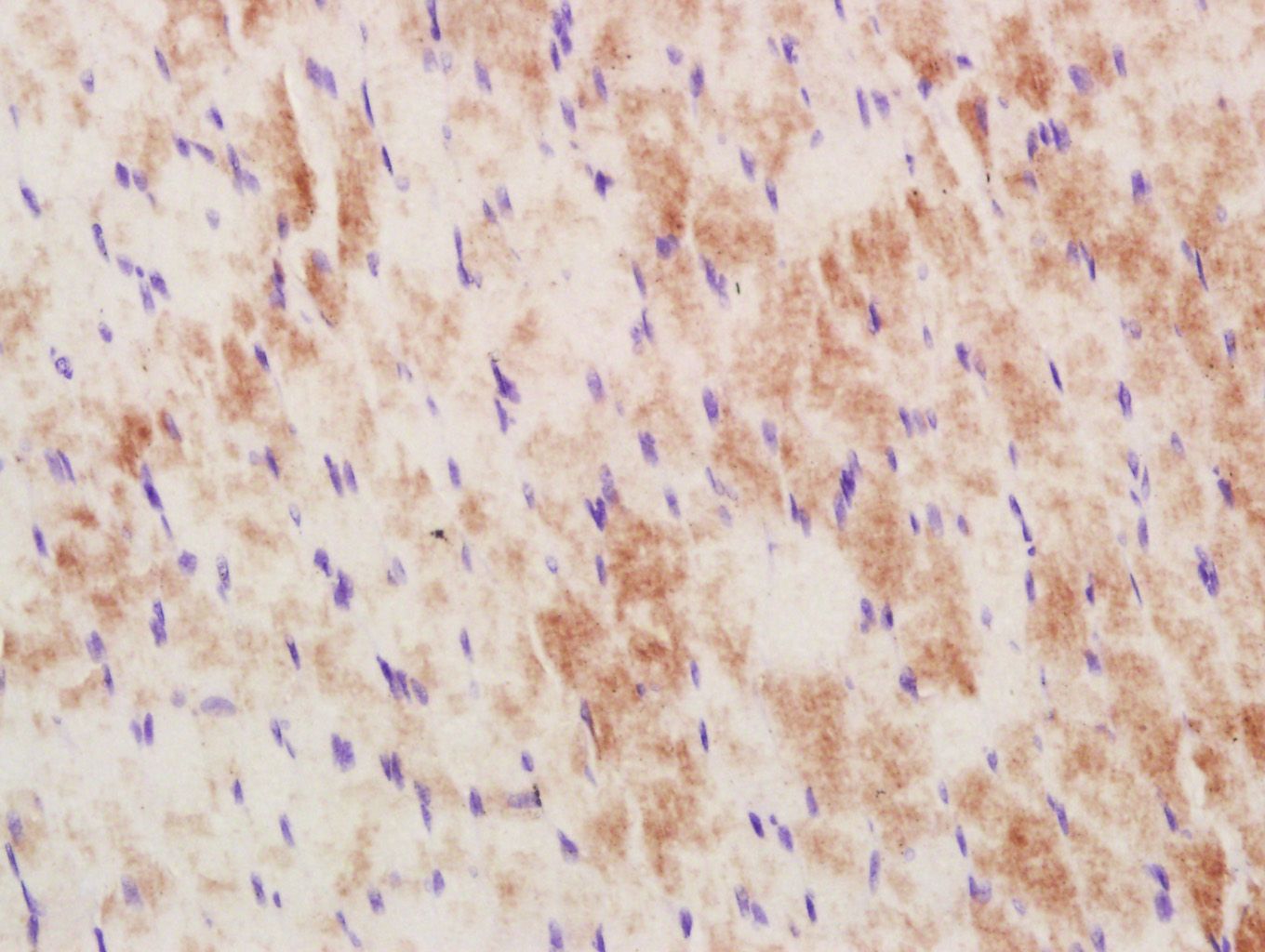
Fig1: Paraformaldehyde-fixed, paraffin embedded (Rat skeletal muscle); Antigen retrieval by boiling in sodium citrate buffer (pH6.0) for 15min; Block endogenous peroxidase by 3% hydrogen peroxide for 20 minutes; Blocking buffer (normal goat serum) at 37℃ for 30min; Antibody incubation with (MUL1) Polyclonal Antibody, Unconjugated (ER1913-38) at 1:400 overnight at 4℃, followed by a conjugated secondary antibody (sp-0023) for 20 minutes and DAB staining.Application
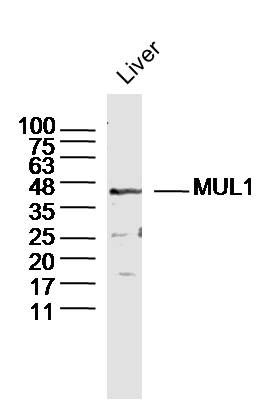
Fig2: Sample: Liver (Mouse) Lysate at 40 ug Primary: Anti-MUL1 (ER1913-38)at 1/300 dilution Secondary: IRDye800CW Goat Anti-Rabbit IgG at 1/20000 dilution Predicted band size: 40kD Observed band size: 40kDApplication
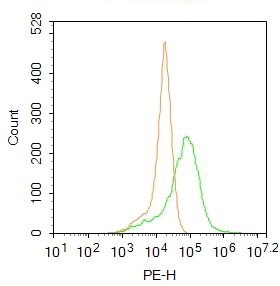
Fig3: Blank control: A549. Primary Antibody (green line): Rabbit Anti-MUL1 antibody (ER1913-38) Dilution: 1μg /10^6 cells; Isotype Control Antibody (orange line): Rabbit IgG . Secondary Antibody : Goat anti-rabbit IgG-PE Dilution: 1μg /test. Protocol The cells were fixed with 4% PFA (10min at room temperature)and then permeabilized with PBST for 20 min at room temperature. The cells were then incubated in 5%BSA to block non-specific protein-protein interactions for 30 min at room temperature .Cells stained with Primary Antibody for 30 min at room temperature. The secondary antibody used for 40 min at room temperature. Acquisition of 20,000 events was performed.| Product Name | MUL1 |
|---|---|
| Antibody Type | Primary Antibodies |
| Antigen Alias | E3 ubiquitin-protein ligase MUL1 C1orf166 E3 ubiquitin ligase E3 ubiquitin protein ligase MUL1 GIDE Growth inhibition and death E3 ligase MAPL Mitochondrial anchored protein ligase Mitochondrial ubiquitin ligase activator of NFKB 1 MUL1 MULAN Putative NF kappa B activating protein 266 RING finger protein 218 RNF218 RP23-25C1.10-002 MUL1_HUMAN. |
| Product description | Exhibits weak E3 ubiquitin-protein ligase activity, but preferentially acts as a SUMO E3 ligase at physiological concentrations. Plays a role in the control of mitochondrial morphology. Promotes mitochondrial fragmentation and influences mitochondrial localization. Inhibits cell growth. When overexpressed, activates JNK through MAP3K7/TAK1 and induces caspase-dependent apoptosis. E3 ubiquitin ligases accept ubiquitin from an E2 ubiquitin-conjugating enzyme in the form of a thioester and then directly transfer the ubiquitin to targeted substrates. |
| Immunogen | KLH conjugated synthetic peptide derived from human MUL1/RNF218 1-100/352 |
| Clonality | Polyclonal |
|---|---|
| Isotype | IgG |
| Host Species | Rabbit |
| Tested Applications | WBIHC-PICC/IFFC |
| WB:1:500-2000: IHC-P:1:400-800: FC:1ug/test: IF:1:50-200: |
|
| Species Reactivity | HumanMouseRatDogPigCowRabbit |
| Concentration | 1mg/ml |
| Alternative Names | E3 ubiquitin-protein ligase MUL1 C1orf166 E3 ubiquitin ligase E3 ubiquitin protein ligase MUL1 GIDE Growth inhibition and death E3 ligase MAPL Mitochondrial anchored protein ligase Mitochondrial ubiquitin ligase activator of NFKB 1 MUL1 MULAN Putative NF kappa B activating protein 266 RING finger protein 218 RNF218 RP23-25C1.10-002 MUL1_HUMAN. |
|---|---|
| Molecular Weight(MW) | 40 KDa |
| Cellular Localization | Mitochondrion outer membrane; Multi-pass membrane protein. Peroxisome. Note: Transported in mitochondrion-derived vesicles from the mitochondrion to the peroxisome. |
| SwissProt ID | Q969V5 |
|---|
Application
Fig1: Paraformaldehyde-fixed, paraffin embedded (Rat skeletal muscle); Antigen retrieval by boiling in sodium citrate buffer (pH6.0) for 15min; Block endogenous peroxidase by 3% hydrogen peroxide for 20 minutes; Blocking buffer (normal goat serum) at 37℃ for 30min; Antibody incubation with (MUL1) Polyclonal Antibody, Unconjugated (ER1913-38) at 1:400 overnight at 4℃, followed by a conjugated secondary antibody (sp-0023) for 20 minutes and DAB staining.
Application
Fig2: Sample: Liver (Mouse) Lysate at 40 ug Primary: Anti-MUL1 (ER1913-38)at 1/300 dilution Secondary: IRDye800CW Goat Anti-Rabbit IgG at 1/20000 dilution Predicted band size: 40kD Observed band size: 40kD
Application
Fig3: Blank control: A549. Primary Antibody (green line): Rabbit Anti-MUL1 antibody (ER1913-38) Dilution: 1μg /10^6 cells; Isotype Control Antibody (orange line): Rabbit IgG . Secondary Antibody : Goat anti-rabbit IgG-PE Dilution: 1μg /test. Protocol The cells were fixed with 4% PFA (10min at room temperature)and then permeabilized with PBST for 20 min at room temperature. The cells were then incubated in 5%BSA to block non-specific protein-protein interactions for 30 min at room temperature .Cells stained with Primary Antibody for 30 min at room temperature. The secondary antibody used for 40 min at room temperature. Acquisition of 20,000 events was performed.| Positive Control | Widely expressed with highest levels in the heart, skeletal muscle, placenta, kidney and liver. Barely detectable in colon and thymus. |
|---|---|
| Application Notes | WB:1:500-2000: IHC-P:1:400-800: FC:1ug/test: IF:1:50-200: |
| Form | Liquid |
|---|---|
| Storage Instructions | Store at -20℃ for one year. Avoid repeated freeze/thaw cycles. The lyophilized antibody is stable at room temperature for at least one month and for greater than a year when kept at -20℃. When reconstituted in sterile pH 7.4 0.01M PBS or diluent of antibody the antibody is stable for at least two weeks at 2-4℃. |
| Storage Buffer | 0.01M TBS(pH7.4) with 1% BSA, 0.03% Proclin300 and 50% Glycerol. |


