Application
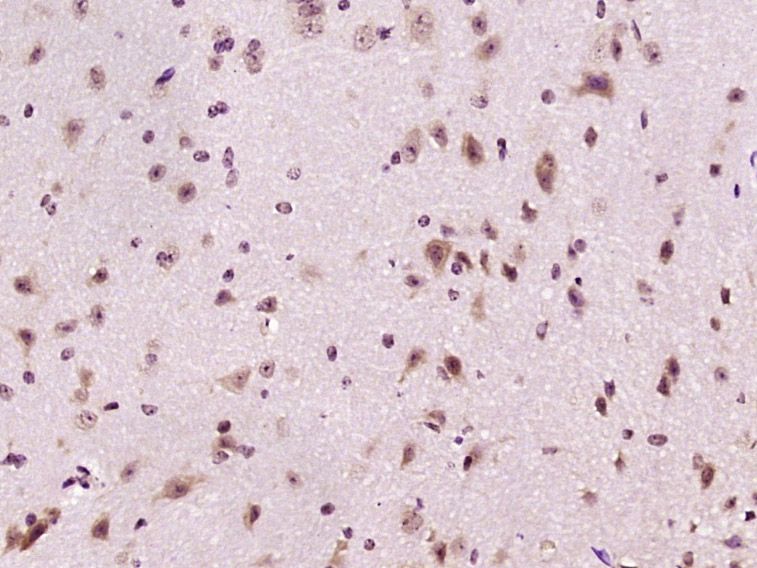
Fig1: Paraformaldehyde-fixed, paraffin embedded (mouse brain tissue); Antigen retrieval by boiling in sodium citrate buffer (pH6.0) for 15min; Block endogenous peroxidase by 3% hydrogen peroxide for 20 minutes; Blocking buffer (normal goat serum) at 37℃ for 30min; Antibody incubation with (MVD) Polyclonal Antibody, Unconjugated (ER1913-40) at 1:400 overnight at 4℃, followed by operating according to SP Kit(Rabbit) (sp-0023) instructionsand DAB staining.Application
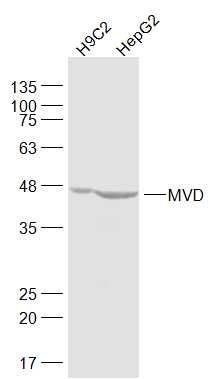
Fig2: Sample: H9C2(Rat) Cell Lysate at 30 ug HepG2(Human) Cell Lysate at 30 ug Primary: Anti-MVD (ER1913-40) at 1/1000 dilution Secondary: IRDye800CW Goat Anti-Rabbit IgG at 1/20000 dilution Predicted band size: 43 kD Observed band size: 43 kD| Product Name | MVD |
|---|---|
| Antibody Type | Primary Antibodies |
| Antigen Alias | Diphosphomevalonate decarboxylase FP17780 MDDase Mevalonate (diphospho) decarboxylase Mevalonate (diphospho)decarboxylase Mevalonate pyrophosphate decarboxylase MPD Mvd MVD1_HUMAN. |
| Product description | Diphosphomevalonate decarboxylase (EC 4.1.1.33), most commonly referred to in scientific literature as mevalonate diphosphate decarboxylase, is an enzyme that catalyzes the chemical reaction. This enzyme converts mevalonate 5-diphosphate (MVAPP) to isopentenyl diphosphate (IPP) through ATP dependent decarboxylation. The two substrates of this enzyme are ATP and mevalonate 5-diphosphate, whereas its 4 products are ADP, phosphate, isopentenyl diphosphate, and CO2. Mevalonate diphosphate decarboxylase catalyzes the final step in the mevalonate pathway. The mevalonate pathway is responsible for the biosynthesis of isoprenoids from acetate. This pathway plays a key role in multiple cellular processes by synthesizing sterol isoprenoids, such as cholesterol, and non-sterol isoprenoids, such as dolichol, heme A, tRNA isopentenyltransferase, and ubiquinone. |
| Immunogen | KLH conjugated synthetic peptide derived from human MVD 201-300/400 |
| Clonality | Polyclonal |
|---|---|
| Isotype | IgG |
| Host Species | Rabbit |
| Tested Applications | WBIHC-P |
| WB:1:500-2000: IHC-P:1:400-800: |
|
| Species Reactivity | HumanMouseRatDogCowHorseRabbit |
| Concentration | 1mg/ml |
| Alternative Names | Diphosphomevalonate decarboxylase
FP17780
MDDase Mevalonate (diphospho) decarboxylase Mevalonate (diphospho)decarboxylase Mevalonate pyrophosphate decarboxylase MPD Mvd MVD1_HUMAN. |
|---|---|
| Molecular Weight(MW) | 43 KDa |
| Cellular Localization | Cytosol. |
| SwissProt ID | P53602 |
|---|
Application
Fig1: Paraformaldehyde-fixed, paraffin embedded (mouse brain tissue); Antigen retrieval by boiling in sodium citrate buffer (pH6.0) for 15min; Block endogenous peroxidase by 3% hydrogen peroxide for 20 minutes; Blocking buffer (normal goat serum) at 37℃ for 30min; Antibody incubation with (MVD) Polyclonal Antibody, Unconjugated (ER1913-40) at 1:400 overnight at 4℃, followed by operating according to SP Kit(Rabbit) (sp-0023) instructionsand DAB staining.
Application
Fig2: Sample: H9C2(Rat) Cell Lysate at 30 ug HepG2(Human) Cell Lysate at 30 ug Primary: Anti-MVD (ER1913-40) at 1/1000 dilution Secondary: IRDye800CW Goat Anti-Rabbit IgG at 1/20000 dilution Predicted band size: 43 kD Observed band size: 43 kD| Positive Control | Expressed in heart, skeletal muscle, lung,liver, brain, pancreas, kidney and placenta. |
|---|---|
| Application Notes | WB:1:500-2000: IHC-P:1:400-800: |
| Form | Liquid |
|---|---|
| Storage Instructions | Store at -20℃ for one year. Avoid repeated freeze/thaw cycles. The lyophilized antibody is stable at room temperature for at least one month and for greater than a year when kept at -20℃. When reconstituted in sterile pH 7.4 0.01M PBS or diluent of antibody the antibody is stable for at least two weeks at 2-4℃. |
| Storage Buffer | 0.01M TBS(pH7.4) with 1% BSA, 0.03% Proclin300 and 50% Glycerol. |


