Application
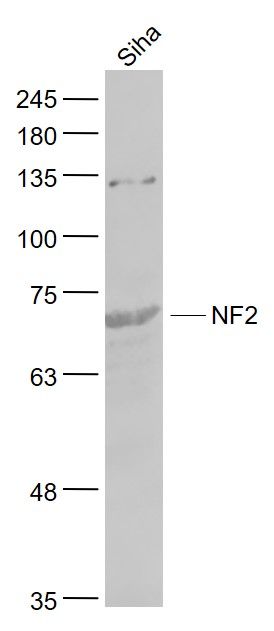
Fig1: Sample: Siha(Human) Cell Lysate at 30 ug Primary: Anti- NF2 (ER1913-78) at 1/1000 dilution Secondary: IRDye800CW Goat Anti-Rabbit IgG at 1/20000 dilution Predicted band size: 70 kD Observed band size: 70 kD| Product Name | NF2 |
|---|---|
| Antibody Type | Primary Antibodies |
| Antigen Alias | neurofibromatosis type 2 CAN BANF bilateral acoustic neuroma moesin ezrin radixin like protein Moesin ezrin radizin like protein merlin Neurofibromatosis 2 ACN Bilateral acoustic neuroma MERL_HUMAN Merlin Moesin ezrin radizin like Moesin-ezrin-radixin-like protein Neurofibromatosis type 2 Neurofibromin-2 NF 2 Nf2 Neurofibromatosis2 Neurofibromin 2 Neurofibromin2 Schwannomerlin NF-2 SCH Schwannomin. |
| Product description | Probable regulator of the Hippo/SWH (Sav/Wts/Hpo) signaling pathway, a signaling pathway that plays a pivotal role in tumor suppression by restricting proliferation and promoting apoptosis. Along with WWC1 can synergistically induce the phosphorylation of LATS1 and LATS2 and can probably function in the regulation of the Hippo/SWH (Sav/Wts/Hpo) signaling pathway. May act as a membrane stabilizing protein. May inhibit PI3 kinase by binding to AGAP2 and impairing its stimulating activity. Suppresses cell proliferation and tumorigenesis by inhibiting the CUL4A-RBX1-DDB1-VprBP/DCAF1 E3 ubiquitin-protein ligase complex. |
| Immunogen | KLH conjugated synthetic peptide derived from human NF2 401-550/590 |
| Clonality | Polyclonal |
|---|---|
| Isotype | IgG |
| Host Species | Rabbit |
| Tested Applications | WB |
| WB:1:500-2000: |
|
| Species Reactivity | HumanMouseRatChickenDogPigCowHorseRabbit |
| Concentration | 1mg/ml |
| Alternative Names | neurofibromatosis type 2 CAN BANF bilateral acoustic neuroma moesin ezrin radixin like protein Moesin ezrin radizin like protein merlin Neurofibromatosis 2 ACN Bilateral acoustic neuroma MERL_HUMAN Merlin Moesin ezrin radizin like Moesin-ezrin-radixin-like protein Neurofibromatosis type 2 Neurofibromin-2 NF 2 Nf2 Neurofibromatosis2 Neurofibromin 2 Neurofibromin2 Schwannomerlin NF-2 SCH Schwannomin. |
|---|---|
| Molecular Weight(MW) | 70 KDa |
| Cellular Localization | Isoform 1: Cell projection, filopodium membrane; Peripheral membrane protein; Cytoplasmic side. Cell projection, ruffle membrane; Peripheral membrane protein; Cytoplasmic side. Nucleus. Note=In a fibroblastic cell line, isoform 1 is found homogeneously distributed over the entire cell, with a particularly strong staining in ruffling membranes and filopodia. Colocalizes with MPP1 in non-myelin-forming Schwann cells. Binds with VPRBP in the nucleus. The intramolecular association of the FERM domain with the C-terminal tail promotes nuclear accumulation. The unphosphorylated form accumulates predominantly in the nucleus while the phosphorylated form is largely confined to the non-nuclear fractions. ;Isoform 7: Cytoplasm, perinuclear region. Cytoplasmic granule. Note=Observed in cytoplasmic granules concentrated in a perinuclear location. Isoform 7 is absent from ruffling membranes and filopodia.;Isoform 9: Cytoplasm, perinuclear region. Cytoplasmic granule. Note=Observed in cytoplasmic granules concentrated in a perinuclear location. Isoform 9 is absent from ruffling membranes and filopodia.;Isoform 10: Nucleus. Cell projection, filopodium membrane; Peripheral membrane protein; Cytoplasmic side. Cell projection, ruffle membrane; Peripheral membrane protein; Cytoplasmic side. Cytoplasm, perinuclear region. Cytoplasmic granule. Cytoplasm, cytoskeleton. Note=In a fibroblastic cell line, isoform 10 is found homogeneously distributed over the entire cell, with a particularly strong staining in ruffling membranes and filopodia. |
| SwissProt ID | P35240 |
|---|
Application
Fig1: Sample: Siha(Human) Cell Lysate at 30 ug Primary: Anti- NF2 (ER1913-78) at 1/1000 dilution Secondary: IRDye800CW Goat Anti-Rabbit IgG at 1/20000 dilution Predicted band size: 70 kD Observed band size: 70 kD| Positive Control | Widely expressed. Isoform 1 and isoform 3 are predominant. Isoform 4, isoform 5 and isoform 6 are expressed moderately. Isoform 8 is found at low frequency. Isoform 7, isoform 9 and isoform 10 are not expressed in adult tissues, with the exception of adult retina expressing isoform 10. Isoform 9 is faintly expressed in fetal brain, heart, lung, skeletal muscle and spleen. Fetal thymus expresses isoforms 1, 7, 9 and 10 at similar levels. |
|---|---|
| Application Notes | WB:1:500-2000: |
| Form | Liquid |
|---|---|
| Storage Instructions | Store at -20℃ for one year. Avoid repeated freeze/thaw cycles. The lyophilized antibody is stable at room temperature for at least one month and for greater than a year when kept at -20℃. When reconstituted in sterile pH 7.4 0.01M PBS or diluent of antibody the antibody is stable for at least two weeks at 2-4℃. |
| Storage Buffer | 0.01M TBS(pH7.4) with 1% BSA, 0.03% Proclin300 and 50% Glycerol. |


