Application
Fig1: Paraformaldehyde-fixed, paraffin embedded (mouse testis); Antigen retrieval by boiling in sodium citrate buffer (pH6.0) for 15min; Block endogenous peroxidase by 3% hydrogen peroxide for 20 minutes; Blocking buffer (normal goat serum) at 37℃ for 30min; Antibody incubation with (Optineurin) Polyclonal Antibody, Unconjugated (bs-13658R) at 1:400 overnight at 4℃, followed by a conjugated secondary (sp-0023) for 20 minutes and DAB staining.Application
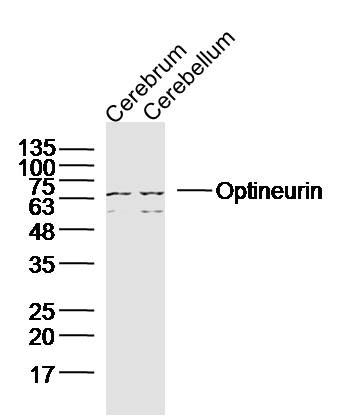
Fig2: Sample: Cerebrum (Mouse) Lysate at 40 ug Cerebellum (Mouse) Lysate at 40 ug Primary: Anti-Optineurin(ER1914-40)at 1/300 dilution Secondary: IRDye800CW Goat Anti-Rabbit IgG at 1/20000 dilution Predicted band size: 66kD Observed band size: 66kD| Product Name | Optineurin |
|---|---|
| Antibody Type | Primary Antibodies |
| Antigen Alias | 14.7K interacting protein Ag9 C5 ALS12 E3 14.7K interacting protein E3-14.7K-interacting protein FIP 2 FIP-2 FIP2 Glaucoma 1 open angle E (adult onset) Glaucoma 1 open angle E GLC1E HIP 7 HIP-7 HIP7 Huntingtin interacting protein 7 Huntingtin interacting protein HYPL Huntingtin interacting protein L Huntingtin yeast partner L Huntingtin-interacting protein 7 Huntingtin-interacting protein L HYPL Injury inducible protein I 55 NEMO related protein NEMO-related protein NRP Optic neuropathy inducing protein Optic neuropathy-inducing protein Optineurin OPTN OPTN_HUMAN TFIIIA IntP TFIIIA-IntP Transcription factor IIIA interacting protein Transcription factor IIIA-interacting protein Tumor necrosis factor alpha inducible cellular protein containing leucine zipper domains. |
| Product description | Plays an important role in the maintenance of the Golgi complex, in membrane trafficking, in exocytosis, through its interaction with myosin VI and Rab8. Links myosin VI to the Golgi complex and plays an important role in Golgi ribbon formation. Negatively regulates the induction of IFNB in response to RNA virus infection. Plays a neuroprotective role in the eye and optic nerve. Probably part of the TNF-alpha signaling pathway that can shift the equilibrium toward induction of cell death. May act by regulating membrane trafficking and cellular morphogenesis via a complex that contains Rab8 and hungtingtin (HD). May constitute a cellular target for adenovirus E3 14.7, an inhibitor of TNF-alpha functions, thereby affecting cell death. |
| Immunogen | KLH conjugated synthetic peptide derived from human Optineurin 341-440/577 |
| Clonality | Polyclonal |
|---|---|
| Isotype | IgG |
| Host Species | Rabbit |
| Tested Applications | WB |
| WB:1:500-2000: |
|
| Species Reactivity | HumanMouseRatCowSheep |
| Concentration | 1mg/ml |
| Alternative Names | 14.7K interacting protein
Ag9 C5
ALS12 E3 14.7K interacting protein E3-14.7K-interacting protein FIP 2 FIP-2 FIP2 Glaucoma 1 open angle E (adult onset) Glaucoma 1 open angle E GLC1E HIP 7 HIP-7 HIP7 Huntingtin interacting protein 7 Huntingtin interacting protein HYPL Huntingtin interacting protein L Huntingtin yeast partner L Huntingtin-interacting protein 7 Huntingtin-interacting protein L HYPL Injury inducible protein I 55 NEMO related protein NEMO-related protein NRP Optic neuropathy inducing protein Optic neuropathy-inducing protein Optineurin OPTN OPTN_HUMAN TFIIIA IntP TFIIIA-IntP Transcription factor IIIA interacting protein Transcription factor IIIA-interacting protein Tumor necrosis factor alpha inducible cellular protein containing leucine zipper domains. |
|---|---|
| Molecular Weight(MW) | 66 KDa |
| Cellular Localization | Cytoplasm > perinuclear region. Golgi apparatus. |
| SwissProt ID | Q96CV9 |
|---|
Application
Fig1: Paraformaldehyde-fixed, paraffin embedded (mouse testis); Antigen retrieval by boiling in sodium citrate buffer (pH6.0) for 15min; Block endogenous peroxidase by 3% hydrogen peroxide for 20 minutes; Blocking buffer (normal goat serum) at 37℃ for 30min; Antibody incubation with (Optineurin) Polyclonal Antibody, Unconjugated (bs-13658R) at 1:400 overnight at 4℃, followed by a conjugated secondary (sp-0023) for 20 minutes and DAB staining.
Application
Fig2: Sample: Cerebrum (Mouse) Lysate at 40 ug Cerebellum (Mouse) Lysate at 40 ug Primary: Anti-Optineurin(ER1914-40)at 1/300 dilution Secondary: IRDye800CW Goat Anti-Rabbit IgG at 1/20000 dilution Predicted band size: 66kD Observed band size: 66kD| Positive Control | Present in acqueous humor of the eye (at protein level). Highly expressed in trabecular meshwork. Expressed nonpigmented ciliary epithelium, retina, brain, adrenal cortex, fetus, lymphocyte, fibroblast, skeletal muscle, heart, liver, brain and placenta. |
|---|---|
| Application Notes | WB:1:500-2000: |
| Form | Liquid |
|---|---|
| Storage Instructions | Store at -20℃ for one year. Avoid repeated freeze/thaw cycles. The lyophilized antibody is stable at room temperature for at least one month and for greater than a year when kept at -20℃. When reconstituted in sterile pH 7.4 0.01M PBS or diluent of antibody the antibody is stable for at least two weeks at 2-4℃. |
| Storage Buffer | 0.01M TBS(pH7.4) with 1% BSA, 0.03% Proclin300 and 50% Glycerol. |


