Application
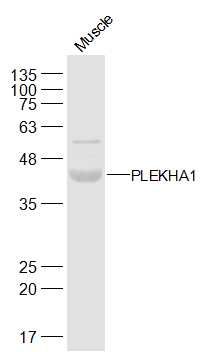
Fig1: Sample: Muscle (Mouse) Lysate at 40 ug Primary: Anti-PLEKHA1 (ER1915-16) at 1/300 dilution Secondary: IRDye800CW Goat Anti-Rabbit IgG at 1/20000 dilution Predicted band size: 46 kD Observed band size: 46 kD| Product Name | PLEKHA1 |
|---|---|
| Antibody Type | Primary Antibodies |
| Antigen Alias | OTTHUMP00000020651 PH domain containing family A member 1 PH domain-containing family A member 1 PKHA1_HUMAN Pleckstrin homology domain containing family A member 1 Pleckstrin homology domain containing, family A (phosphoinositide binding specific) member Pleckstrin homology domain-containing family A member 1 PLEKHA1 Tandem PH domain containing protein 1 Tandem PH domain-containing protein 1 TAPP 1 TAPP-1 TAPP1. |
| Product description | Binds specifically to phosphatidylinositol 3,4-diphosphate (PtdIns3,4P2), but not to other phosphoinositides. May recruit other proteins to the plasma membrane. |
| Immunogen | KLH conjugated synthetic peptide derived from human PLEKHA1 111-210/404 |
| Clonality | Polyclonal |
|---|---|
| Isotype | IgG |
| Host Species | Rabbit |
| Tested Applications | WB |
| WB:1:500-2000: |
|
| Species Reactivity | HumanMouseRatPigCowHorseSheep |
| Concentration | 1mg/ml |
| Alternative Names | OTTHUMP00000020651
PH domain containing family A member 1
PH domain-containing family A member 1
PKHA1_HUMAN
Pleckstrin homology domain containing family A member 1
Pleckstrin homology domain containing family A (phosphoinositide binding specific) member Pleckstrin homology domain-containing family A member 1 PLEKHA1 Tandem PH domain containing protein 1 Tandem PH domain-containing protein 1 TAPP 1 TAPP-1 TAPP1. |
|---|---|
| Molecular Weight(MW) | 46 KDa |
| Cellular Localization | Cytoplasm. Cell membrane. Nucleus. Locates to the plasma membrane after treatments that stimulate the production of PtdIns3,4P2. |
| SwissProt ID | Q9HB21 |
|---|
Application
Fig1: Sample: Muscle (Mouse) Lysate at 40 ug Primary: Anti-PLEKHA1 (ER1915-16) at 1/300 dilution Secondary: IRDye800CW Goat Anti-Rabbit IgG at 1/20000 dilution Predicted band size: 46 kD Observed band size: 46 kD| Positive Control | Highly expressed in skeletal muscle, thymus, pancreas, placenta and lung. Detected at low levels in brain, heart, peripheral blood leukocytes, testis, ovary, spinal cord, thyroid, kidney, liver, small intestine and colon. |
|---|---|
| Application Notes | WB:1:500-2000: |
| Form | Liquid |
|---|---|
| Storage Instructions | Store at -20℃ for one year. Avoid repeated freeze/thaw cycles. The lyophilized antibody is stable at room temperature for at least one month and for greater than a year when kept at -20℃. When reconstituted in sterile pH 7.4 0.01M PBS or diluent of antibody the antibody is stable for at least two weeks at 2-4℃. |
| Storage Buffer | 0.01M TBS(pH7.4) with 1% BSA, 0.03% Proclin300 and 50% Glycerol. |


