Application
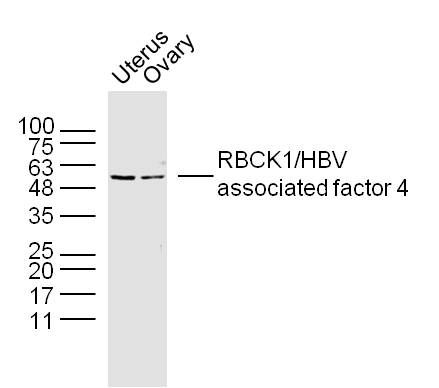
Fig1: Sample: Uterus(mouse) Lysate at 40 ug ovary(mouse) Lysate at 40 ug Primary: Anti-RBCK1/HBV associated factor 4 (ER1915-724R) at 1/300 dilution Secondary: IRDye800CW Goat Anti-Rabbit IgG at 1/20000 dilution Predicted band size: 56 kD Observed band size: 56 kD| Product Name | RBCK1/HBV associated factor 4 |
|---|---|
| Antibody Type | Primary Antibodies |
| Antigen Alias | XAP3 XAP4 HOIL1 PBMEI PGBM1 RBCK2 RNF54 HOIL-1 ZRANB4 C20orf18 UBCE7IP3 Chromosome 20 open reading frame 18 HBV associated factor 4 HBV-associated factor 4 Heme-oxidized IRP2 ubiquitin ligase 1 Hepatitis B virus X associated protein 4 Hepatitis B virus X-associated protein 4 HOIL 1L HOIL-1L HOIL1 HOIL1L RanBP type and C3HC4 type zinc finger containing 1 RanBP-type and C3HC4-type zinc finger-containing protein 1 RBCC protein interacting with PKC1 Rbck1 RBCK2 RING finger protein 54 RNF54 UB7I3_HUMAN UBCE7IP3 Ubiquitin conjugating enzyme 7 interacting protein 3 Ubiquitin-conjugating enzyme 7-interacting protein 3. |
| Product description | Acts as an E3 ubiquitin-protein ligase, or as part of an E3 complex, which accepts ubiquitin from specific E2 ubiquitin-conjugating enzymes, such as UBE2L3/UBCM4, and then transfers it to substrates. Functions as an E3 ligase for oxidized IREB2 and both heme and oxygen are necessary for IREB2 ubiquitination. Promotes ubiquitination of TAB2 and IRF3 and their degradation by the proteoasome. Component of the LUBAC complex which conjugates linear polyubiquitin chains in a head-to-tail manner to substrates. LUBAC conjugates linear polyubiquitin to IKBKG at 'Lys-285' and 'Lys-309' and is involved in activation of the canonical NF-kappa-B and the JNK signaling pathways. LUBAC is proposed to be recruited to the TNF-R1 signaling complex (TNF-RSC) following polyubiquitination of TNF-RSC components by BIRC2 and/or BIRC3 and to conjugate linear polyubiquitin to IKBKG and possibly other components contributing to the stability of the complex. Binds polyubiquitin of different linkage types. |
| Immunogen | KLH conjugated synthetic peptide derived from human RBCK1/HBV associated factor 4 251-350/510 |
| Clonality | Polyclonal |
|---|---|
| Isotype | IgG |
| Host Species | Rabbit |
| Tested Applications | WB |
| WB:1:500-2000: |
|
| Species Reactivity | HumanMouseRatDogCowRabbitSheep |
| Concentration | 1mg/ml |
| Alternative Names | XAP3 XAP4 HOIL1 PBMEI PGBM1 RBCK2 RNF54 HOIL-1 ZRANB4 C20orf18 UBCE7IP3 Chromosome 20 open reading frame 18 HBV associated factor 4 HBV-associated factor 4 Heme-oxidized IRP2 ubiquitin ligase 1 Hepatitis B virus X associated protein 4 Hepatitis B virus X-associated protein 4 HOIL 1L HOIL-1L HOIL1 HOIL1L RanBP type and C3HC4 type zinc finger containing 1 RanBP-type and C3HC4-type zinc finger-containing protein 1 RBCC protein interacting with PKC1 Rbck1 RBCK2 RING finger protein 54 RNF54 UB7I3_HUMAN UBCE7IP3 Ubiquitin conjugating enzyme 7 interacting protein 3 Ubiquitin-conjugating enzyme 7-interacting protein 3. |
|---|---|
| Molecular Weight(MW) | 56 KDa |
| Cellular Localization | Forms homodimers in vitro (By similarity). Component of the LUBAC complex (linear ubiquitin chain assembly complex) which consists of SHARPIN, RBCK1 and RNF31. LUBAC has a MW of approximative 600 kDa suggesting a heteromultimeric assembly of its subunits. Interacts with beta-I-type (PRKCB1) and zeta-type protein kinase C (PRKCZ) and with UBE2L3. Interacts with PRKCH. Interacts with the HBV pX/HBx protein, which is required to activate transcription of the viral genome. Isoform 1 and isoform 2 interact with IREB2 only in iron-rich conditions. Associates with the TNF-R1 signaling complex (TNF-RSC) in a stimulation-dependent manner. Interacts with EYA1, TAB2, TAB3, MAP3K7 TRAF6 and RIPK1. Interacts with IRF3. |
| SwissProt ID | Q9BYM8 |
|---|
Application
Fig1: Sample: Uterus(mouse) Lysate at 40 ug ovary(mouse) Lysate at 40 ug Primary: Anti-RBCK1/HBV associated factor 4 (ER1915-724R) at 1/300 dilution Secondary: IRDye800CW Goat Anti-Rabbit IgG at 1/20000 dilution Predicted band size: 56 kD Observed band size: 56 kD| Application Notes | WB:1:500-2000: |
|---|
| Form | Liquid |
|---|---|
| Storage Instructions | Store at -20℃ for one year. Avoid repeated freeze/thaw cycles. The lyophilized antibody is stable at room temperature for at least one month and for greater than a year when kept at -20℃. When reconstituted in sterile pH 7.4 0.01M PBS or diluent of antibody the antibody is stable for at least two weeks at 2-4℃. |
| Storage Buffer | 0.01M TBS(pH7.4) with 1% BSA, 0.03% Proclin300 and 50% Glycerol. |


