Application
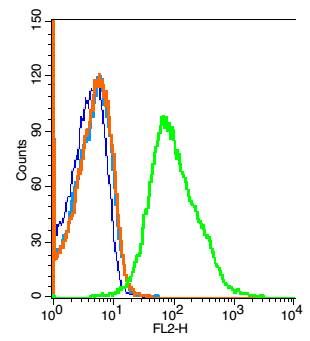
Fig1: Blank control: Mouse Spleen Cells(fixed with 2% paraformaldehyde (10 min) , then permeabilized with 90% ice-cold methanol for 30 min on ice). Primary Antibody:Rabbit Anti- RNF74 antibody(ER1916-06), Dilution: 1ug in 100 uL 1X PBS containing 0.5% BSA; Isotype Control Antibody: Rabbit IgG(orange) ,used under the same conditions ); Secondary Antibody: Goat anti-rabbit IgG-PE(white blue), Dilution: 1:200 in 1 X PBS containing 0.5% BSA.Application
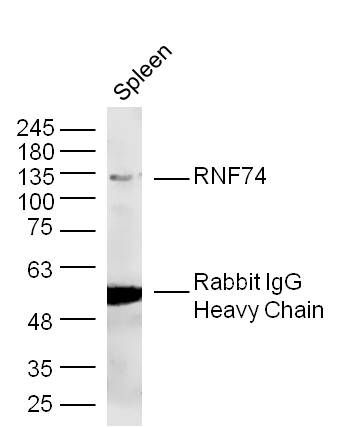
Fig2: Sample: Spleen (Mouse) Lysate at 40 ug Primary: Anti-RNF74 (ER1916-06) at 1/300 dilution Secondary: IRDye800CW Goat Anti-Rabbit IgG at 1/20000 dilution Predicted band size: 115 kD Observed band size: 130 kD| Product Name | RNF74 |
|---|---|
| Antibody Type | Primary Antibodies |
| Antigen Alias | RAG-1 E3 ubiquitin-protein ligase RAG1 RAG-1 RAG1 RAG1_HUMAN recombination activating gene 1 recombination activating protein 1 RING finger protein 74 RNF74 V(D)J recombination-activating protein 1. |
| Product description | Catalytic component of the RAG complex, a multiprotein complex that mediates the DNA cleavage phase during V(D)J recombination. V(D)J recombination assembles a diverse repertoire of immunoglobulin and T-cell receptor genes in developing B and T-lymphocytes through rearrangement of different V (variable), in some cases D (diversity), and J (joining) gene segments. In the RAG complex, RAG1 mediates the DNA-binding to the conserved recombination signal sequences (RSS) and catalyzes the DNA cleavage activities by introducing a double-strand break between the RSS and the adjacent coding segment. RAG2 is not a catalytic component but is required for all known catalytic activities. DNA cleavage occurs in 2 steps: a first nick is introduced in the top strand immediately upstream of the heptamer, generating a 3'-hydroxyl group that can attack the phosphodiester bond on the opposite strand in a direct transesterification reaction, thereby creating 4 DNA ends: 2 hairpin coding ends and 2 blunt, 5'-phosphorylated ends. The chromatin structure plays an essential role in the V(D)J recombination reactions and the presence of histone H3 trimethylated at 'Lys-4' (H3K4me3) stimulates both the nicking and haipinning steps. The RAG complex also plays a role in pre-B cell allelic exclusion, a process leading to expression of a single immunoglobulin heavy chain allele to enforce clonality and monospecific recognition by the B-cell antigen receptor (BCR) expressed on individual B-lymphocytes. The introduction of DNA breaks by the RAG complex on one immunoglobulin allele induces ATM-dependent repositioning of the other allele to pericentromeric heterochromatin, preventing accessibility to the RAG complex and recombination of the second allele. In addition to its endonuclease activity, RAG1 also acts as a E3 ubiquitin-protein ligase that mediates monoubiquitination of histone H3. Histone H3 monoubiquitination is required for the joining step of V(D)J recombination. Mediates polyubiquitination of KPNA1. |
| Immunogen | KLH conjugated synthetic peptide derived from human RAG1/RNF74 351-450/1043 |
| Clonality | Polyclonal |
|---|---|
| Isotype | IgG |
| Host Species | Rabbit |
| Tested Applications | WBFC |
| WB:1:500-2000: FC:1μg/Test: |
|
| Species Reactivity | HumanMouseRatPigSheep |
| Concentration | 1mg/ml |
| Alternative Names | RAG-1 E3 ubiquitin-protein ligase RAG1 RAG-1 RAG1 RAG1_HUMAN recombination activating gene 1 recombination activating protein 1 RING finger protein 74 RNF74 V(D)J recombination-activating protein 1. |
|---|---|
| Molecular Weight(MW) | 115 KDa |
| Cellular Localization | Nucleus. |
| SwissProt ID | P15918 |
|---|
Application
Fig1: Blank control: Mouse Spleen Cells(fixed with 2% paraformaldehyde (10 min) , then permeabilized with 90% ice-cold methanol for 30 min on ice). Primary Antibody:Rabbit Anti- RNF74 antibody(ER1916-06), Dilution: 1ug in 100 uL 1X PBS containing 0.5% BSA; Isotype Control Antibody: Rabbit IgG(orange) ,used under the same conditions ); Secondary Antibody: Goat anti-rabbit IgG-PE(white blue), Dilution: 1:200 in 1 X PBS containing 0.5% BSA.
Application
Fig2: Sample: Spleen (Mouse) Lysate at 40 ug Primary: Anti-RNF74 (ER1916-06) at 1/300 dilution Secondary: IRDye800CW Goat Anti-Rabbit IgG at 1/20000 dilution Predicted band size: 115 kD Observed band size: 130 kD| Positive Control | Maturing lymphoid cells. |
|---|---|
| Application Notes | WB:1:500-2000: FC:1μg/Test: |
| Form | Liquid |
|---|---|
| Storage Instructions | Store at -20℃ for one year. Avoid repeated freeze/thaw cycles. The lyophilized antibody is stable at room temperature for at least one month and for greater than a year when kept at -20℃. When reconstituted in sterile pH 7.4 0.01M PBS or diluent of antibody the antibody is stable for at least two weeks at 2-4℃. |
| Storage Buffer | 0.01M TBS(pH7.4) with 1% BSA, 0.03% Proclin300 and 50% Glycerol. |


