Application
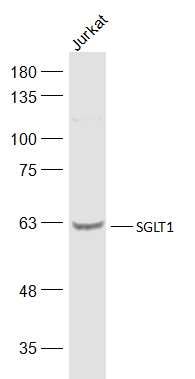
Fig1: Sample: Jurkat(Human) Cell Lysate at 30 ug Primary: Anti-SGLT1 (ER1916-51) at 1/500 dilution Secondary: IRDye800CW Goat Anti-Rabbit IgG at 1/20000 dilution Predicted band size: 73 kD Observed band size: 60 kDApplication
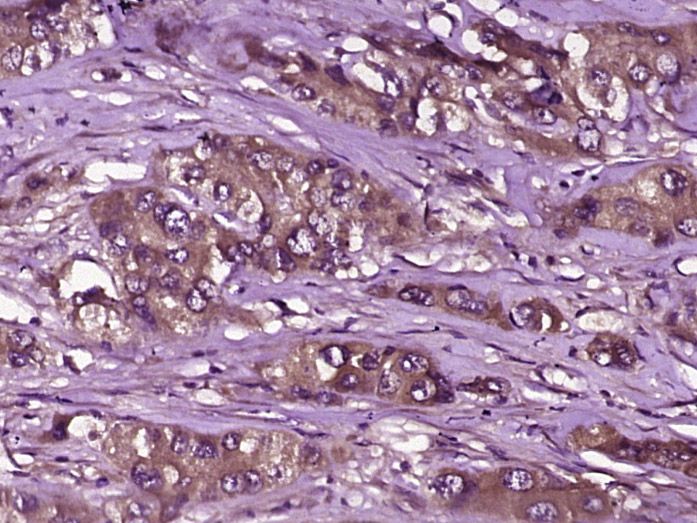
Fig2: Paraformaldehyde-fixed, paraffin embedded (human liver carcinoma); Antigen retrieval by boiling in sodium citrate buffer (pH6.0) for 15min; Block endogenous peroxidase by 3% hydrogen peroxide for 20 minutes; Blocking buffer (normal goat serum) at 37℃ for 30min; Antibody incubation with (SGLT1) Polyclonal Antibody, Unconjugated (ER1916-51) at 1:400 overnight at 4℃, followed by operating according to SP Kit (Rabbit) (sp-0023) instructionsand DAB staining.| Product Name | SGLT1 |
|---|---|
| Antibody Type | Primary Antibodies |
| Antigen Alias | D22S675 High affinity sodium glucose cotransporter 1 GLT1 GLT-1 High affinity sodium glucose cotransporter Human Na+/glucose cotransporter 1 Na(+)/glucose cotransporter 1 NAGT SGLT 1 SLC5A1 Sodium glucose cotransporter 1 Sodium/glucose cotransporter 1 Solute carrier family 5 (sodium/glucose cotransporter) member 1 Solute carrier family 5 member 1. |
| Product description | Sodium-dependent glucose cotransporters (or sodium-glucose linked transporter, SGLT) are a family of glucose transporter found in the intestinal mucosa (enterocytes) of the small intestine (SGLT1) and the proximal tubule of the nephron (SGLT2 in PCT and SGLT1 in PST). They contribute to renal glucose reabsorption. In the kidneys, 100% of the filtered glucose in the glomerulus has to be reabsorbed along the nephron (98% in PCT, via SGLT2). If the plasma glucose concentration is too high (hyperglycemia), glucose is excreted in urine (glucosuria) because SGLT are saturated with the filtered glucose. Glucose is never secreted by a healthy nephron. Firstly, an Na+/K+ ATPase pump on the basolateral membrane of the proximal tubule cell uses ATP molecules to move 3 sodium ions outward into the blood, while bringing in 2 potassium ions. This action creates a downhill sodium ion gradient from the outside to the inside of the proximal tubule cell. The SGLT proteins use the energy from this downhill sodium ion gradient created by the ATPase pump to transport glucose across the apical membrane, against an uphill glucose gradient. These co-transporters are an example of secondary active transport. Members of the GLUT family of glucose uniporters then transport the glucose across the basolateral membrane, and into the peritubular capillaries. |
| Immunogen | KLH conjugated synthetic peptide derived from human SGLT1 401-500/665 |
| Clonality | Polyclonal |
|---|---|
| Isotype | IgG |
| Host Species | Rabbit |
| Tested Applications | WBIHC-P |
| WB:1:500-2000: IHC-P:1:400-800: |
|
| Species Reactivity | HumanMouseRatDogPigCowHorseRabbitSheep |
| Concentration | 1mg/ml |
| Alternative Names | D22S675
High affinity sodium glucose cotransporter 1
GLT1 GLT-1 High affinity sodium glucose cotransporter Human Na+/glucose cotransporter 1 Na(+)/glucose cotransporter 1 NAGT SGLT 1 SLC5A1 Sodium glucose cotransporter 1 Sodium/glucose cotransporter 1 Solute carrier family 5 (sodium/glucose cotransporter) member 1 Solute carrier family 5 member 1. |
|---|---|
| Molecular Weight(MW) | 73 KDa |
| Cellular Localization | Membrane; Multi-pass membrane protein. |
| SwissProt ID | Q8C3K6 |
|---|
Application
Fig1: Sample: Jurkat(Human) Cell Lysate at 30 ug Primary: Anti-SGLT1 (ER1916-51) at 1/500 dilution Secondary: IRDye800CW Goat Anti-Rabbit IgG at 1/20000 dilution Predicted band size: 73 kD Observed band size: 60 kD
Application
Fig2: Paraformaldehyde-fixed, paraffin embedded (human liver carcinoma); Antigen retrieval by boiling in sodium citrate buffer (pH6.0) for 15min; Block endogenous peroxidase by 3% hydrogen peroxide for 20 minutes; Blocking buffer (normal goat serum) at 37℃ for 30min; Antibody incubation with (SGLT1) Polyclonal Antibody, Unconjugated (ER1916-51) at 1:400 overnight at 4℃, followed by operating according to SP Kit (Rabbit) (sp-0023) instructionsand DAB staining.| Positive Control | Expressed mainly in intestine and kidney. |
|---|---|
| Application Notes | WB:1:500-2000: IHC-P:1:400-800: |
| Form | Liquid |
|---|---|
| Storage Instructions | Store at -20℃ for one year. Avoid repeated freeze/thaw cycles. The lyophilized antibody is stable at room temperature for at least one month and for greater than a year when kept at -20℃. When reconstituted in sterile pH 7.4 0.01M PBS or diluent of antibody the antibody is stable for at least two weeks at 2-4℃. |
| Storage Buffer | 0.01M TBS(pH7.4) with 1% BSA, 0.03% Proclin300 and 50% Glycerol. |


