Application
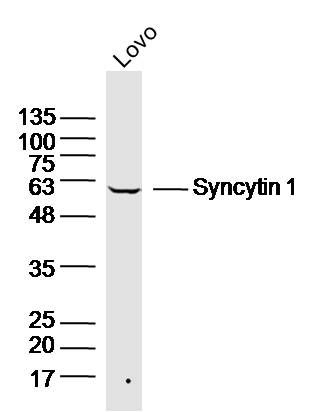
Fig1: Sample: Lovo(Human) Cell Lysate at 30 ug Primary: Anti-Syncytin 1 (ER1917-43) at 1/300 dilution Secondary: IRDye800CW Goat Anti-Rabbit IgG at 1/20000 dilution Predicted band size: 33/58 kD Observed band size: 58kDApplication
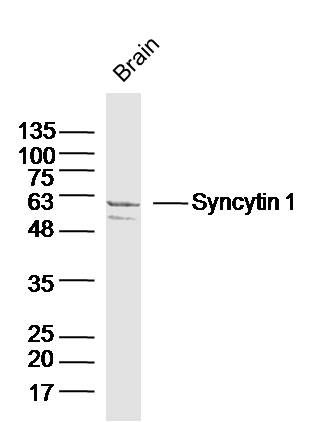
Fig2: Sample: Brain (Mouse) Lysate at 40 ug Primary: Anti-Syncytin 1 (ER1917-43) at 1/300 dilution Secondary: IRDye800CW Goat Anti-Rabbit IgG at 1/20000 dilution Predicted band size: 33/58 kD Observed band size: 58kD| Product Name | Syncytin 1 |
|---|---|
| Antibody Type | Primary Antibodies |
| Antigen Alias | HERV-W_7q21.2 provirus ancestral Env polyprotein Endogenous retrovirus group W member 1 env Env-W Envelope polyprotein gPr73 Enverin ENW1_HUMAN ERVW ERVW-1 Gp24 Gp50 HERV-7q Envelope protein HERV-W envelope protein HERVW SU Syncytin 1 Syncytin Syncytin-1 TM Transmembrane protein Surface protein. |
| Product description | Retroviral envelope proteins mediate receptor recognition and membrane fusion during early infection. Endogenous envelope proteins may have kept, lost or modified their original function during evolution. This endogenous envelope protein has retained its original fusogenic properties and participates in trophoblast fusion during placenta morphogenesis.;SU mediates receptor recognition. This interaction triggers the refolding of the transmembrane protein (TM) and is thought to activate its fusogenic potential by unmasking its fusion peptide (By similarity). Seems to recognize the type D mammalian retrovirus receptors SLC1A4 and SLC1A5, as it induces fusion of cells expressing these receptors in vitro.;The transmembrane protein (TM) acts as a class I viral fusion protein. Under the current model, the protein has at least 3 conformational states: pre-fusion native state, pre-hairpin intermediate state, and post-fusion hairpin state. During viral and target cell membrane fusion, the coiled coil regions (heptad repeats) assume a trimer-of-hairpins structure, positioning the fusion peptide in close proximity to the C-terminal region of the ectodomain. The formation of this structure appears to drive apposition and subsequent fusion of membranes (By similarity). |
| Immunogen | KLH conjugated synthetic peptide derived from human Syncytin 1 451-550/538 |
| Clonality | Polyclonal |
|---|---|
| Isotype | IgG |
| Host Species | Rabbit |
| Tested Applications | WB |
| WB:1:500-2000: |
|
| Species Reactivity | HumanMouse |
| Concentration | 1mg/ml |
| Alternative Names | HERV-W_7q21.2 provirus ancestral Env polyprotein Endogenous retrovirus group W member 1 env Env-W Envelope polyprotein gPr73 Enverin ENW1_HUMAN ERVW ERVW-1 Gp24 Gp50 HERV-7q Envelope protein HERV-W envelope protein HERVW SU Syncytin 1 Syncytin Syncytin-1 TM Transmembrane protein Surface protein. |
|---|---|
| Molecular Weight(MW) | 33/58 KDa |
| Cellular Localization | Transmembrane protein: Cell membrane; Single-pass type I membrane protein (By similarity).;Surface protein: Cell membrane; Peripheral membrane protein (By similarity). Note=The surface protein is not anchored to the membrane, but localizes to the extracellular surface through its binding to TM (By similarity).;HERV-W_7q21.2 provirus ancestral Env polyprotein: Virion (By similarity). |
| SwissProt ID | Q9UQF0 |
|---|
Application
Fig1: Sample: Lovo(Human) Cell Lysate at 30 ug Primary: Anti-Syncytin 1 (ER1917-43) at 1/300 dilution Secondary: IRDye800CW Goat Anti-Rabbit IgG at 1/20000 dilution Predicted band size: 33/58 kD Observed band size: 58kD
Application
Fig2: Sample: Brain (Mouse) Lysate at 40 ug Primary: Anti-Syncytin 1 (ER1917-43) at 1/300 dilution Secondary: IRDye800CW Goat Anti-Rabbit IgG at 1/20000 dilution Predicted band size: 33/58 kD Observed band size: 58kD| Positive Control | Expressed at higher level in placental syncytiotrophoblast. Expressed at intermediate level in testis. Seems also to be found at low level in adrenal tissue, bone marrow, breast, colon, kidney, ovary, prostate, skin, spleen, thymus, thyroid, brain and trachea. Both mRNA and protein levels are significantly increased in the brain of individuals with multiple sclerosis, particularly in astrocytes and microglia. |
|---|---|
| Application Notes | WB:1:500-2000: |
| Form | Liquid |
|---|---|
| Storage Instructions | Store at -20℃ for one year. Avoid repeated freeze/thaw cycles. The lyophilized antibody is stable at room temperature for at least one month and for greater than a year when kept at -20℃. When reconstituted in sterile pH 7.4 0.01M PBS or diluent of antibody the antibody is stable for at least two weeks at 2-4℃. |
| Storage Buffer | 0.01M TBS(pH7.4) with 1% BSA, 0.03% Proclin300 and 50% Glycerol. |


