Application
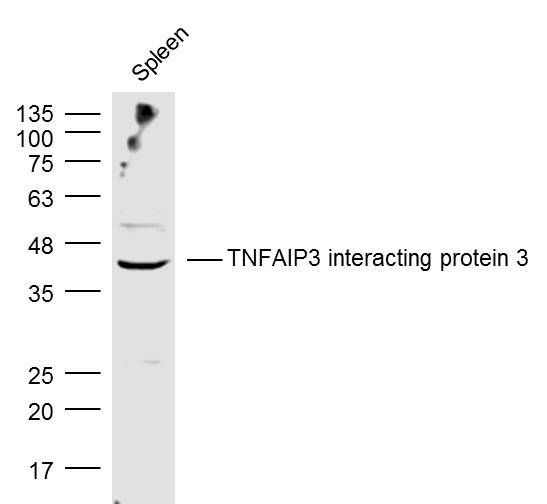
Fig1: Sample: Spleen (Mouse) Lysate at 40 ug Primary: Anti- TNFAIP3 interacting protein 3 (ER1917-86) at 1/300 dilution Secondary: IRDye800CW Goat Anti-Rabbit IgG at 1/20000 dilution Predicted band size: 39 kD Observed band size: 39 kD| Product Name | TNFAIP3 interacting protein 3 |
|---|---|
| Antibody Type | Primary Antibodies |
| Antigen Alias | Listeria induced A20-binding inhibitor of NF-kappa-B activation 3 ABIN-3 ABIN-3 beta FLJ21162 LIND Listeria induced gene protein TNFAIP3 interacting protein 3 TNFAIP3-interacting protein 3 beta TNIP3 TNIP3 beta TNIP3_HUMAN. |
| Product description | Binds to zinc finger protein TNFAIP3 and inhibits NF-kappa-B activation induced by tumor necrosis factor, Toll-like receptor 4 (TLR4), interleukin-1 and 12-O-tetradecanoylphorbol-13-acetate. Overexpression inhibits NF-kappa-B-dependent gene expression in response to lipopolysaccharide at a level downstream of TRAF6 and upstream of IKBKB. NF-kappa-B inhibition is independent of TNFAIP3 binding. |
| Immunogen | KLH conjugated synthetic peptide derived from human TNFAIP3 interacting protein 3/ABIN3 51-150/325 |
| Clonality | Polyclonal |
|---|---|
| Isotype | IgG |
| Host Species | Rabbit |
| Tested Applications | WB |
| WB:1:500-2000: |
|
| Species Reactivity | HumanMouseRatCowSheep |
| Concentration | 1mg/ml |
| Alternative Names | Listeria induced A20-binding inhibitor of NF-kappa-B activation 3 ABIN-3 ABIN-3 beta FLJ21162 LIND Listeria induced gene protein TNFAIP3 interacting protein 3 TNFAIP3-interacting protein 3 beta TNIP3 TNIP3 beta TNIP3_HUMAN. |
|---|---|
| Molecular Weight(MW) | 39 KDa |
| SwissProt ID | Q96KP6 |
|---|
Application
Fig1: Sample: Spleen (Mouse) Lysate at 40 ug Primary: Anti- TNFAIP3 interacting protein 3 (ER1917-86) at 1/300 dilution Secondary: IRDye800CW Goat Anti-Rabbit IgG at 1/20000 dilution Predicted band size: 39 kD Observed band size: 39 kD| Positive Control | Highly expressed in lung, lymph node, thymus and fetal liver. Expressed at lower levels in bone marrow, brain, kidney, spleen, leukocytes and tonsils. Could be detected in heart, salivary gland, adrenal gland, pancreas, ovary and fetal brain. High levels detected in liver, colon, small intestine, muscle, stomach, testis, placenta, thyroid, uterus, prostate, skin and PBL. |
|---|---|
| Application Notes | WB:1:500-2000: |
| Form | Liquid |
|---|---|
| Storage Instructions | Store at -20℃ for one year. Avoid repeated freeze/thaw cycles. The lyophilized antibody is stable at room temperature for at least one month and for greater than a year when kept at -20℃. When reconstituted in sterile pH 7.4 0.01M PBS or diluent of antibody the antibody is stable for at least two weeks at 2-4℃. |
| Storage Buffer | 0.01M TBS(pH7.4) with 1% BSA, 0.03% Proclin300 and 50% Glycerol. |


