Application
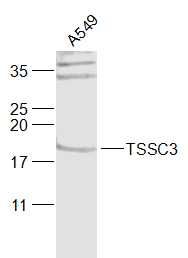
Fig1: Sample: A549(Human) Cell Lysate at 30 ug Primary: Anti-TSSC3 (ER1918-26) at 1/1000 dilution Secondary: IRDye800CW Goat Anti-Rabbit IgG at 1/20000 dilution Predicted band size: 17 kD Observed band size: 18 kD| Product Name | TSSC3 |
|---|---|
| Antibody Type | Primary Antibodies |
| Antigen Alias | Beckwith Wiedemann syndrome chromosome region 1 candidate protein C Beckwith-Wiedemann syndrome chromosomal region 1 candidate gene C protein BRW 1C BRW1C BWR 1C BWR1C HLDA 2 HLDA2 Imprinted in placenta and liver Imprinted in placenta and liver protein IPL p17 Beckwith Wiedemann region 1C p17 BWR1C p17-Beckwith-Wiedemann region 1 C p17-BWR1C PHLA2_HUMAN PHLDA 2 PHLDA2 Pleckstrin homology like domain family A member 2 Pleckstrin homology-like domain family A member 2 TSSC 3 Tumor suppressing STF cDNA 3 protein Tumor suppressing subchromosomal transferable fragment candidate gene 3 protein Tumor suppressing subchromosomal transferable fragment cDNA 3 Tumor suppressing subtransferable candidate 3 Tumor supressing STF cDNA 3 Tumor-suppressing STF cDNA 3 protein Tumor-suppressing subchromosomal transferable fragment candidate gene 3 protein. |
| Product description | TSSC3 (Tumor-suppressing STF cDNA 3 protein), also known as PHLDA2 (pleckstrin homology-like domain family A member 2), BWR1C, HLDA2 or IPL, is a cytoplasmic protein that is involved in fetal and placental growth. Expressed at high levels in placenta and adult prostate and at low levels in liver, lung and brain, TSSC3 is an apoptosis-related protein that acts as a negative growth regulator and is expressed during normal human development. TSSC3, a protein expressed from the maternal allele, is imprinted on placenta, liver and fetal tissues during embryogenesis and is removed once development is complete. Defects or alterations in the gene encoding TSSC3 are associated with several afflictions such as lung, ovarian and breast cancer, rhabdomyosarcoma, Beckwith-Wiedemann syndrome, Wilms tumor, low birth weight and adrenocortical carcinoma. May act via its PH domain that competes with other PH domain-containing proteins, thereby preventing their binding to membrane lipids (By similarity). |
| Immunogen | KLH conjugated synthetic peptide derived from human TSSC3 31-80/152 |
| Clonality | Polyclonal |
|---|---|
| Isotype | IgG |
| Host Species | Rabbit |
| Tested Applications | WB |
| WB:1:500-2000: |
|
| Species Reactivity | HumanMouseRatChickenPigCowHorse |
| Concentration | 1mg/ml |
| Alternative Names | Beckwith Wiedemann syndrome chromosome region 1 candidate protein C
Beckwith-Wiedemann syndrome chromosomal region 1 candidate gene C protein
BRW 1C BRW1C BWR 1C BWR1C HLDA 2 HLDA2 Imprinted in placenta and liver Imprinted in placenta and liver protein IPL p17 Beckwith Wiedemann region 1C p17 BWR1C p17-Beckwith-Wiedemann region 1 C p17-BWR1C PHLA2_HUMAN PHLDA 2 PHLDA2 Pleckstrin homology like domain family A member 2 Pleckstrin homology-like domain family A member 2 TSSC 3 Tumor suppressing STF cDNA 3 protein Tumor suppressing subchromosomal transferable fragment candidate gene 3 protein Tumor suppressing subchromosomal transferable fragment cDNA 3 Tumor suppressing subtransferable candidate 3 Tumor supressing STF cDNA 3 Tumor-suppressing STF cDNA 3 protein Tumor-suppressing subchromosomal transferable fragment candidate gene 3 protein. |
|---|---|
| Molecular Weight(MW) | 17 KDa |
| Cellular Localization | Cytoplasm. Membrane. |
| SwissProt ID | Q53GA4 |
|---|
Application
Fig1: Sample: A549(Human) Cell Lysate at 30 ug Primary: Anti-TSSC3 (ER1918-26) at 1/1000 dilution Secondary: IRDye800CW Goat Anti-Rabbit IgG at 1/20000 dilution Predicted band size: 17 kD Observed band size: 18 kD| Positive Control | Expressed in placenta and adult prostate gland. |
|---|---|
| Application Notes | WB:1:500-2000: |
| Form | Liquid |
|---|---|
| Storage Instructions | Store at -20℃ for one year. Avoid repeated freeze/thaw cycles. The lyophilized antibody is stable at room temperature for at least one month and for greater than a year when kept at -20℃. When reconstituted in sterile pH 7.4 0.01M PBS or diluent of antibody the antibody is stable for at least two weeks at 2-4℃. |
| Storage Buffer | 0.01M TBS(pH7.4) with 1% BSA, 0.03% Proclin300 and 50% Glycerol. |


