Application
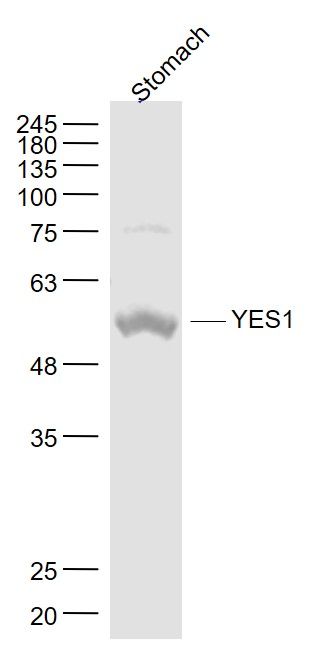
Fig1: Sample: Stomach (Mouse) Lysate at 40 ug Primary: Anti- YES1 (ER1918-77) at 1/1000 dilution Secondary: IRDye800CW Goat Anti-Rabbit IgG at 1/20000 dilution Predicted band size: 60 kD Observed band size: 58 kD| Product Name | YES1 |
|---|---|
| Antibody Type | Primary Antibodies |
| Antigen Alias | c Yes c-Yes Cellular Yes 1 protein Cellular Yes1 protein HsT441 P61 YES p61-Yes Proto oncogene tyrosine protein kinase YES Proto-oncogene c-Yes Proto-oncogene tyrosine-protein kinase Yes v yes 1 Yamaguchi sarcoma viral oncogene homolog 1 Viral oncogene yes 1 homolog 1 Viral oncogene yes1 homolog 1 Yamaguchi sarcoma oncogene Yes 1 Yes YES_HUMAN YES1. |
| Product description | Non-receptor protein tyrosine kinase that is involved in the regulation of cell growth and survival, apoptosis, cell-cell adhesion, cytoskeleton remodeling, and differentiation. Stimulation by receptor tyrosine kinases (RTKs) including EGRF, PDGFR, CSF1R and FGFR leads to recruitment of YES1 to the phosphorylated receptor, and activation and phosphorylation of downstream substrates. Upon EGFR activation, promotes the phosphorylation of PARD3 to favor epithelial tight junction assembly. Participates in the phosphorylation of specific junctional components such as CTNND1 by stimulating the FYN and FER tyrosine kinases at cell-cell contacts. Upon T-cell stimulation by CXCL12, phosphorylates collapsin response mediator protein 2/DPYSL2 and induces T-cell migration. Participates in CD95L/FASLG signaling pathway and mediates AKT-mediated cell migration. Plays a role in cell cycle progression by phosphorylating the cyclin-dependent kinase 4/CDK4 thus regulating the G1 phase. Also involved in G2/M progression and cytokinesis. |
| Immunogen | KLH conjugated synthetic peptide derived from human YES1 441-541/541 |
| Clonality | Polyclonal |
|---|---|
| Isotype | IgG |
| Host Species | Rabbit |
| Tested Applications | WB |
| WB:1:500-2000: |
|
| Species Reactivity | HumanMouseRatChickenDogPigCowRabbitGuinea Pig |
| Concentration | 1mg/ml |
| Alternative Names | c Yes c-Yes Cellular Yes 1 protein Cellular Yes1 protein HsT441 P61 YES p61-Yes Proto oncogene tyrosine protein kinase YES Proto-oncogene c-Yes Proto-oncogene tyrosine-protein kinase Yes v yes 1 Yamaguchi sarcoma viral oncogene homolog 1 Viral oncogene yes 1 homolog 1 Viral oncogene yes1 homolog 1 Yamaguchi sarcoma oncogene Yes 1 Yes YES_HUMAN YES1. |
|---|---|
| Molecular Weight(MW) | 60 KDa |
| Cellular Localization | Cell membrane. Cytoplasm, cytoskeleton, centrosome. Cytoplasm, cytosol. Note=Newly synthesized protein initially accumulates in the Golgi region and traffics to the plasma membrane through the exocytic pathway. |
| SwissProt ID | P07947 |
|---|
Application
Fig1: Sample: Stomach (Mouse) Lysate at 40 ug Primary: Anti- YES1 (ER1918-77) at 1/1000 dilution Secondary: IRDye800CW Goat Anti-Rabbit IgG at 1/20000 dilution Predicted band size: 60 kD Observed band size: 58 kD| Positive Control | Expressed in the epithelial cells of renal proximal tubules and stomach as well as hematopoietic cells in the bone marrow and spleen in the fetal tissues. In adult, expressed in epithelial cells of the renal proximal tubules and present in keratinocytes in the basal epidermal layer of epidermis. |
|---|---|
| Application Notes | WB:1:500-2000: |
| Form | Liquid |
|---|---|
| Storage Instructions | Store at -20℃ for one year. Avoid repeated freeze/thaw cycles. The lyophilized antibody is stable at room temperature for at least one month and for greater than a year when kept at -20℃. When reconstituted in sterile pH 7.4 0.01M PBS or diluent of antibody the antibody is stable for at least two weeks at 2-4℃. |
| Storage Buffer | 0.01M TBS(pH7.4) with 1% BSA, 0.03% Proclin300 and 50% Glycerol. |


