Application
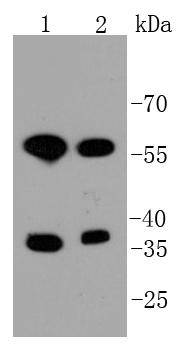
Fig1: Western blot analysis of Mst2 on different lysates using anti-Mst2 antibody at 1/1,000 dilution. Positive control: Lane 1: CRC Lane 2: HCT116Application
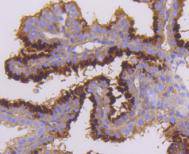
Fig2: Immunohistochemical analysis of paraffin-embedded mouse placenta tissue using anti-Mst2 antibody. Counter stained with hematoxylin.| Product Name | Mst2 [SC05-83] |
|---|---|
| Antibody Type | Primary Antibodies |
| Antigen Alias | DKFZp686A2068 antibody FLJ90748 antibody KRS1 antibody KRS2 antibody Mammalian STE20 like protein kinase 1 antibody Mammalian STE20 like protein kinase 2 antibody MST 1 antibody MST 2 antibody MST1 antibody MST2 antibody Serine/threonine kinase 3 (STE20 homolog yeast) antibody Serine/threonine kinase 3 (Ste20 yeast homolog) antibody Serine/threonine kinase 3 antibody Serine/threonine kinase 4 antibody Serine/threonine protein kinase 3 antibody Serine/threonine protein kinase 4 antibody Serine/threonine protein kinase Krs 1 antibody Serine/threonine protein kinase Krs 2 antibody STE20 like kinase MST1 antibody STE20 like kinase MST2 antibody STK 3 antibody STK 4 antibody STK3 antibody STK4 antibody YSK3 antibody |
| Product description | Sterile-20 (Ste20) is a serine/threonine kinase in Saccharomyces cerevisiae that is involved in relaying signals from G protein-coupled receptors to cyto-solic MAP kinase cascades. Mammalian protein kinases that display sequence similarity to Ste20 are divided into two groups, the PAK subfamily and the GCK subfamily. The PAK subfamily members contain a C-terminal catalytic domain and an N-terminal regulatory domain with a p21Rac/Cdc42-binding site, and these kinases can activate both p38 MAPK and JNK. The GCK subfamily members contain a C-terminal regulatory domain and an N-terminal catalytic domain, and they have diverse roles in many pathways, including the activation of ERK, JNK, p38 MAPK, and caspase-3. The mammalian Ste20-like kinases (MST kinases), also known as Krs proteins, are members of the GCK subfamily. Ksr-1 (MST-2) and Ksr-2 (MST-1) are both direct substrates of caspase-3 that accelerate caspase-3 activation. MST-3 is ubiquitously expressed in mammalian tissue and can phosphorylate exogenous substrates as well as itself. MST-4 is highly expressed in placenta, thymus, and peripheral blood leukocytes, and it specifically activates ERK. |
| Immunogen | recombinant protein |
| Clonality | Monoclonal |
|---|---|
| Isotype | IgG |
| Host Species | Recombinant rabbit |
| Tested Applications | WBIHCIP |
| WB:1:1,000-1:5,000 IHC:1:50-1:200 |
|
| Species Reactivity | HumanMouseRat |
| Concentration | 1mg/ml |
| Alternative Names | DKFZp686A2068 antibody FLJ90748 antibody KRS1 antibody KRS2 antibody Mammalian STE20 like protein kinase 1 antibody Mammalian STE20 like protein kinase 2 antibody MST 1 antibody MST 2 antibody MST1 antibody MST2 antibody Serine/threonine kinase 3 (STE20 homolog yeast) antibody Serine/threonine kinase 3 (Ste20 yeast homolog) antibody Serine/threonine kinase 3 antibody Serine/threonine kinase 4 antibody Serine/threonine protein kinase 3 antibody Serine/threonine protein kinase 4 antibody Serine/threonine protein kinase Krs 1 antibody Serine/threonine protein kinase Krs 2 antibody STE20 like kinase MST1 antibody STE20 like kinase MST2 antibody STK 3 antibody STK 4 antibody STK3 antibody STK4 antibody YSK3 antibody |
|---|---|
| Molecular Weight(MW) | 36/56 kDa |
| Cellular Localization | Cytoplasm, Nucleus. |
Application
Fig1: Western blot analysis of Mst2 on different lysates using anti-Mst2 antibody at 1/1,000 dilution. Positive control: Lane 1: CRC Lane 2: HCT116
Application
Fig2: Immunohistochemical analysis of paraffin-embedded mouse placenta tissue using anti-Mst2 antibody. Counter stained with hematoxylin.| Positive Control | CRC, HCT116, mouse placenta tissue. |
|---|---|
| Application Notes | WB:1:1,000-1:5,000 IHC:1:50-1:200 |
| Form | Liquid |
|---|---|
| Storage Instructions | Store at +4℃ after thawing. Aliquot store at -20℃ or -80℃. Avoid repeated freeze / thaw cycles. |
| Storage Buffer | 1*TBS (pH7.4), 1%BSA, 40%Glycerol. Preservative: 0.05% Sodium Azide. |


