Application
Fig8: Flow cytometric analysis of LTA4H was done on F9 cells. The cells were fixed, permeabilized and stained with the primary antibody (ET7110-13, 1/50) (red). After incubation of the primary antibody at room temperature for an hour, the cells were stained with a Alexa Fluor 488-conjugated Goat anti-Rabbit IgG Secondary antibody at 1/1000 dilution for 30 minutes.Unlabelled sample was used as a control (cells without incubation with primary antibody; black).Application
Fig8: Flow cytometric analysis of LTA4H was done on F9 cells. The cells were fixed, permeabilized and stained with the primary antibody (ET7110-13, 1/50) (red). After incubation of the primary antibody at room temperature for an hour, the cells were stained with a Alexa Fluor 488-conjugated Goat anti-Rabbit IgG Secondary antibody at 1/1000 dilution for 30 minutes.Unlabelled sample was used as a control (cells without incubation with primary antibody; black).Application
Fig8: Flow cytometric analysis of LTA4H was done on F9 cells. The cells were fixed, permeabilized and stained with the primary antibody (ET7110-13, 1/50) (red). After incubation of the primary antibody at room temperature for an hour, the cells were stained with a Alexa Fluor 488-conjugated Goat anti-Rabbit IgG Secondary antibody at 1/1000 dilution for 30 minutes.Unlabelled sample was used as a control (cells without incubation with primary antibody; black).Application
Fig8: Flow cytometric analysis of LTA4H was done on F9 cells. The cells were fixed, permeabilized and stained with the primary antibody (ET7110-13, 1/50) (red). After incubation of the primary antibody at room temperature for an hour, the cells were stained with a Alexa Fluor 488-conjugated Goat anti-Rabbit IgG Secondary antibody at 1/1000 dilution for 30 minutes.Unlabelled sample was used as a control (cells without incubation with primary antibody; black).Application
Fig8: Flow cytometric analysis of LTA4H was done on F9 cells. The cells were fixed, permeabilized and stained with the primary antibody (ET7110-13, 1/50) (red). After incubation of the primary antibody at room temperature for an hour, the cells were stained with a Alexa Fluor 488-conjugated Goat anti-Rabbit IgG Secondary antibody at 1/1000 dilution for 30 minutes.Unlabelled sample was used as a control (cells without incubation with primary antibody; black).Application
Fig8: Flow cytometric analysis of LTA4H was done on F9 cells. The cells were fixed, permeabilized and stained with the primary antibody (ET7110-13, 1/50) (red). After incubation of the primary antibody at room temperature for an hour, the cells were stained with a Alexa Fluor 488-conjugated Goat anti-Rabbit IgG Secondary antibody at 1/1000 dilution for 30 minutes.Unlabelled sample was used as a control (cells without incubation with primary antibody; black).Application
Fig8: Flow cytometric analysis of LTA4H was done on F9 cells. The cells were fixed, permeabilized and stained with the primary antibody (ET7110-13, 1/50) (red). After incubation of the primary antibody at room temperature for an hour, the cells were stained with a Alexa Fluor 488-conjugated Goat anti-Rabbit IgG Secondary antibody at 1/1000 dilution for 30 minutes.Unlabelled sample was used as a control (cells without incubation with primary antibody; black).Application
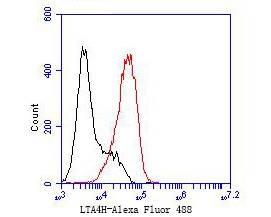
Fig8: Flow cytometric analysis of LTA4H was done on F9 cells. The cells were fixed, permeabilized and stained with the primary antibody (ET7110-13, 1/50) (red). After incubation of the primary antibody at room temperature for an hour, the cells were stained with a Alexa Fluor 488-conjugated Goat anti-Rabbit IgG Secondary antibody at 1/1000 dilution for 30 minutes.Unlabelled sample was used as a control (cells without incubation with primary antibody; black).| Product Name | LTA4H [JE52-14] |
|---|---|
| Antibody Type | Primary Antibodies |
| Antigen Alias | FLJ17564 antibody Leukotriene A(4) hydrolase antibody Leukotriene A-4 hydrolase antibody Leukotriene A4 hydrolase antibody LKHA4_HUMAN antibody LTA-4 hydrolase antibody LTA4 antibody LTA4 hydrolase antibody LTA4H antibody |
| Product description | Leukotriene A4 hydrolase, also known as LTA4H is a human gene. The protein encoded by this gene is a bifunctional enzyme (EC 3.3.2.6) which converts leukotriene A4 to leukotriene B4 and acts as an aminopeptidase. This enzyme belongs to the family of hydrolases, specifically those acting on ether bonds (ether hydrolases). The systematic name of this enzyme class is (7E,9E,11Z,14Z)-(5S,6S)-5,6-epoxyicosa-7,9,11,14-tetraenoate hydrolase. Other names in common use include LTA4 hydrolase, LTA4H, and leukotriene A4 hydrolase. This enzyme participates in arachidonic acid metabolism. The hydrolase activity is used in the final step of the biosynthesis of leukotriene B4, a proinflammatory mediator. The aminopeptidase activity has been shown to degrade proline-glycine-proline (PGP), a neutrophil chemoattractant and biomarker for chronic obstructive pulmonary disease (COPD). Several transcript variants encoding different isoforms have been found for this gene. |
| Immunogen | Synthetic peptide within C-terminal human LTA4H |
| Clonality | Monoclonal |
|---|---|
| Isotype | IgG |
| Host Species | Recombinant rabbit |
| Tested Applications | WBIHC-PFC |
| WB:1:500-1:2,000 IHC-P:1:50-1:200 FC:1:50-1:100 |
|
| Species Reactivity | HumanMouseRat |
| Concentration | 1mg/mL |
| Alternative Names | FLJ17564 antibody
Leukotriene A(4) hydrolase antibody
Leukotriene A-4 hydrolase antibody Leukotriene A4 hydrolase antibody LKHA4_HUMAN antibody LTA-4 hydrolase antibody LTA4 antibody LTA4 hydrolase antibody LTA4H antibody |
|---|---|
| Molecular Weight(MW) | 69 kDa |
| Cellular Localization | Cytoplasm. |
Application
Fig8: Flow cytometric analysis of LTA4H was done on F9 cells. The cells were fixed, permeabilized and stained with the primary antibody (ET7110-13, 1/50) (red). After incubation of the primary antibody at room temperature for an hour, the cells were stained with a Alexa Fluor 488-conjugated Goat anti-Rabbit IgG Secondary antibody at 1/1000 dilution for 30 minutes.Unlabelled sample was used as a control (cells without incubation with primary antibody; black).
Application
Fig8: Flow cytometric analysis of LTA4H was done on F9 cells. The cells were fixed, permeabilized and stained with the primary antibody (ET7110-13, 1/50) (red). After incubation of the primary antibody at room temperature for an hour, the cells were stained with a Alexa Fluor 488-conjugated Goat anti-Rabbit IgG Secondary antibody at 1/1000 dilution for 30 minutes.Unlabelled sample was used as a control (cells without incubation with primary antibody; black).| Positive Control | 293, A549, rat bladder tissue, human tonsil tissue, human breast tissue, human esophagus tissue, human small intestine tissue, human pancreas tissue, F9. |
|---|---|
| Application Notes | WB:1:500-1:2,000 IHC-P:1:50-1:200 FC:1:50-1:100 |
| Form | Liquid |
|---|---|
| Storage Instructions | Store at +4℃ after thawing. Aliquot store at -20℃. Avoid repeated freeze / thaw cycles. |
| Storage Buffer | 1*TBS (pH7.4), 1%BSA, 50%Glycerol. Preservative: 0.05% Sodium Azide. |


