Application
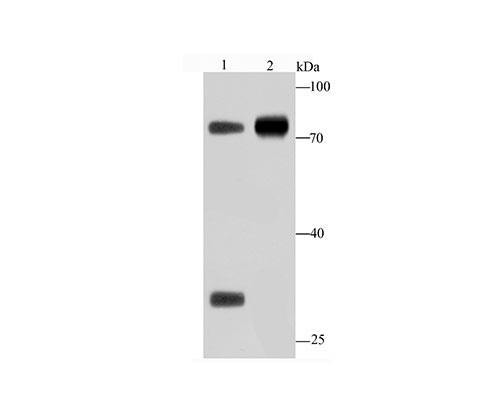
Fig1: Western blot analysis of human IgM on Human plasma (1) and Raji (2) lysate using anti-Human IgM antibody at 1/1,000 dilution.Application
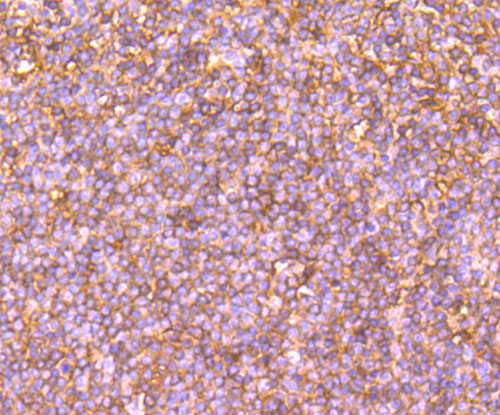
Fig2: Immunohistochemical analysis of paraffin-embedded human tonsil tissue using anti-Human IgM antibody. Counter stained with hematoxylin.Application
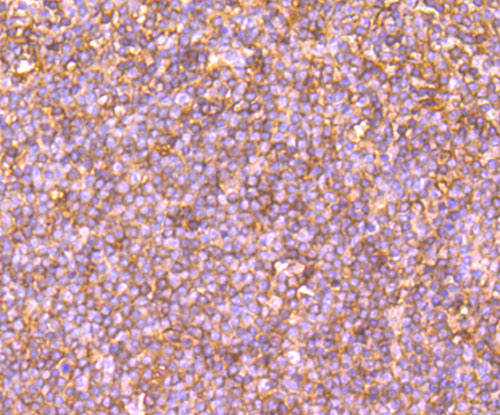
Fig3: Immunohistochemical analysis of paraffin-embedded human spleen tissue using anti-Human IgM antibody. Counter stained with hematoxylin.| Product Name | Human IgM |
|---|---|
| Antibody Type | Primary Antibodies |
| Antigen Alias | Immunoglobin heavy chain constant region mu edit item name - Immunoglobin heavy chain mu constant region antibody Immunoglobin heavy chain constant region mu antibody AGM1 antibody Constant region of heavy chain of IgM antibody DKFZp686I15196 antibody DKFZp686I15212 antibody FLJ00385 antibody Ig mu chain C region antibody IGHM antibody IgM heavy chain constant region antibody Immunoglobin heavy constant mu antibody Immunoglobulin mu antibody MGC104996 antibody MGC52291 antibody MU antibody VH antibody |
| Product description | Constant region of immunoglobulin heavy chains. Immunoglobulins, also known as antibodies, are membrane-bound or secreted glycoproteins produced by B lymphocytes. In the recognition phase of humoral immunity, the membrane-bound immunoglobulins serve as receptors which, upon binding of a specific antigen, trigger the clonal expansion and differentiation of B lymphocytes into immunoglobulins-secreting plasma cells. Secreted immunoglobulins mediate the effector phase of humoral immunity, which results in the elimination of bound antigens. The antigen binding site is formed by the variable domain of one heavy chain, together with that of its associated light chain. Thus, each immunoglobulin has two antigen binding sites with remarkable affinity for a particular antigen. The variable domains are assembled by a process called V-(D)-J rearrangement and can then be subjected to somatic hypermutations which, after exposure to antigen and selection, allow affinity maturation for a particular antigen. IgM antibodies play an important role in primary defense mechanisms. They have been shown to be involved in early recognition of external invaders like bacteria and viruses, cellular waste and modified self, as well as in recognition and elimination of precancerous and cancerous lesions. The membrane-bound form is found in the majority of normal B-cells alongside with IgD. Membrane-bound IgM induces the phosphorylation of CD79A and CD79B by the Src family of protein tyrosine kinases. It may cause death of cells by apoptosis. It is also found in soluble form, which represents about 30% of the total serum immunoglobulins where it is found almost exclusively as a homopentamer. After the antigen binds to the B-cell receptor, the secreted form is secreted in large amounts . |
| Immunogen | Native protein |
| Clonality | Polyclonal |
|---|---|
| Isotype | IgG |
| Host Species | Rabbit |
| Tested Applications | WBIHC |
| WB:1:500~1:2000 IHC:1:50~1:200 Notes:Optimal dilutions/concentrations should be determined by the researcher. |
|
| Species Reactivity | Human |
| Concentration | 1mg/ml |
| Alternative Names | Immunoglobin heavy chain constant region mu edit item name - Immunoglobin heavy chain mu constant region antibody Immunoglobin heavy chain constant region mu antibody AGM1 antibody Constant region of heavy chain of IgM antibody DKFZp686I15196 antibody DKFZp686I15212 antibody FLJ00385 antibody Ig mu chain C region antibody IGHM antibody IgM heavy chain constant region antibody Immunoglobin heavy constant mu antibody Immunoglobulin mu antibody MGC104996 antibody MGC52291 antibody MU antibody VH antibody |
|---|---|
| Molecular Weight(MW) | 70/30 kDa |
| Cellular Localization | Cell Membrane and Secreted. |
| SwissProt ID | P01871 |
|---|
Application
Fig1: Western blot analysis of human IgM on Human plasma (1) and Raji (2) lysate using anti-Human IgM antibody at 1/1,000 dilution.
Application
Fig2: Immunohistochemical analysis of paraffin-embedded human tonsil tissue using anti-Human IgM antibody. Counter stained with hematoxylin.
Application
Fig3: Immunohistochemical analysis of paraffin-embedded human spleen tissue using anti-Human IgM antibody. Counter stained with hematoxylin.| Positive Control | Raji, human plasma, human tonsil tissue, human spleen tissue. |
|---|---|
| Application Notes | WB:1:500~1:2000 IHC:1:50~1:200 Notes:Optimal dilutions/concentrations should be determined by the researcher. |
| Form | Liquid |
|---|---|
| Storage Instructions | Store at +4℃ after thawing. Aliquot store at -20℃ or -80℃. Avoid repeated freeze / thaw cycles. |
| Storage Buffer | 1*TBS (pH7.4), 1%BSA, 40%Glycerol. Preservative: 0.05% Sodium Azide. |


