Application
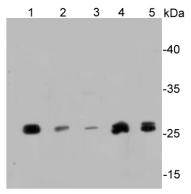
Fig1: Western blot analysis on different lysates using anti-SIRT3 rabbit polyclonal antibody. Positive control: Lane 1: A172 Lane 2: Mouse liver Lane 3: NIH/3T3 Lane 4: Mouse kidney Lane 5: F9Application
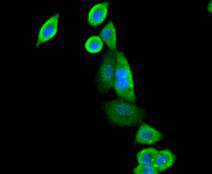
Fig2: Immunocytochemical staining of MCF-7 cells using anti-SIRT3 rabbit polyclonal antibody.Application
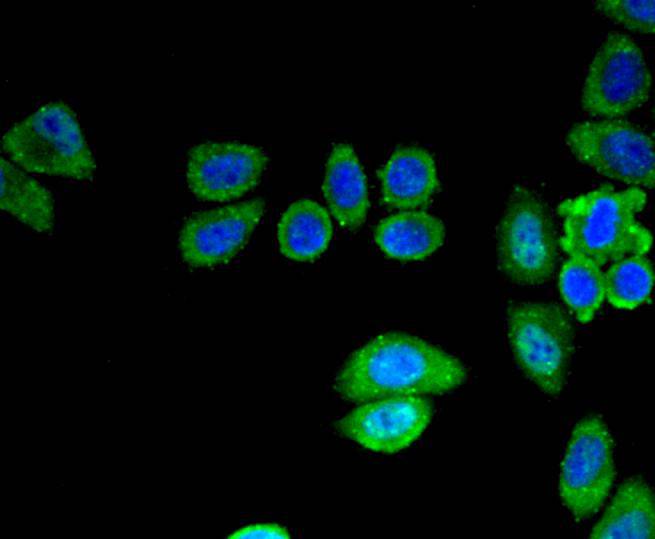
Fig3: Immunocytochemical staining of HepG2 cells using anti-SIRT3 rabbit polyclonal antibody.Application
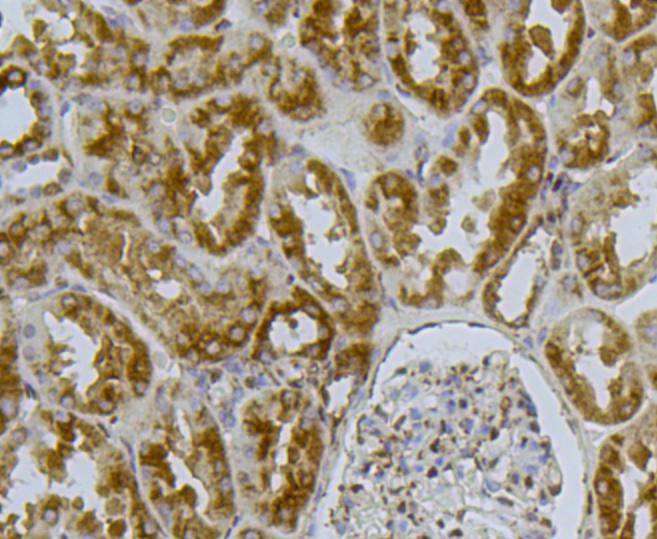
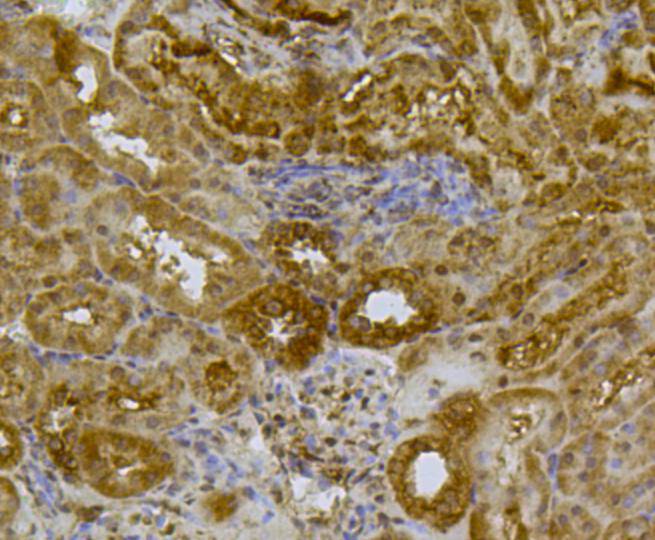
Fig4: Immunohistochemical analysis of paraffin- embedded human kidney tissue using anti-SIRT3 rabbit polyclonal antibody.Application
Fig5: Immunohistochemical analysis of paraffin- embedded mouse kidney tissue using anti-SIRT3 rabbit polyclonal antibody.Application
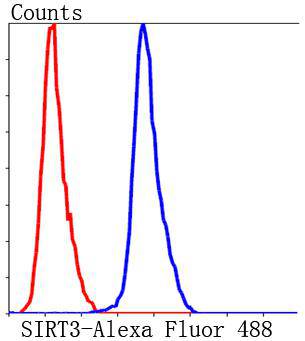
Fig6: Flow cytometric analysis of HepG2 cells with SIRT3 antibody at 1/50 dilution (blue) compared with an unlabelled control (cells without incubation with primary antibody; red). Alexa Fluor 488-conjugated Goat anti rabbit IgG was used as the secondary antibody.| Product Name | SIRT3 |
|---|---|
| Antibody Type | Primary Antibodies |
| Antigen Alias | hSIRT 3 antibody hSIRT3 antibody Mitochondrial nicotinamide adenine dinucleotide dependent deacetylase antibody NAD dependent deacetylase sirtuin 3 mitochondrial antibody NAD-dependent protein deacetylase sirtuin-3, mitochondrial antibody Regulatory protein SIR2 homolog 3 antibody Silent mating type information regulation 2 S.cerevisiae homolog 3 antibody Sir 2 like 3 antibody SIR 2 like protein 3 antibody SIR 3 antibody SIR2 L3 antibody Sir2 like 3 antibody SIR2 like protein 3 antibody SIR2-like protein 3 antibody SIR2L3 antibody SIR3_HUMAN antibody SIRT 3 antibody SIRT3 antibody Sirtuin 3 antibody Sirtuin silent mating type information regulation 2 homolog 3 (S. cerevisiae) antibody Sirtuin type 3 antibody Sirtuin3 antibody |
| Product description | The Silent Information Regulator (SIR2) family of genes are highly conserved from prokaryotes to eukaryotes and are involved in diverse processes, including transcriptional regulation, cell cycle progression, DNA-damage repair and aging. In S. cerevisiae, Sir2p deacetylates histones in an NAD-dependent manner, which regulates silencing at the telomeric, rDNA and silent mating-type loci. Sir2p is the founding member of a large family, designated sirtuins, which contain a conserved catalytic domain. The human homologues, which include SIRT1-7, are divided into four main branches: SIRT1-3 are class I, SIRT4 is class II, SIRT5 is class III and SIRT6-7 are class IV. SIRT3 is a NAD-dependent deacetylase that contains one deacetylase sirtuin-type domain. The SIRT3 protein is widely expressed and localizes to the mitochondira where it is processed by mitochondrial processing peptidase (MPP) to yield a final product. This processing is most-likely necessary for its enzymatic activity. |
| Immunogen | peptide |
| Clonality | Polyclonal |
|---|---|
| Isotype | IgG |
| Host Species | Rabbit |
| Tested Applications | WBICCIHCFC |
| WB:1:1,000 ICC:1:50-1:200 IHC:1:50-1:200 FC:1:50-1:100 |
|
| Species Reactivity | HumanMouse |
| Concentration | 1mg/ml |
| Alternative Names | hSIRT 3 antibody
hSIRT3 antibody
Mitochondrial nicotinamide adenine dinucleotide dependent deacetylase antibody
NAD dependent deacetylase sirtuin 3 mitochondrial antibody
NAD-dependent protein deacetylase sirtuin-3 mitochondrial antibody Regulatory protein SIR2 homolog 3 antibody Silent mating type information regulation 2 S.cerevisiae homolog 3 antibody Sir 2 like 3 antibody SIR 2 like protein 3 antibody SIR 3 antibody SIR2 L3 antibody Sir2 like 3 antibody SIR2 like protein 3 antibody SIR2-like protein 3 antibody SIR2L3 antibody SIR3_HUMAN antibody SIRT 3 antibody SIRT3 antibody Sirtuin 3 antibody Sirtuin silent mating type information regulation 2 homolog 3 (S. cerevisiae) antibody Sirtuin type 3 antibody Sirtuin3 antibody |
|---|---|
| Molecular Weight(MW) | 44/28kDa |
| Cellular Localization | Mitochondrion matrix |
| SwissProt ID | Q9NTG7 |
|---|
Application
Fig1: Western blot analysis on different lysates using anti-SIRT3 rabbit polyclonal antibody. Positive control: Lane 1: A172 Lane 2: Mouse liver Lane 3: NIH/3T3 Lane 4: Mouse kidney Lane 5: F9
Application
Fig2: Immunocytochemical staining of MCF-7 cells using anti-SIRT3 rabbit polyclonal antibody.
Application
Fig3: Immunocytochemical staining of HepG2 cells using anti-SIRT3 rabbit polyclonal antibody.
Application
Fig4: Immunohistochemical analysis of paraffin- embedded human kidney tissue using anti-SIRT3 rabbit polyclonal antibody.
Application
Fig5: Immunohistochemical analysis of paraffin- embedded mouse kidney tissue using anti-SIRT3 rabbit polyclonal antibody.
Application
Fig6: Flow cytometric analysis of HepG2 cells with SIRT3 antibody at 1/50 dilution (blue) compared with an unlabelled control (cells without incubation with primary antibody; red). Alexa Fluor 488-conjugated Goat anti rabbit IgG was used as the secondary antibody.| Positive Control | A172, NIH/3T3, MCF-7, HepG2, mouse kidney tissue, human kidney tissue |
|---|---|
| Application Notes | WB:1:1,000 ICC:1:50-1:200 IHC:1:50-1:200 FC:1:50-1:100 |
| Form | Liquid |
|---|---|
| Storage Instructions | Store at +4℃ after thawing. Aliquot store at -20℃ or -80℃. Avoid repeated freeze / thaw cycles. |
| Storage Buffer | 1*TBS (pH7.4), 1%BSA, 40%Glycerol. Preservative: 0.05% Sodium Azide. |


