WB
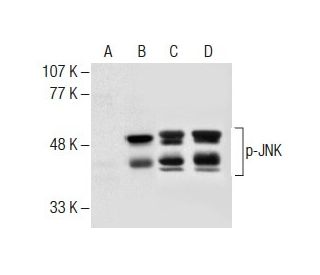
Western blot analysis of p-JNK in Jurkat whole cell lysate without treatment (A, C) and treated with erythromycin (B, D)WB
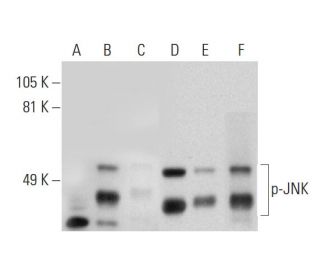
Western blot analysis of p-JNK in NIH/3T3 whole cell lysate untreated (A, D), treated with isomycin (B, E), and treated with isomycin and λ protein phosphatase(C, F).IHC
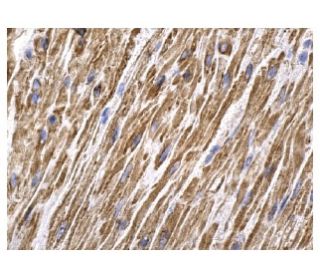
Immunoperoxidase staining was performed on human smooth muscle tissue fixed in formalin and embedded in paraffin, revealing cytoplasmic staining of smooth muscle cells.ICC/IF
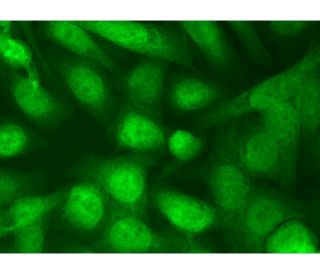
Immunofluorescence staining of SW480 cells fixed in formalin reveals the localization of the nucleus and cytoplasm.| Product Name | Mouse monoclonal antibody to p-JNK (JNK1+JNK2+JNK3)(Thr183+Tyr185) |
|---|---|
| Antibody Type | Primary Antibodies |
| Immunogen | raised against a sequence containing Thr 183 and Tyr 185 phosphorylated JNK of human origin. |
| Modification | P-Thr183+Tyr185 |
| Clonality | monoclonal |
|---|---|
| Isotype | IgG1, k |
| Host Species | Mouse |
| Tested Applications | ICC/IFIHCWB |
| WB:1:100-1:1000 IHC:1:50-1:500 ICC/IF:1:50-1:500 |
|
| Species Reactivity | HumanMouseRat |
| Concentration | 0.2mg/ml |
| Purification | Affinity purified |
| Gene Symbol | MAPK8 |
|---|---|
| Gene Synonyms | NK JNK1 PRKM8 SAPK1 JNK-46 JNK1A2 SAPK1c JNK21B1/2 |
| Gene Full Name | mitogen-activated protein kinase 8 |
| Gene Summary | The protein encoded by this gene is a member of the MAP kinase family. MAP kinases act as an integration point for multiple biochemical signals, and are involved in a wide variety of cellular processes such as proliferation, differentiation, transcription regulation and development. This kinase is activated by various cell stimuli, and targets specific transcription factors, and thus mediates immediate-early gene expression in response to cell stimuli. The activation of this kinase by tumor-necrosis factor alpha (TNF-alpha) is found to be required for TNF-alpha induced apoptosis. This kinase is also involved in UV radiation induced apoptosis, which is thought to be related to cytochrom c-mediated cell death pathway. Studies of the mouse counterpart of this gene suggested that this kinase play a key role in T cell proliferation, apoptosis and differentiation. Several alternatively spliced transcript variants encoding distinct isoforms have been reported. [provided by RefSeq, Apr 2016] |
| Target Description | The mitogen-activated protein (MAP) kinases ERK-1 and ERK-2 are proline- directed kinases that are activated through concomitant phosphorylation of tyrosine and threonine residues. The JNK family, which includes JNK1, JNK2 and JNK3, is distantly related to the MAP kinase family, members of which are activated by dual phosphorylation at a Thr-Pro-Tyr motif, specifically at Thr 183 and Tyr 185 residues, in response to ultraviolet (UV) light. This motif is divergent from the Thr-Glu-Tyr motif characteristic of the MAP kinase family. JNK is phosphorylated by JNK-activating kinase (JNKK1 and JNKK2), which are members of the MEK family. Activated JNK mediates the phosphorylation of c-Jun at the amino-terminal serine regulatory sites, Ser 63 and Ser 73, which stimulates the transactivation function of c-Jun. |
| Molecular Weight(MW) | Molecular Weight of p-JNK p46 isoform: 46 kDa. Molecular Weight of p-JNK p54 isoform: 54 kDa. |
| Cellular Localization | Cytoplasm,Nucleus,Synapse. |
WB
Western blot analysis of p-JNK in Jurkat whole cell lysate without treatment (A, C) and treated with erythromycin (B, D)
WB
Western blot analysis of p-JNK in NIH/3T3 whole cell lysate untreated (A, D), treated with isomycin (B, E), and treated with isomycin and λ protein phosphatase(C, F).
IHC
Immunoperoxidase staining was performed on human smooth muscle tissue fixed in formalin and embedded in paraffin, revealing cytoplasmic staining of smooth muscle cells.
ICC/IF
Immunofluorescence staining of SW480 cells fixed in formalin reveals the localization of the nucleus and cytoplasm.| Application Notes | WB:1:100-1:1000 IHC:1:50-1:500 ICC/IF:1:50-1:500 |
|---|
| Form | Liquid |
|---|---|
| Storage Instructions | Store at 4° C, **DO NOT FREEZE**. Stable for one year from the date of shipment. Non-hazardous. No MSDS required. |
| Storage Buffer | Each vial contains 200 µg IgG2b kappa light chain in 1.0 ml of PBS with < 0.1% sodium azide and 0.1% gelatin. |


