WB
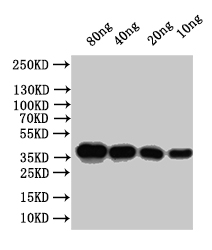
Western Blot Positive WB detected in: recombinant protein All lanes:Outer capsid protein VP4 Antibody at 1:1000 Secondary Goat polyclonal to rabbit IgG at 1/50000 dilution.| Product Name | Rabbit anti-VP4 (outer capsid protein) polyclonal antibody |
|---|---|
| Antibody Type | Primary Antibodies |
| Immunogen | Recombinant Rotavirus A (strain RVA/Human/United States/DS-1/1976/G2P1B[4]) (RV-A) (Rotavirus A (strain DS1)) Outer capsid protein VP4 protein (247-479aa) |
| Clonality | Polyclonal |
|---|---|
| Isotype | IgG |
| Host Species | Rabbit |
| Tested Applications | WB |
| WB:1:500-1:5000 |
|
| Species Reactivity | Virus |
| Concentration | 1mg/ml |
| Purification | Protein G |
| Alternative Names | Outer capsid protein VP4 (Hemagglutinin) [Cleaved into: Outer capsid protein VP8* Outer capsid protein VP5*] |
|---|---|
| Molecular Weight(MW) | 31.4 kDa(Observed band size:32 kDa) |
| Function | Spike-forming protein that mediates virion attachment to the host epithelial cell receptors and plays a major role in cell penetration, determination of host range restriction and virulence. Rotavirus attachment and entry into the host cell probably involves multiple sequential contacts between the outer capsid proteins VP4 and VP7, and the cell receptors. It is subsequently lost, together with VP7, following virus entry into the host cell. Following entry into the host cell, low intracellular or intravesicular Ca(2+) concentration probably causes the calcium-stabilized VP7 trimers to dissociate from the virion. This step is probably necessary for the membrane-disrupting entry step and the release of VP4, which is locked onto the virion by VP7. During the virus exit from the host cell, VP4 seems to be required to target the newly formed virions to the host cell lipid rafts.; Forms the spike 'foot' and 'body' and acts as a membrane permeabilization protein that mediates release of viral particles from endosomal compartments into the cytoplasm. During entry, the part of VP5* that protrudes from the virus folds back on itself and reorganizes from a local dimer to a trimer. This reorganization may be linked to membrane penetration by exposing VP5* hydrophobic region. In integrin-dependent strains, VP5* targets the integrin heterodimer ITGA2/ITGB1 for cell attachment.; Forms the head of the spikes and mediates the recognition of specific host cell surface glycans. It is the viral hemagglutinin and an important target of neutralizing antibodies. In sialic acid-dependent strains, VP8* binds to host cell sialic acid, most probably a ganglioside, providing the initial contact. In some other strains, VP8* mediates the attachment to histo-blood group antigens (HBGAs) for viral entry. |
| Cellular Localization | [Outer capsid protein VP4]: Virion. Host rough endoplasmic reticulum. Host cell membrane. Host cytoplasm, host cytoskeleton. Host endoplasmic reticulum-Golgi intermediate compartment.; [Outer capsid protein VP8*]: Virion.; [Outer capsid protein VP5*]: Virion. |
WB
Western Blot Positive WB detected in: recombinant protein All lanes:Outer capsid protein VP4 Antibody at 1:1000 Secondary Goat polyclonal to rabbit IgG at 1/50000 dilution.| Application Notes | WB:1:500-1:5000 |
|---|
| Form | Liquid |
|---|---|
| Storage Instructions | Upon receipt, store at -20°C or -80°C. Avoid repeated freeze. |
| Storage Buffer | Preservative: 0.03% Proclin 300; Constituents: 50% Glycerol, 0.01M PBS, pH 7.4. |


