WB
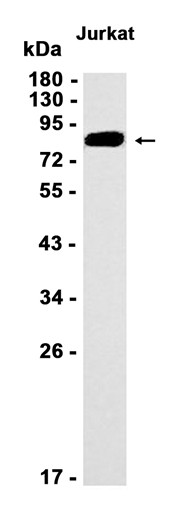
Western blot analysis of extracts from Jurkat cells using Factor XIIIa Rabbit mAb at 1:1000.IHC
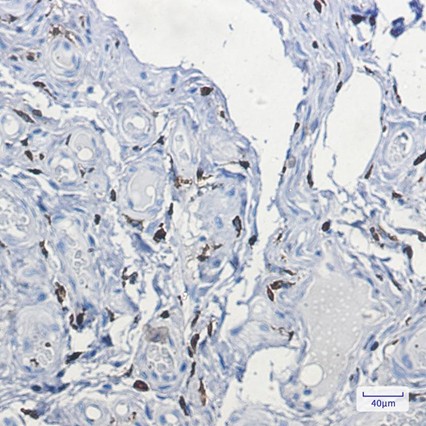
Immunohistochemical analysis of paraffin-embedded human colon cancer using Factor XIIIa Rabbit mAb antibody.| Product Name | Factor XIIIa Rabbit mAb |
|---|---|
| Antibody Type | Primary Antibodies |
| Immunogen | Recombinant protein of human Factor XIIIa. |
| Clonality | Monoclonal |
|---|---|
| Isotype | IgG |
| Host Species | Rabbit |
| Tested Applications | IHCWB |
| WB:1:1000-1:5000 IHC:1:100-1:200 |
|
| Species Reactivity | HumanMouseRat |
| Concentration | 1mg/ml |
| Purification | Affinity purified |
| Gene Symbol | F13A1 |
|---|---|
| Gene Synonyms | F13A |
| Gene Full Name | coagulation factor XIII A chain |
| Gene Summary | This gene encodes the coagulation factor XIII A subunit. Coagulation factor XIII is the last zymogen to become activated in the blood coagulation cascade. Plasma factor XIII is a heterotetramer composed of 2 A subunits and 2 B subunits. The A subunits have catalytic function, and the B subunits do not have enzymatic activity and may serve as plasma carrier molecules. Platelet factor XIII is comprised only of 2 A subunits, which are identical to those of plasma origin. Upon cleavage of the activation peptide by thrombin and in the presence of calcium ion, the plasma factor XIII dissociates its B subunits and yields the same active enzyme, factor XIIIa, as platelet factor XIII. This enzyme acts as a transglutaminase to catalyze the formation of gamma-glutamyl-epsilon-lysine crosslinking between fibrin molecules, thus stabilizing the fibrin clot. It also crosslinks alpha-2-plasmin inhibitor, or fibronectin, to the alpha chains of fibrin. Factor XIII deficiency is classified into two categories: type I deficiency, characterized by the lack of both the A and B subunits; and type II deficiency, characterized by the lack of the A subunit alone. These defects can result in a lifelong bleeding tendency, defective wound healing, and habitual abortion. [provided by RefSeq, Jul 2008] |
| Alternative Names | F13A |
| Molecular Weight(MW) | 83 kDa |
| Cellular Localization | Cytoplasm,Secreted. |
WB
Western blot analysis of extracts from Jurkat cells using Factor XIIIa Rabbit mAb at 1:1000.
IHC
Immunohistochemical analysis of paraffin-embedded human colon cancer using Factor XIIIa Rabbit mAb antibody.| Application Notes | WB:1:1000-1:5000 IHC:1:100-1:200 |
|---|
| Form | Liquid |
|---|---|
| Storage Instructions | Store at -20°C.Stable for 12 months from date of receipt. |
| Storage Buffer | Supplied in 50mM Tris-Glycine(pH 7.4), 0.15M NaCl, 40% Glycerol, 0.01% sodium azide and 0.05% BSA. |


