IHC
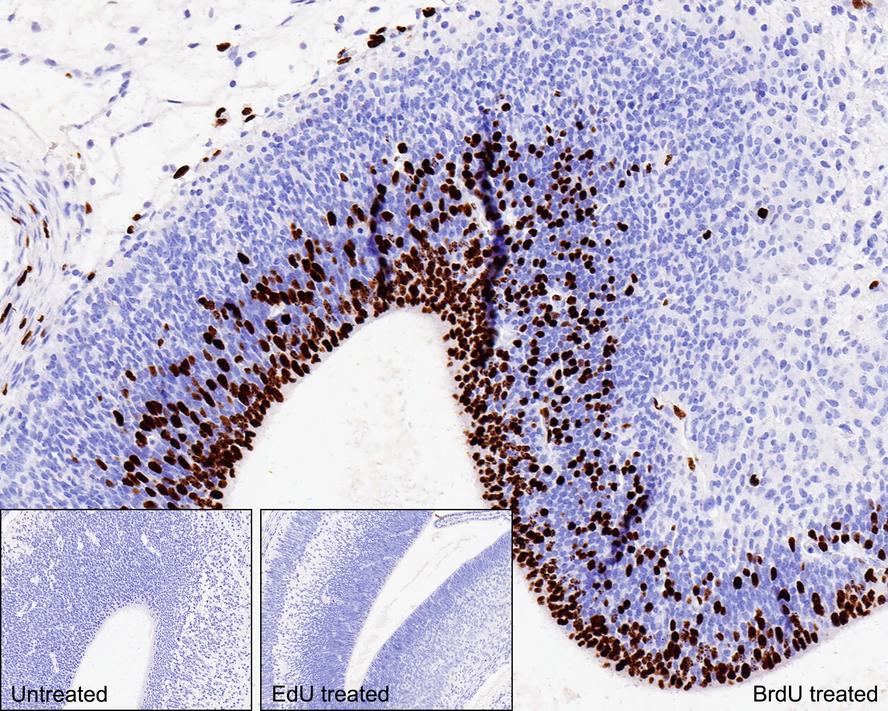
Immunohistochemical analysis of paraffin-embedded Brdu treated / Untreated / Edu treated mouse embryo brain tissue with Rabbit anti-BrdU antibody at 1/10,000 dilution. The section was pre-treated using heat mediated antigen retrieval with sodium citrate buffer (pH 6.0) (high pressure) for 2 minutes. The tissues were blocked in 1% BSA for 20 minutes at room temperature, washed with ddH2O and PBS, and then probed with the primary antibody at 1/10,000 dilution for 1 hour at room temperature. The detection was performed using an HRP conjugated compact polymer system. DAB was used as the chromogen. Tissues were counterstained with hematoxylin and mounted with DPX.ICC/IF
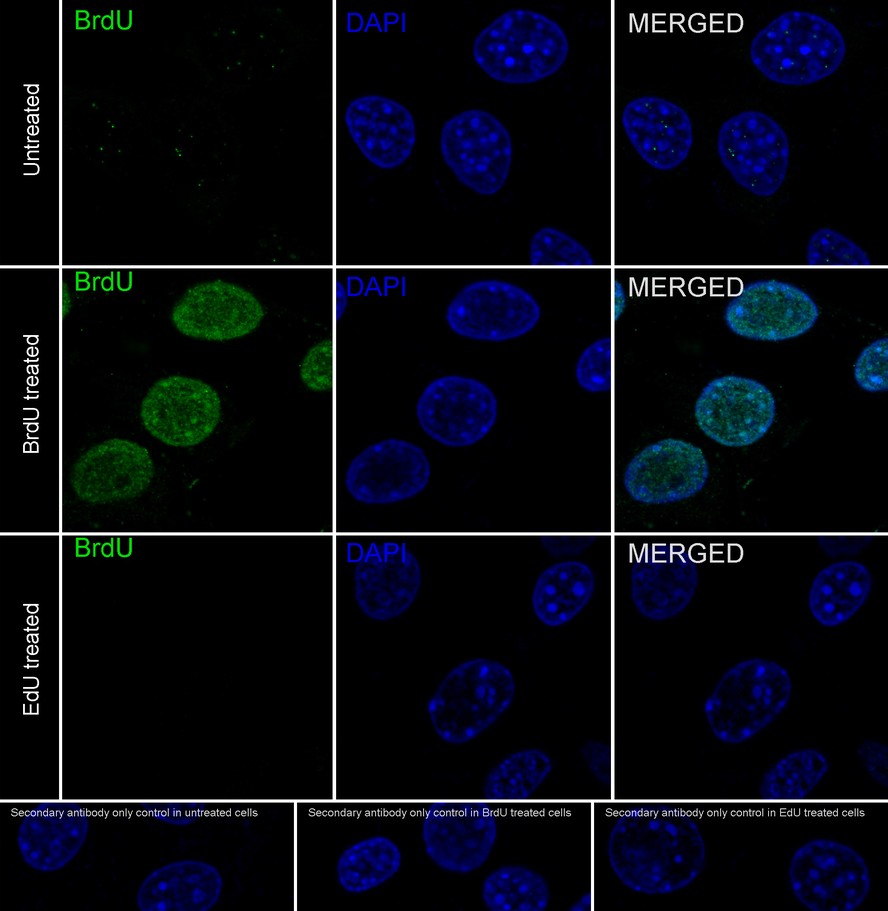
Immunocytochemistry analysis of NIH/3T3 cells (Untreated / Brdu treated / Edu treated) labeling BrdU with Rabbit anti-BrdU antibody at 1/200 dilution. Cells were fixed in 70% ethyl alcohol for 5 minutes at room temperature, then subjected to acid hydrolysis using 2M HCl in TBST for 30 minutes at room temperature. Permeabilized with 0.1% Triton X-100 in PBS for 15 minutes, and then blocked with 2% BSA for 30 minutes at room temperature. Cells were then incubated with Rabbit anti-BrdU antibody at 1/200 dilution in 2% negative goat serum overnight at 4 ℃. Goat Anti-Rabbit IgG H&L (488) was used as the secondary antibody at 1/1,000 dilution. PBS instead of the primary antibody was used as the secondary antibody only control. Nuclear DNA was labelled in blue with DAPI.IF-P
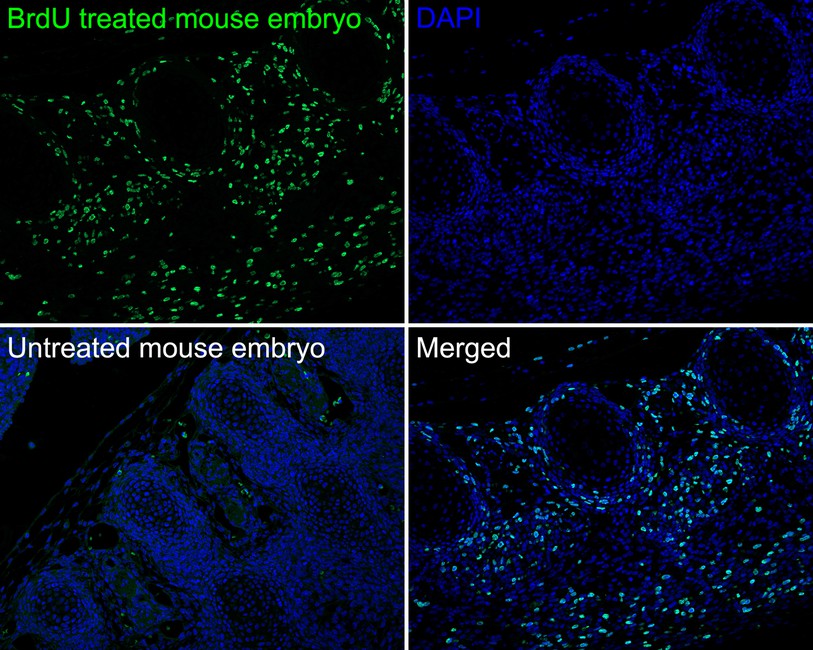
Immunofluorescence analysis of paraffin-embedded BrdU treated mouse embryo tissue labeling BrdU with Rabbit anti-BrdU antibody at 1/2,000 dilution. The section was pre-treated using heat mediated antigen retrieval with sodium citrate buffer (pH 6.0) (high pressure) for 2 minutes. The tissues were blocked in 10% negative goat serum for 1 hour at room temperature, washed with PBS, and then probed with the primary antibody (green) at 1/2,000 dilution overnight at 4 ℃, washed with PBS. Goat Anti-Rabbit IgG H&L (488) was used as the secondary antibody at 1/1,000 dilution. Nuclei were counterstained with DAPI (blue).| Product Name | BrdU Recombinant Rabbit Monoclonal Antibody |
|---|---|
| Antibody Type | Primary Antibodies |
| Immunogen | BrdU-OVA. |
| Clonality | Monoclonal |
|---|---|
| Isotype | IgG |
| Host Species | Rabbit |
| Tested Applications | ICC/IFIF-PIHC |
| IHC:1:10000 ICC/IF:1:200 IF-P:1:2000 |
|
| Species Reactivity | All |
| Concentration | 1mg/ml |
| Purification | Protein A |
| Alternative Names | Bromodeoxyuridine antibody BUdr antibody |
|---|---|
| Function | Bromodeoxyuridine (5-bromo-2'-deoxyuridine, BrdU, BUdR, BrdUrd, broxuridine) is a synthetic nucleoside analogue with a chemical structure similar to thymidine. BrdU is commonly used to study cell proliferation in living tissues and has been studied as a radiosensitizer and diagnostic tool in people with cancer. During S phase of the cell cycle (when DNA replication occurs), BrdU can be incorporated in place of thymidine in newly synthesized DNA molecules of dividing cells. Cells that have recently performed DNA replication or DNA repair can be detected with antibodies specific for BrdU using techniques such as immunohistochemistry or immunofluorescence. BrdU-labelled cells in humans can be detected up to two years after BrdU infusion. Because BrdU can replace thymidine during DNA replication, it can cause mutations, and its use is therefore potentially a health hazard. However, because it is neither radioactive nor myelotoxic at labeling concentrations, it is widely preferred for in vivo studies of cancer cell proliferation. However, at radiosensitizing concentrations, BrdU becomes myelosuppressive, thus limiting its use for radiosensitizing. BrdU differs from thymidine in that BrdU substitutes a bromine atom for thymidine's CH3 group. The Br substitution can be used in X-ray diffraction experiments in crystals containing either DNA or RNA. The Br atom acts as an anomalous scatterer and its larger size will affect the crystal's X-ray diffraction enough to detect isomorphous differences as well. Bromodeoxyuridine releases gene silencing caused by DNA methylation. DNA with BrdU transcribes as usual DNA, with guanine included into RNA as a complement to BrdU. |
| Cellular Localization | Nucleus. |
IHC
Immunohistochemical analysis of paraffin-embedded Brdu treated / Untreated / Edu treated mouse embryo brain tissue with Rabbit anti-BrdU antibody at 1/10,000 dilution. The section was pre-treated using heat mediated antigen retrieval with sodium citrate buffer (pH 6.0) (high pressure) for 2 minutes. The tissues were blocked in 1% BSA for 20 minutes at room temperature, washed with ddH2O and PBS, and then probed with the primary antibody at 1/10,000 dilution for 1 hour at room temperature. The detection was performed using an HRP conjugated compact polymer system. DAB was used as the chromogen. Tissues were counterstained with hematoxylin and mounted with DPX.
ICC/IF
Immunocytochemistry analysis of NIH/3T3 cells (Untreated / Brdu treated / Edu treated) labeling BrdU with Rabbit anti-BrdU antibody at 1/200 dilution. Cells were fixed in 70% ethyl alcohol for 5 minutes at room temperature, then subjected to acid hydrolysis using 2M HCl in TBST for 30 minutes at room temperature. Permeabilized with 0.1% Triton X-100 in PBS for 15 minutes, and then blocked with 2% BSA for 30 minutes at room temperature. Cells were then incubated with Rabbit anti-BrdU antibody at 1/200 dilution in 2% negative goat serum overnight at 4 ℃. Goat Anti-Rabbit IgG H&L (488) was used as the secondary antibody at 1/1,000 dilution. PBS instead of the primary antibody was used as the secondary antibody only control. Nuclear DNA was labelled in blue with DAPI.
IF-P
Immunofluorescence analysis of paraffin-embedded BrdU treated mouse embryo tissue labeling BrdU with Rabbit anti-BrdU antibody at 1/2,000 dilution. The section was pre-treated using heat mediated antigen retrieval with sodium citrate buffer (pH 6.0) (high pressure) for 2 minutes. The tissues were blocked in 10% negative goat serum for 1 hour at room temperature, washed with PBS, and then probed with the primary antibody (green) at 1/2,000 dilution overnight at 4 ℃, washed with PBS. Goat Anti-Rabbit IgG H&L (488) was used as the secondary antibody at 1/1,000 dilution. Nuclei were counterstained with DAPI (blue).| Application Notes | IHC:1:10000 ICC/IF:1:200 IF-P:1:2000 |
|---|
| Form | Liquid |
|---|---|
| Storage Instructions | Shipped at 4℃. Store at +4℃ short term (1-2 weeks). Store at -20℃ long term. |
| Storage Buffer | PBS (pH7.4), 0.1% BSA, 40% Glycerol. Preservative: 0.05% Sodium Azide. |


