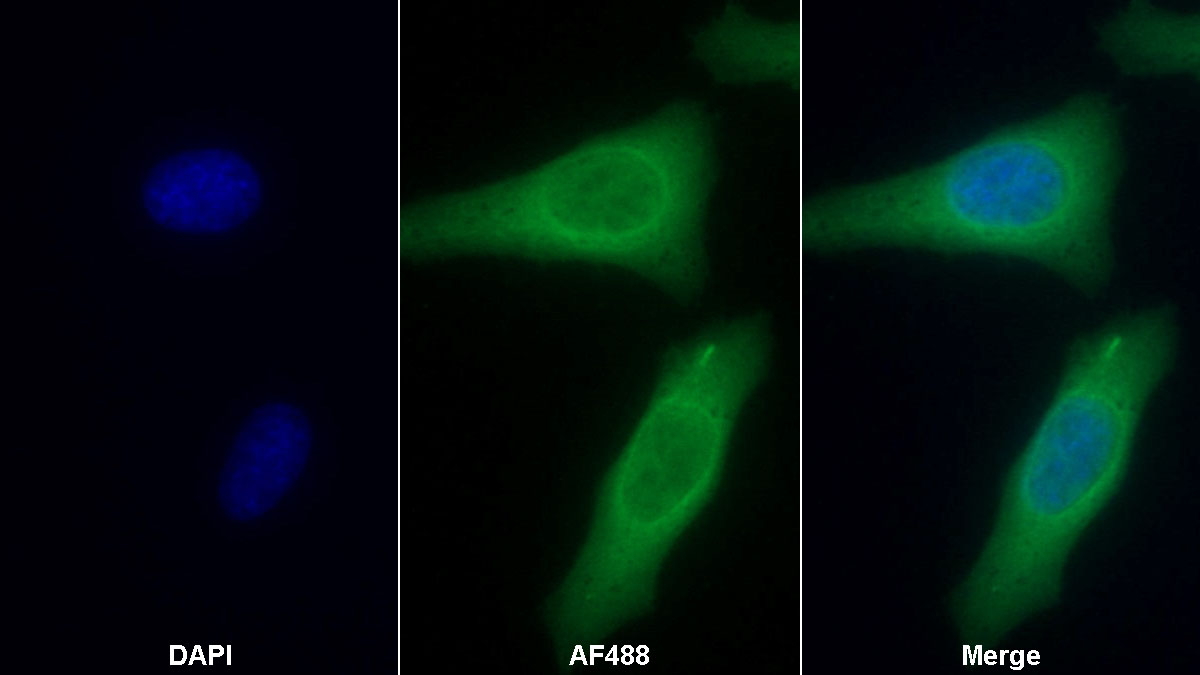
ICC/IF
AF488 staining on IF;Sample: Hela cellPrimary Ab: 30µg/ml Mouse Anti-Human PLS3 AntibodySecond Ab: 2μg/ml AF488-Linked Caprine Anti-Mouse IgG Polyclonal Antibody| Product Name | Monoclonal Antibody to Plastin 3 (PLS3) |
|---|---|
| Antibody Type | Primary Antibodies |
| Immunogen | RPH365Hu02-Recombinant Plastin 3 (PLS3) |
| Clonality | Monoclonal |
|---|---|
| Isotype | IgG2bKappa |
| Host Species | Mouse |
| Tested Applications | ICC/IF |
| ICC/IF: 5-30µg/mL |
|
| Species Reactivity | Human |
| Concentration | 1mg/ml |
| Purification | Protein A/G |
| Gene Symbol | PLS3 |
|---|---|
| Gene Synonyms | DIH5,BMND18,T-plastin |
| Gene Full Name | plastin 3 |
| Gene Summary | Plastins are a family of actin-binding proteins that are conserved throughout eukaryote evolution and expressed in most tissues of higher eukaryotes. In humans, two ubiquitous plastin isoforms (L and T) have been identified. Plastin 1 (otherwise known as Fimbrin) is a third distinct plastin isoform which is specifically expressed at high levels in the small intestine. The L isoform is expressed only in hemopoietic cell lineages, while the T isoform has been found in all other normal cells of solid tissues that have replicative potential (fibroblasts, endothelial cells, epithelial cells, melanocytes, etc.). The C-terminal 570 amino acids of the T-plastin and L-plastin proteins are 83% identical. It contains a potential calcium-binding site near the N terminus. Alternate splicing results in multiple transcript variants.[provided by RefSeq, Feb 2010] |
| Alternative Names | T-PLASTIN |
ICC/IF
AF488 staining on IF;Sample: Hela cellPrimary Ab: 30µg/ml Mouse Anti-Human PLS3 AntibodySecond Ab: 2μg/ml AF488-Linked Caprine Anti-Mouse IgG Polyclonal Antibody| Application Notes | ICC/IF: 5-30µg/mL |
|---|
| Form | Liquid |
|---|---|
| Storage Instructions | Store at 4°C for frequent use. Stored at -20°C in a manual defrost freezer for two year without detectable loss of activity. Avoid repeated freeze-thaw cycles. |
| Storage Buffer | 0.01M PBS, pH7.4, containing 0.05% Proclin-300, 50% glycerol. |


