Western blot
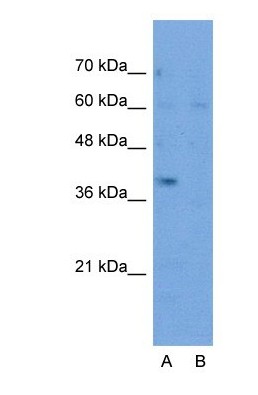
Host: Rabbit Target Name:IDH3A Sample Tissue:JurkatLane A: Primary Antibody Lane B: Primary Antibody + Blocking Peptide Primary Antibody Concentration:2.5ug/mL Peptide Concentration: 2.0ug/mL Lysate Quantity: 25ug/lane Gel Concentration: 12%Western blot
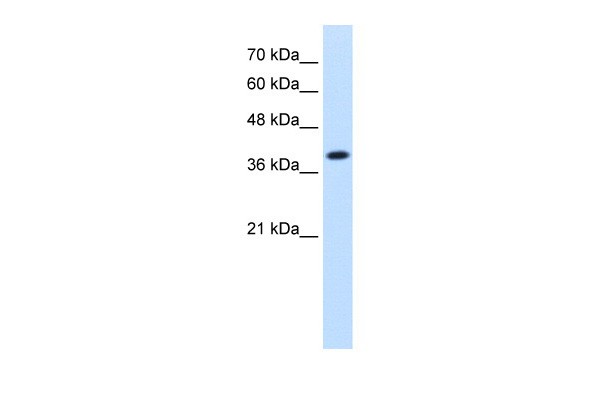
1.25ug/mlPositive Control: Jurkat cell lysate| Product Name | Rabbit anti-IDH3A polyclonal antibody - N-terminal region |
|---|---|
| Antibody Type | Primary Antibodies |
| Immunogen | The immunogen for anti-IDH3A antibody: synthetic peptide directed towards the N terminal of human IDH3A |
| Clonality | Polyclonal |
|---|---|
| Isotype | IgG |
| Host Species | Rabbit |
| Tested Applications | WBIHC |
| WB:1:500~1:2000 IHC:1:50~1:200 Notes:Optimal dilutions/concentrations should be determined by the researcher. |
|
| Species Reactivity | BovineDogHumanMousePigRatZebra Fish |
| Concentration | 1mg/ml |
| Purification | Protein A |
| Gene Symbol | IDH3A |
|---|---|
| Gene Full Name | Isocitrate dehydrogenase 3 (NAD+) alpha |
| Gene Summary | Isocitrate dehydrogenases catalyze the oxidative decarboxylation of isocitrate to 2-oxoglutarate. These enzymes belong to two distinct subclasses, one of which utilizes NAD(+) as the electron acceptor and the other NADP(+). Five isocitrate dehydrogenases have been reported: three NAD(+)-dependent isocitrate dehydrogenases, which localize to the mitochondrial matrix, and two NADP(+)-dependent isocitrate dehydrogenases, one of which is mitochondrial and the other predominantly cytosolic. NAD(+)-dependent isocitrate dehydrogenases catalyze the allosterically regulated rate-limiting step of the tricarboxylic acid cycle. Each isozyme is a heterotetramer that is composed of two alpha subunits, one beta subunit, and one gamma subunit. IDH3A is the alpha subunit of one isozyme of NAD(+)-dependent isocitrate dehydrogenase.Isocitrate dehydrogenases catalyze the oxidative decarboxylation of isocitrate to 2-oxoglutarate. These enzymes belong to two distinct subclasses, one of which utilizes NAD(+) as the electron acceptor and the other NADP(+). Five isocitrate dehydrogenases have been reported: three NAD(+)-dependent isocitrate dehydrogenases, which localize to the mitochondrial matrix, and two NADP(+)-dependent isocitrate dehydrogenases, one of which is mitochondrial and the other predominantly cytosolic. NAD(+)-dependent isocitrate dehydrogenases catalyze the allosterically regulated rate-limiting step of the tricarboxylic acid cycle. Each isozyme is a heterotetramer that is composed of two alpha subunits, one beta subunit, and one gamma subunit. The protein encoded by this gene is the alpha subunit of one isozyme of NAD(+)-dependent isocitrate dehydrogenase. |
| Molecular Weight(MW) | 40kDa |
| Sequence | 366 amino acids |
Western blot
Host: Rabbit Target Name:IDH3A Sample Tissue:JurkatLane A: Primary Antibody Lane B: Primary Antibody + Blocking Peptide Primary Antibody Concentration:2.5ug/mL Peptide Concentration: 2.0ug/mL Lysate Quantity: 25ug/lane Gel Concentration: 12%
Western blot
1.25ug/mlPositive Control: Jurkat cell lysate| Application Notes | WB:1:500~1:2000 IHC:1:50~1:200 Notes:Optimal dilutions/concentrations should be determined by the researcher. |
|---|
| Form | Liquid |
|---|---|
| Storage Instructions | Aliquot and store at -20°C. Avoid repeated freeze / thaw cycles |
| Storage Buffer | phosphate buffered saline , pH 7.4, 150mM NaCl, 0.02% sodium azide and 50% glycerol. |


