Application
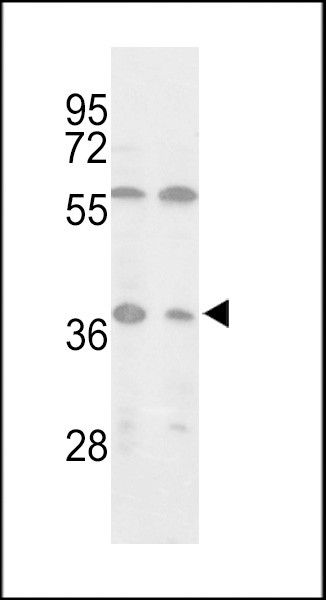
Western blot analysis of Isocitrate dehydrogenase in MCF-7, Jurkat cell line lysates (35ug/lane).| Product Name | IsocitRe dehydrogenase Antibody |
|---|---|
| Antibody Type | Primary Antibodies |
| Product description | Isocitrate dehydrogenases catalyze the oxidative decarboxylation of isocitrate to 2-oxoglutarate. These enzymes belong to two distinct subclasses, one of which utilizes NAD(+) as the electron acceptor and the other NADP(+). Five isocitrate dehydrogenases have been reported: three NAD(+)-dependent isocitrate dehydrogenases, which localize to the mitochondrial matrix, and two NADP(+)-dependent isocitrate dehydrogenases, one of which is mitochondrial and the other predominantly cytosolic. NAD(+)-dependent isocitrate dehydrogenases catalyze the allosterically regulated rate-limiting step of the tricarboxylic acid cycle. Each isozyme is a heterotetramer that is composed of two alpha subunits, one beta subunit, and one gamma subunit. The protein described here is the alpha subunit of one isozyme of NAD(+)-dependent isocitrate dehydrogenase.1) Soundar, S., et al., J. Biol. Chem. 278(52):52146-52153 (2003). |
| Immunogen | This Isocitrate dehydrogenase (IDH3) antibody is generated from rabbits immunized with a KLH conjugated synthetic peptide between 317-346 amino acids from the C-terminal region of human Isocitrate dehydrogenase (IDH3). |
| Clonality | Polyclonal |
|---|---|
| Isotype | Ig |
| Host Species | Rabbit |
| Tested Applications | WB |
| For WB starting dilution is: 1:1000 | |
| Species Reactivity | Human |
| Concentration | 1mg/ml |
| Purification | Unpurified |
| Gene Symbol | IDH3A |
|---|---|
| Alternative Names | Isocitrate dehydrogenase [NAD] subunit alpha mitochondrial Isocitric dehydrogenase subunit alpha NAD(+)-specific ICDH subunit alpha IDH3A |
| Molecular Weight(MW) | 40 kDa |
| Sequence Similarities | Predicted species reactivity based on immunogen sequence: Bovine |
Application
Western blot analysis of Isocitrate dehydrogenase in MCF-7, Jurkat cell line lysates (35ug/lane).| Application Notes | For WB starting dilution is: 1:1000 |
|---|
| Form | Liquid |
|---|---|
| Storage Instructions | Store at 4˚C for three months and -20˚C, stable for up to one year. As with all antibodies care should be taken to avoid repeated freeze thaw cycles. Antibodies should not be exposed to prolonged high temperatures. |
| Storage Buffer | Supplied in PBS with 0.09% (W/V) sodium azide. |


