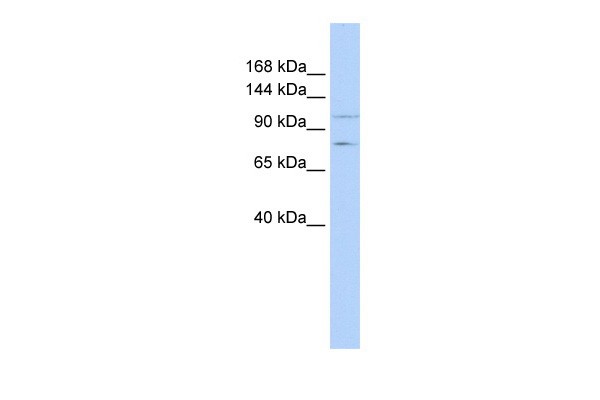
Western blot
0.2-1 ug/mlELISA Titer: 1:62500Positive Control: MCF7 cell lysate| Product Name | Rabbit anti-PTPRH polyclonal antibody - middle region |
|---|---|
| Antibody Type | Primary Antibodies |
| Antigen Alias | FLJ39938, MGC133058, MGC133059, SAP-1, SAP1 |
| Immunogen | The immunogen for anti-PTPRH antibody: synthetic peptide directed towards the middle region of human PTPRH |
| Clonality | Polyclonal |
|---|---|
| Isotype | IgG |
| Host Species | Rabbit |
| Tested Applications | WB |
| WB:1:500~1:2000 Notes:Optimal dilutions/concentrations should be determined by the researcher. |
|
| Species Reactivity | Human |
| Concentration | 1mg/ml |
| Purification | Affinity purified |
| Gene Symbol | PTPRH |
|---|---|
| Gene Synonyms | FLJ39938 MGC133058 MGC133059 SAP-1 SAP1 |
| Gene Full Name | Protein tyrosine phosphatase, receptor type, H |
| Gene Summary | PTPRH is a member of the protein tyrosine phosphatase (PTP) family. PTPs are known to be signaling molecules that regulate a variety of cellular processes including cell growth, differentiation, mitotic cycle, and oncogenic transformation. This PTP possesses an extracellular region, a single transmembrane region, and a single intracytoplasmic catalytic domain, and thus represents a receptor-type PTP. The extracellular region contains eight fibronectin type III-like repeats and multiple N-glycosylation sites. It was also found to be expressed in several cancer cell lines, but not in the corresponding normal tissues.The protein encoded by this gene is a member of the protein tyrosine phosphatase (PTP) family. PTPs are known to be signaling molecules that regulate a variety of cellular processes including cell growth, differentiation, mitotic cycle, and oncogenic transformation. This PTP possesses an extracellular region, a single transmembrane region, and a single intracytoplasmic catalytic domain, and thus represents a receptor-type PTP. The extracellular region contains eight fibronectin type III-like repeats and multiple N-glycosylation sites. The gene was shown to be expressed primarily in brain and liver, and at a lower level in heart and stomach. It was also found to be expressed in several cancer cell lines, but not in the corresponding normal tissues. |
| Alternative Names | FLJ39938 MGC133058 MGC133059 SAP-1 SAP1 |
| Molecular Weight(MW) | 120kDa |
| Sequence | 1115 amino acids |
Western blot
0.2-1 ug/mlELISA Titer: 1:62500Positive Control: MCF7 cell lysate| Application Notes | WB:1:500~1:2000 Notes:Optimal dilutions/concentrations should be determined by the researcher. |
|---|
| Form | Liquid |
|---|---|
| Storage Instructions | Aliquot and store at -20°C. Avoid repeated freeze / thaw cycles |
| Storage Buffer | phosphate buffered saline , pH 7.4, 150mM NaCl, 0.02% sodium azide and 50% glycerol. |


