Application
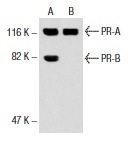
Antibodies tested include PR (AB-52): (A) and PR (B-30): (B).| Product Name | PR Antibody (AB-52) |
|---|---|
| Antibody Type | Primary Antibodies |
| Modification Notes | The effects of progesterone are mediated by two functionally different isoforms of the progesterone receptor, PR-A and PR-B, which are transcribed from distinct, estrogen-inducible promoters within a single copy of the PR gene. The first 164 amino acids of PR-B are absent in PR-A. Progesterone-bound PR-A and PR-B have different transcription activation properties. Specifically, PR-B functions as a transcriptional activator in most cell and promoter contexts, while PR-A is transcriptionally inactive and functions as a strong ligand-dependent transdominant repressor of steroid hormone receptor transcriptional activity. An inhibitory domain (ID), which maps to the amino terminus of the receptor, exists within both PR isoforms. Interestingly, the ID is functionally active only in PR-A and is necessary for steroid hormone transrepression by PR-A, suggesting that PR-A and PR-B may have different conformations in the cell. Phosphorylation of human PR occurs on at least nine serine residues. Phosphorylation of three of the residues is hormone-inducible (Ser 102, Ser 294 and Ser 345); the others are basal but hormone-stimulated . |
| Clonality | Monoclonal |
|---|---|
| Isotype | IgG1 |
| Host Species | Mouse |
| Tested Applications | WBIPIFIHCGSChIP |
| recommended for detection of progesterone receptor (PR-A and PR-B) of human origin by WB, IP, IF and IHC(P) | |
| Species Reactivity | HumanMouseRat |
| Concentration | 1mg/ml |
| Purification | Affinity purified |
| Alternative Names | produced by immunization with native human progesterone receptor purified from breast cancer cells |
|---|---|
| Tissue Specificity | produced by immunization with native human progesterone receptor purified from breast cancer cells |
| Entrez Gene | 5241 |
|---|
Application
Antibodies tested include PR (AB-52): (A) and PR (B-30): (B).| Application Notes | recommended for detection of progesterone receptor (PR-A and PR-B) of human origin by WB, IP, IF and IHC(P) |
|---|
| Form | Liquid |
|---|---|
| Storage Instructions | For short-term storage, store at 4° C. For long-term storage, aliquot and store at -20ºC or below. Avoid multiple freeze-thaw cycles. |
| Storage Buffer | phosphate buffered saline , pH 7.4, 150mM NaCl, 0.02% sodium azide and 50% glycerol. |


