Application
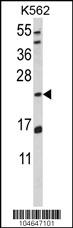
Western blot analysis of hMLP-H31 in K562 cell line lysates (35ug/lane). MLP (arrow) was detected using the purified Pab.| Product Name | MARCKS-like 1 Protein (MLP) Antibody (N-term) |
|---|---|
| Antibody Type | Primary Antibodies |
| Antigen Alias | MARCKSL1; MLP; MRP; MARCKS-related protein; MARCKS-like protein 1; Macrophage myristoylated alanine-rich C kinase substrate |
| Clonality | Polyclonal |
|---|---|
| Isotype | Ig |
| Host Species | Rabbit |
| Tested Applications | WB |
| WB:1:50~100 |
|
| Species Reactivity | Human |
| Concentration | 1mg/ml |
| Gene Synonyms | MLP MRP |
|---|---|
| Alternative Names | MARCKSL1 MLP MRP MARCKS-related protein MARCKS-like protein 1 Macrophage myristoylated alanine-rich C kinase substrate |
| Molecular Weight(MW) | 19529 Da |
| Function | Controls cell movement by regulating actin cytoskeleton homeostasis and filopodium and lamellipodium formation. When unphosphorylated, induces cell migration. When phosphorylated by MAPK8, induces actin bundles formation and stabilization, thereby reducing actin plasticity, hence restricting cell movement, including neuronal migration. May also affect cancer cell migration. May be involved in coupling the protein kinase C and calmodulin signal transduction systems (By similarity) |
| Tissue Specificity | This MLP antibody is generated from rabbits immunized with a KLH conjugated synthetic peptide between 23~53 amino acids from the N-terminal region of human MLP. |
| Cellular Localization | Cytoplasm (By similarity). Cell membrane (By similarity). Note=Associates with the membrane via the insertion of the N-terminal N-myristoyl chain and the partial insertion of the effector domain. Association of the effector domain with membranes may be regulated by Ca(2+)/calmodulin (By similarity) In prostate cancers, detected in the cytoplasm and associated with apical or basal membranes (By similarity) |
Application
Western blot analysis of hMLP-H31 in K562 cell line lysates (35ug/lane). MLP (arrow) was detected using the purified Pab.| Application Notes | WB:1:50~100 |
|---|
| Form | Liquid |
|---|---|
| Storage Instructions | For short-term storage, store at 4° C. For long-term storage, aliquot and store at -20ºC or below. Avoid multiple freeze-thaw cycles. |
| Storage Buffer | Purified polyclonal antibody supplied in PBS with 0.09% (W/V) sodium azide. This antibody is purified through a protein G column, eluted with high and low pH buffers and neutralized immediately, followed by dialysis against PBS. |


